Custom AI
Intelligent Document Processing Cost: Per-Page Prices and TCO
Intelligent document processing cost as of November 2026: $1 to $100 per 1,000 pages on AWS, Azure, Google and LLMs, plus the review and build costs.

In this article
- What does intelligent document processing cost per page?
- Why human review costs more than the AI
- Intelligent document processing cost at 1,000, 10,000 and 100,000 documents a month
- What does it cost to build an IDP system?
- Hidden costs that produce surprise IDP bills
- Cloud API, SaaS tool or LLM: which costs least for your documents?
- When does building IDP pay for itself?
- IDP budget checklist: 10 questions before you commit
- The bottom line on intelligent document processing cost
- Frequently asked questions
- Sources
Intelligent document processing cost has three parts, and the one vendors advertise is the smallest. As of November 2026, the AI fee to pull fields from a one-page invoice ranges from about $1 to $100 per 1,000 pages on the official price lists of AWS, Microsoft Azure, Google Cloud, Anthropic and OpenAI. The people who check the uncertain results usually cost more than that every month, and the build (integration, validation rules, a review screen) is a one-time $2,000 to $150,000 depending on how much you automate.
This guide gives you every per-page price we verified on the providers' own pricing pages, a cost model at 1,000, 10,000 and 100,000 documents a month with every assumption stated, the billing rules that produce surprise invoices, and a simple test for when building pays off. It is written for finance, operations and IT leaders who are being asked "what will it really cost to stop keying invoices, claims or forms by hand?"
Key takeaway: Choose the API last. Exception rate, review minutes and integration scope move the total far more than the difference between a $10 and a $40 per-1,000-page price.
What does intelligent document processing cost per page?
Intelligent document processing (IDP) means software that reads a document, classifies it, extracts the fields you need (vendor, invoice number, totals, line items) and hands them to another system with a confidence score. The per-page price depends mostly on how much structure you ask for: plain text is cheap, prebuilt document models cost about seven times more, and custom models cost about three times more again.
Here are the list prices we checked on November 4, 2026. Prices are pay-as-you-go in US dollars for the first volume tier.
| What you need | AWS | Azure (Central US) | Google Cloud |
|---|---|---|---|
| Text only (OCR) | Textract Detect Document Text: $1.50 per 1,000 pages | Read: $1.50 per 1,000 pages | Enterprise Document OCR: $1.50 per 1,000 pages (first 1,000 free) |
| Invoices and receipts, prebuilt | Textract Analyze Expense: $10 per 1,000 pages | Prebuilt invoice or receipt: $10 per 1,000 pages | Invoice Parser or Expense Parser: $0.10 per document of up to 10 pages |
| Forms (key-value pairs) | Analyze Document Forms: $50 per 1,000 pages | Prebuilt layout/document: $10 per 1,000 pages | Form Parser: $30 per 1,000 pages |
| Custom fields you define | Custom Queries: $25 per 1,000 pages; Bedrock Data Automation custom output: $40 per 1,000 pages | Custom extraction or custom generative extraction: $30 per 1,000 pages | Custom Extractor: $30 per 1,000 pages |
| Document classification | (part of Bedrock Data Automation) | Custom classification: $3 per 1,000 pages | Custom Classifier or Splitter: $5 per 1,000 pages |
Sources: Amazon Textract pricing, Amazon Bedrock pricing, Azure Document Intelligence pricing, Google Document AI pricing. AWS's published examples are for US West (Oregon); check your region in the AWS Pricing Calculator.
Volume discounts exist on all three clouds. Textract drops to $0.60 per 1,000 pages for text and $8 per 1,000 for Analyze Expense after the first million pages a month. Azure's prebuilt commitment tiers cost $190 for 20,000 pages, $900 for 100,000 and $4,000 for 500,000 a month. Google offers 10 percent off with a one-year Gemini Enterprise Flexible Savings Plan and 20 percent off with a three-year plan on most Document AI processors.
What about LLMs like Claude and GPT?
Large language models (LLMs) charge per token, not per page, so you have to estimate tokens per page. Anthropic's PDF support documentation says each page typically uses 1,500 to 3,000 text tokens, and because each page is also converted into an image, image tokens are added. Its vision documentation caps a page image at 4,784 visual tokens on Claude 4.7 and later models.
So our planning assumption is 8,000 input tokens and 600 output tokens per page (page text, page image, your instructions and a JSON answer). At Anthropic's November 2026 prices:
| Model | Input / output per million tokens | Cost per 1,000 pages | With the Batch API (50% off) |
|---|---|---|---|
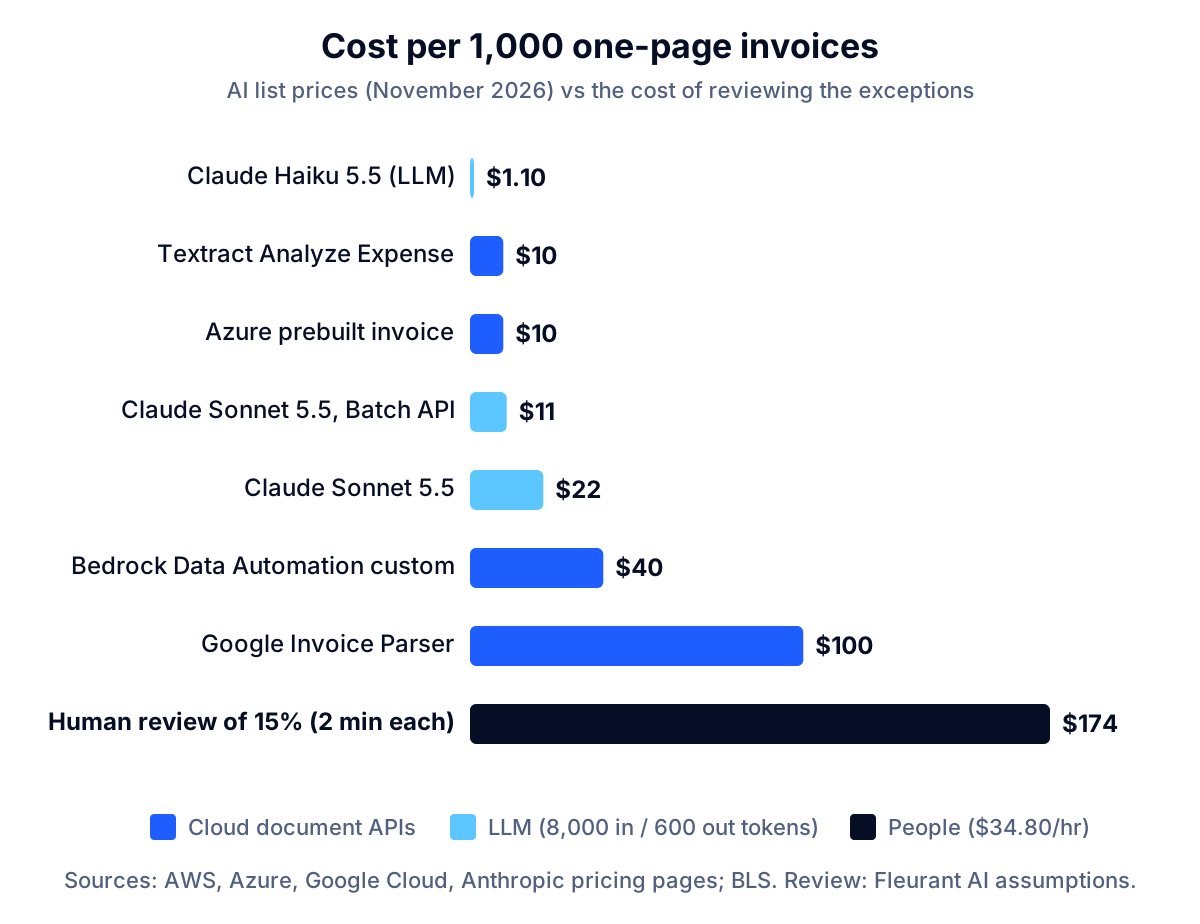
| Claude Haiku 5.5 | $0.10 / $0.50 | about $1.10 | about $0.55 |
| Claude Sonnet 5.5 | $2 / $10 | about $22 | about $11 |
| Claude Opus 5.5 | $4 / $20 | about $44 | about $22 |
OpenAI lists gpt-6-luna at the same $0.10 / $0.50 and gpt-6.1-sol at the same $2 / $10 per million tokens, with batch at half price (OpenAI API pricing). OpenAI counts image tokens differently, so measure your own documents with each provider's token counter before you budget. Our LLM API cost optimization guide covers batch, caching and model routing in more depth.
Key takeaway: For invoices, a small LLM and a prebuilt cloud model both land near $1 to $10 per 1,000 pages. The price list will not decide this for you; accuracy on your documents and the review workflow will.
Why human review costs more than the AI
Human review is usually the largest monthly line in an IDP budget, because even a good model sends some documents to a person and people cost dollars per hour, not fractions of a cent per page. The way to cut IDP cost is to cut the exception rate and the minutes per exception.
Here is the arithmetic, with every input stated:
- Wage: the median pay for bookkeeping, accounting and auditing clerks was $24.36 an hour in 2025, according to the BLS Occupational Outlook Handbook.
- Benefits: wages and salaries were 70.0 percent of private-industry employer compensation costs in June 2026 (BLS Employer Costs for Employee Compensation), so the loaded cost is about $34.80 an hour.
- Exception rate (assumption): 15 percent of documents flagged for review. Real rates vary from a few percent on clean digital invoices to over half on handwritten or poor scans.
- Minutes per exception (assumption): two minutes to open the document, check flagged fields and fix them.
That is about $0.17 per document, or $174 per 1,000 documents, which is more than any of the prebuilt API prices above. For comparison, if keying one invoice by hand takes four minutes (also an assumption; time your own team), fully manual entry costs about $2.32 per invoice, or $2,320 per 1,000.
How confidence scores set the review rate
Azure Document Intelligence and Textract return a confidence score with each extracted value. Microsoft's documentation on accuracy and confidence explains that a confidence of 0.95 means the prediction "is likely correct 19 out of 20 times" and recommends using confidence to decide whether to accept a value automatically or flag it for human review. The Textract FAQs describe its confidence score as a number from 0 to 100 indicating the probability that a prediction is correct.
Your threshold is a cost decision. Set it too high and reviewers check values that were already right. Set it too low and errors flow into your ledger. The practical approach:
- Set thresholds per field, not per document. A wrong invoice total or bank account number costs far more than a wrong vendor address.
- Add validation rules that do not depend on the model. Line items should sum to the subtotal, tax should match the rate, the PO number should exist in your ERP, the vendor should be in your master file. A document that passes every rule can skip review even with a middling score on a low-risk field.
- Measure reviewer edits. If reviewers almost never change values above 0.90 on a field, lower that field's threshold. If they often change values above 0.97, raise it.
LLMs do not return calibrated per-field confidence scores the way these services do. With an LLM you rely more heavily on validation rules, on a second extraction pass for disagreement checks, or on an evaluation set. That is engineering time, and it belongs in the comparison. Our guide to evaluating AI accuracy explains how to build a test set and measure error rates with enough samples to trust them.
Intelligent document processing cost at 1,000, 10,000 and 100,000 documents a month
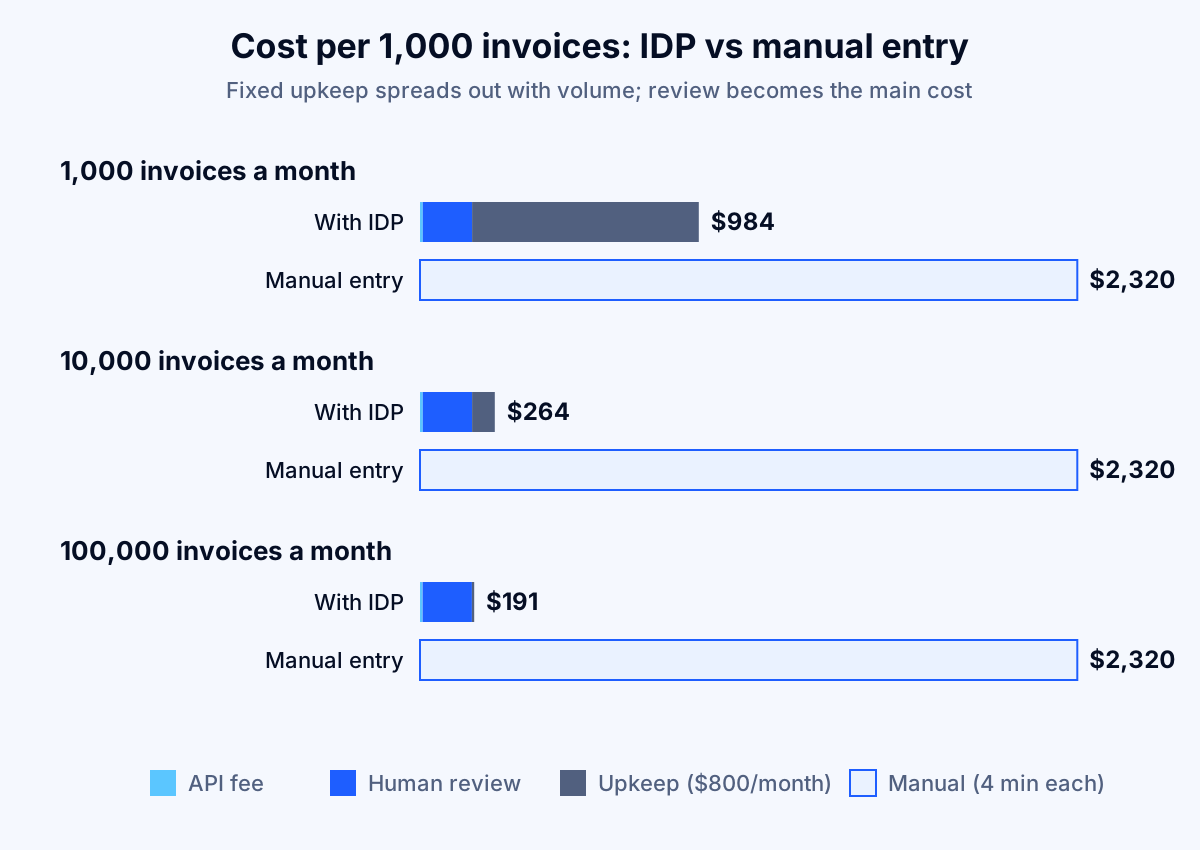
At realistic volumes, the AI fee stays small while review and upkeep dominate, and the savings over manual entry grow with volume. The table below models one-page invoices on Azure's prebuilt invoice model (Textract Analyze Expense has the same list price), with the review and manual assumptions from the previous section.
| Monthly cost | 1,000 invoices | 10,000 invoices | 100,000 invoices |
|---|---|---|---|
| API fee (prebuilt invoice, pay-as-you-go) | $10 | $100 | $1,000 ($900 on the 100,000-page commitment tier) |
| Human review (15% at 2 minutes, $34.80/hr) | $174 | $1,740 | $17,400 |
| Monitoring and upkeep (assumption: 8 hours at $100/hr) | $800 | $800 | $800 |
| Total with IDP | about $984 | about $2,640 | about $19,100 |
| Fully manual entry (4 minutes each) | $2,320 | $23,200 | $232,000 |
| Monthly saving | about $1,340 | about $20,560 | about $212,900 |
The $100 hourly engineering rate is the midpoint we use across our cost guides: the median software developer wage was $135,980 in May 2025 (BLS), about $194,000 a year once benefits are added at the 70 percent wage share, and we use $100 per hour as a midpoint for a US agency or in-house team, the same method as our SaaS MVP cost guide. At 100,000 invoices a month, a second reviewer workflow, stronger audit logging and more upkeep hours are likely, so treat that column as a floor.
Swapping the API changes the totals less than you might expect. At 10,000 invoices a month, moving from a $10 per 1,000 prebuilt model to Bedrock Data Automation custom output at $40 per 1,000 adds $300 a month. Cutting the exception rate from 15 to 10 percent saves $580 a month.
What does it cost to build an IDP system?
The build is a one-time cost of roughly $2,000 to $150,000, and the spread comes from integration and workflow, not from the AI. The table uses Fleurant AI planning estimates at $100 per hour.
| Build approach | Typical scope | Hours | At $100/hr |
|---|---|---|---|
| SaaS IDP tool, configured | One or two document types, upload or email-in, export to CSV or an accounting connector | 20–80 | $2,000–$8,000 |
| Cloud API pipeline | Prebuilt model (Textract, Azure, Google), validation rules, review queue, ERP or accounting system integration, audit log | 240–600 | $24,000–$60,000 |
| Custom or LLM pipeline | Several document types, classification and splitting, custom fields, an evaluation set, model routing, security review | 600–1,500 | $60,000–$150,000 |
What moves a project to the top of its range:
- Integration depth. Writing approved data into an ERP with PO matching and vendor master lookups is often half the build.
- Document variety. Every new layout family (a different supplier format, a new claim form) needs test samples and sometimes its own model. Microsoft recommends training separate models for visually distinct document types and composing them.
- Review workflow. A review screen that shows the source image next to the flagged field, with keyboard shortcuts, is what turns two minutes per exception into one.
- Compliance. Health records, loan files and claims carry retention, access and audit requirements. See our HIPAA-compliant AI development checklist and AI audit trail requirements for what that adds.
If you are weighing a packaged product against your own pipeline, the same logic as our build vs buy guide for AI agents applies: buy for standard documents at modest volume, build when your documents, rules or integrations are what make the process valuable.
Hidden costs that produce surprise IDP bills
Most surprise invoices come from billing units, idle resources and repeated processing, not from production volume. These are the ones we see buyers miss, each checked against the provider's documentation.
1. Per-document pricing on one-page documents
Google's specialized processors bill per "count", and the pricing page states that 1 count equals up to 10 pages. A one-page invoice and a ten-page invoice both cost $0.10 on the Invoice Parser. That is $100 per 1,000 one-page invoices, ten times Azure's or Textract's prebuilt price for the same work, but competitive for long multi-page documents. Bank statements are billed at $0.75 and pay slips and W-2s at $0.30 per classified document.
2. Custom processor hosting
On Google Document AI, custom processors bill hosting at $0.05 an hour for each deployed processor version. Google's own example: one version deployed for a year costs $438. Teams that deploy a new version for every training run and never undeploy old ones pay for all of them.
3. Training time
Azure charges for custom neural model training beyond the free first 10 hours, at $3 per hour. Retraining for every new supplier layout adds up.
4. Every page counts, including the ones you did not need
Textract counts each page of a PDF as a page processed, and an image counts as one page (Textract FAQs). Azure bills all pages of a document unless you set the pages parameter to a range. A 40-page contract sent in full to extract one signature block is billed for 40 pages. Splitting and classifying first, at $3 to $5 per 1,000 pages, then sending only the relevant pages to the expensive model, often pays for itself.
5. Feature stacking
Textract prices combinations: Forms alone is $50 per 1,000 pages, but Forms plus Tables plus Queries is $70. Azure adds $6 per 1,000 pages for its high-resolution, font and formula add-ons, and $10 per 1,000 for Query Fields. Request only the features each document type needs.
6. Reprocessing during development
Test runs are billed like production. Rerunning a 50,000-page archive five times while tuning prompts or thresholds is 250,000 billable pages. Cache raw OCR output and rerun only the extraction step when you can. Google notes one helpful exception: you are not billed for failed requests (4xx or 5xx responses).
7. Long prompts on LLMs
Claude Haiku 5.5 is priced at $0.10 per million input tokens for prompts up to 100,000 tokens and $0.50 above that, five times more. Sending a 60-page document in one request can cross that line. Anthropic also limits a request to 600 PDF pages (100 when the context window is under 1 million tokens), so very long files need splitting anyway.
Key takeaway: Before you sign off on a pilot budget, ask how the vendor counts a page, what is billed while idle, and whether test traffic is billed. Those three answers explain most surprise bills.
Cloud API, SaaS tool or LLM: which costs least for your documents?
The cheapest option depends on document type, volume and how much the extraction has to be trusted without a person looking. Use this as a starting rule, then test on 200 of your own documents.
| Your situation | Usually cheapest overall | Why |
|---|---|---|
| Under about 2,000 standard invoices or receipts a month | SaaS IDP tool or prebuilt cloud model with light integration | The build cost of a custom pipeline takes years to recover at low volume |
| 2,000 to 100,000 standard documents a month | Prebuilt cloud model (Textract Analyze Expense, Azure prebuilt invoice) plus your own validation and review queue | $10 per 1,000 pages, field confidence scores, and you control the exception rate |
| Varied or unstructured documents (contracts, claims packets, letters) | LLM extraction with validation rules, or custom generative extraction | Prebuilt models do not know your fields; LLMs handle variety without per-layout training |
| Very high volume of simple text extraction (archives, search) | OCR tier at $0.60 to $1.50 per 1,000 pages | Volume tiers and commitment plans cut cost; no field extraction needed |
| Regulated data that cannot leave your environment | Azure connected or disconnected containers, or a self-hosted model | Azure publishes container commitment tiers (disconnected prebuilt starts at $8,640 a year for up to 1.2 million pages); see our on-premise LLM cost guide for self-hosting |
Many good systems combine options: a $3 per 1,000 classifier routes documents, a prebuilt model handles the standard invoices, and an LLM handles the long tail of odd formats. Routing like this is what keeps both the API bill and the review queue small. It is also where a process starts to look like an agent: our article on AI agents for insurance claims processing shows how document extraction feeds decisions downstream.
When does building IDP pay for itself?
Building pays back quickly at volume and slowly below a few thousand documents a month. Divide the one-time build cost by the monthly saving from the cost model above.
Using a $40,000 cloud API pipeline (the middle of the range) and our stated assumptions:
| Monthly volume | Monthly saving vs manual | Payback on a $40,000 build |
|---|---|---|
| 1,000 invoices | about $1,340 | about 30 months |
| 10,000 invoices | about $20,560 | about 2 months |
| 100,000 invoices | about $212,900 | under 1 month |
Three cautions keep this honest:
- Savings only count if hours are redeployed. If the clerk who keyed invoices spends freed time on collections or vendor management, the saving is real. If not, the business case is weaker than the table suggests.
- Measure your manual baseline first. Time 50 invoices across a normal week. Four minutes per invoice is our assumption, not a benchmark.
- Include the cost of errors. A duplicate payment or a missed early-payment discount can outweigh review savings. Validation rules are part of the business case, not an extra.
For a full return-on-investment method with risk adjustments, see how to calculate AI agent ROI.
IDP budget checklist: 10 questions before you commit
Use these questions to turn a vendor quote or internal estimate into a number you can defend.
- What is our monthly volume, by document type and pages per document? Per-document and per-page billing produce very different totals.
- What is our manual baseline? Minutes per document, measured, and the loaded hourly cost of the people doing it.
- Which fields matter, and what does an error in each one cost? This sets review thresholds.
- What exception rate does the pilot show on 200 of our real documents? Use scans, photos and odd suppliers, not only clean PDFs.
- How does the vendor count a page or a document, and are failed or test requests billed?
- Are we paying for anything while idle? Hosting of custom processors, commitment tiers, minimum monthly fees.
- Where does approved data go, and who builds that integration? ERP, accounting, claims or case management.
- What validation rules can catch errors without a person? Totals, PO matching, vendor master, duplicate checks.
- What are the retention, access and audit requirements for these documents?
- Who maintains it? New layouts, threshold tuning, model version changes. Budget monthly hours, not zero.
The bottom line on intelligent document processing cost
The per-page AI fee is the easiest number to find and the least important one. Intelligent document processing cost is driven by how many documents a person still has to touch, how long each one takes, and how much integration work it takes to get clean data into the system that pays, approves or files it. As of November 2026, a one-page invoice costs about a cent to extract on AWS or Azure and about a tenth of a cent with a small LLM; reviewing it costs about 17 cents on average under our assumptions.
Start with a measured baseline and a 200-document pilot that reports the exception rate, then choose the API that minimizes review for your documents. If you want help scoping a pilot or comparing options on your own files, our connecting the tools you already pay for can build a working prototype in one to two weeks, or you can talk to a specialist about your documents and volumes. You can also see the rest of what we do on the Fleurant AI home page.
If you'd like one clear, practical take on AI, software and cloud decisions each month, subscribe to the Fleurant AI Briefing: one email a month, unsubscribe any time.
Frequently asked questions
How much does intelligent document processing cost per page?
As of November 2026, list prices for extracting invoice fields run from about $0.001 per page with a small LLM such as Claude Haiku 5.5 to $0.01 with Amazon Textract Analyze Expense or Azure's prebuilt invoice model, $0.04 with Bedrock Data Automation custom output, and $0.10 per document with Google's Invoice Parser. Plain OCR is $0.0015 per page on all three clouds. The API fee is rarely the largest cost; human review and the build usually are.
Is it cheaper to use an LLM like Claude or GPT instead of Textract or Document Intelligence?
Per page, a small model can be cheaper: at our planning assumption of 8,000 input and 600 output tokens per page, Claude Haiku 5.5 costs about $1.10 per 1,000 pages. A mid-tier model such as Sonnet 5.5 costs about $22, or $11 through the Batch API. LLMs do not return per-field confidence scores the way Azure and Textract do, so you need validation rules and an evaluation set to decide what goes to review, which adds build cost.
What is the biggest hidden cost in document processing automation?
Human review of exceptions. At a fully loaded clerk cost of about $34.80 an hour (BLS median wage of $24.36 grossed up for benefits), reviewing 15 percent of documents for two minutes each costs about $174 per 1,000 documents, which is more than any prebuilt API fee. Cutting the exception rate through validation rules and better routing saves more money than switching API vendors.
Why did my Google Document AI bill come out higher than expected?
Three common reasons. Specialized parsers such as the Invoice Parser bill $0.10 per count, where one count covers up to 10 pages, so a one-page invoice costs the same as a ten-page one. Custom processors also bill hosting at $0.05 an hour for every deployed version, about $438 a year each, whether or not you send documents. And reprocessing the same files during testing is billed like production traffic.
How much does it cost to build an intelligent document processing system?
Using Fleurant AI planning estimates at $100 an hour: configuring a SaaS tool takes about 20 to 80 hours ($2,000 to $8,000); a cloud-API pipeline with validation, a review queue and ERP integration takes 240 to 600 hours ($24,000 to $60,000); a multi-document custom or LLM pipeline with classification and an evaluation set takes 600 to 1,500 hours ($60,000 to $150,000). Integration and review design drive the range, not the AI model.
At what volume does building custom document processing pay off?
Under our stated assumptions, a $40,000 cloud-API build pays back in about two months at 10,000 one-page invoices a month, but takes about 30 months at 1,000 a month. Below roughly 2,000 documents a month, a SaaS tool or prebuilt model with light integration is usually the better buy. Run the numbers with your own exception rate and minutes per document before deciding.
Do I need human review if the model is 95 percent confident?
Usually for some fields, yes. Microsoft describes a 0.95 confidence score as likely correct 19 times out of 20, which still means about one error in 20 for that field. Set thresholds by field and by consequence: a wrong payment amount or bank account deserves review at a higher confidence than a wrong vendor address. Track how often reviewers change high-confidence values and adjust thresholds from that data.
Sources
- Amazon Textract pricing, Amazon Web Services
- Amazon Textract FAQs, Amazon Web Services
- Amazon Bedrock pricing (Data Automation), Amazon Web Services
- Azure Document Intelligence in Foundry Tools pricing, Microsoft Azure
- Interpret and improve model accuracy and confidence scores, Microsoft Learn
- Document AI pricing, Google Cloud
- Pricing, Claude Platform Docs (Anthropic)
- PDF support, Claude Platform Docs (Anthropic)
- Vision: resolution and token cost, Claude Platform Docs (Anthropic)
- API pricing, OpenAI
- Bookkeeping, Accounting, and Auditing Clerks (Occupational Outlook Handbook), U.S. Bureau of Labor Statistics
- Software Developers, Quality Assurance Analysts, and Testers (Occupational Outlook Handbook), U.S. Bureau of Labor Statistics
- Employer Costs for Employee Compensation, June 2026, U.S. Bureau of Labor Statistics