AI Agents
AI Agents for Insurance Claims Processing: What to Automate First
AI agents for insurance claims processing: eight workflows, the claim deadlines and state rules they must respect, a reference design, run costs and where they fail.

In this article
- What an AI agent actually does in a claims operation
- Eight claims workflows for AI agents
- Where the law draws the line on AI claim decisions
- The claim clock: deadlines your agent must respect
- Reference design for a claims AI agent
- What large insurers have shown, and what it means for regional carriers
- What AI agents for insurance claims processing cost to run
- Where claims AI agents fail
- Which claims workflow to automate first: a scoring sheet
- A 90-day plan for your first claims agent
- The bottom line
- Frequently asked questions
- Sources
AI agents for insurance claims processing are past the demo stage, but the useful ones look less like robot adjusters and more like tireless file clerks. The short answer: an agent can take first notice of loss around the clock, open the draft claim, read estimates and records, route the file, draft the letters the claim clock requires and assemble a settlement recommendation. A licensed person should still own every coverage position, every fraud decision and every payment or denial. The law is moving in that direction state by state, and the carriers that have published results all keep that line.
This guide is for claims, operations and IT leaders at regional carriers, MGAs and third-party administrators. You will get the eight claims workflows where agents earn their keep, the deadlines and state rules they have to respect, a reference design, an illustrative run-cost model, the failure modes we see most often, and a scoring sheet for choosing your first build.
None of this is legal advice. Claims handling rules differ by state and line of business, so confirm specifics with your counsel or compliance team.
What an AI agent actually does in a claims operation
Insurers have used models in claims for years. In the NAIC's 2021 private passenger auto survey of 193 larger auto writers, 169 companies, about 88%, used, planned to use or planned to explore advanced AI or machine learning. Claims was the busiest area at 70%, ahead of marketing at 50% and fraud detection at 49%. The memo says those claims models were used mostly as an informational resource for adjusters, with other uses including settlement amounts, claim assignment and evaluating images of loss.
Those were scoring models: they take structured inputs and return a number. An AI agent is different in two ways. First, it can read the messy material claims run on: emails, PDFs, recorded statements, repair estimates, photos and medical records. Second, it can take a sequence of actions through tools you give it, such as looking up a policy, creating a draft claim, requesting a document or writing a diary note, and decide the next step based on what it found.
That combination is why agents fit claims so well and why they need tighter controls than a scoring model. A model that suggests a reserve is advice. An agent that can write to the claim file, email the claimant and request a payment is an actor inside a regulated process.
Key takeaway: Treat a claims agent as a new team member with a narrow job description and supervised permissions, not as a smarter model. Most of the design work is deciding what it may touch.
Eight claims workflows for AI agents
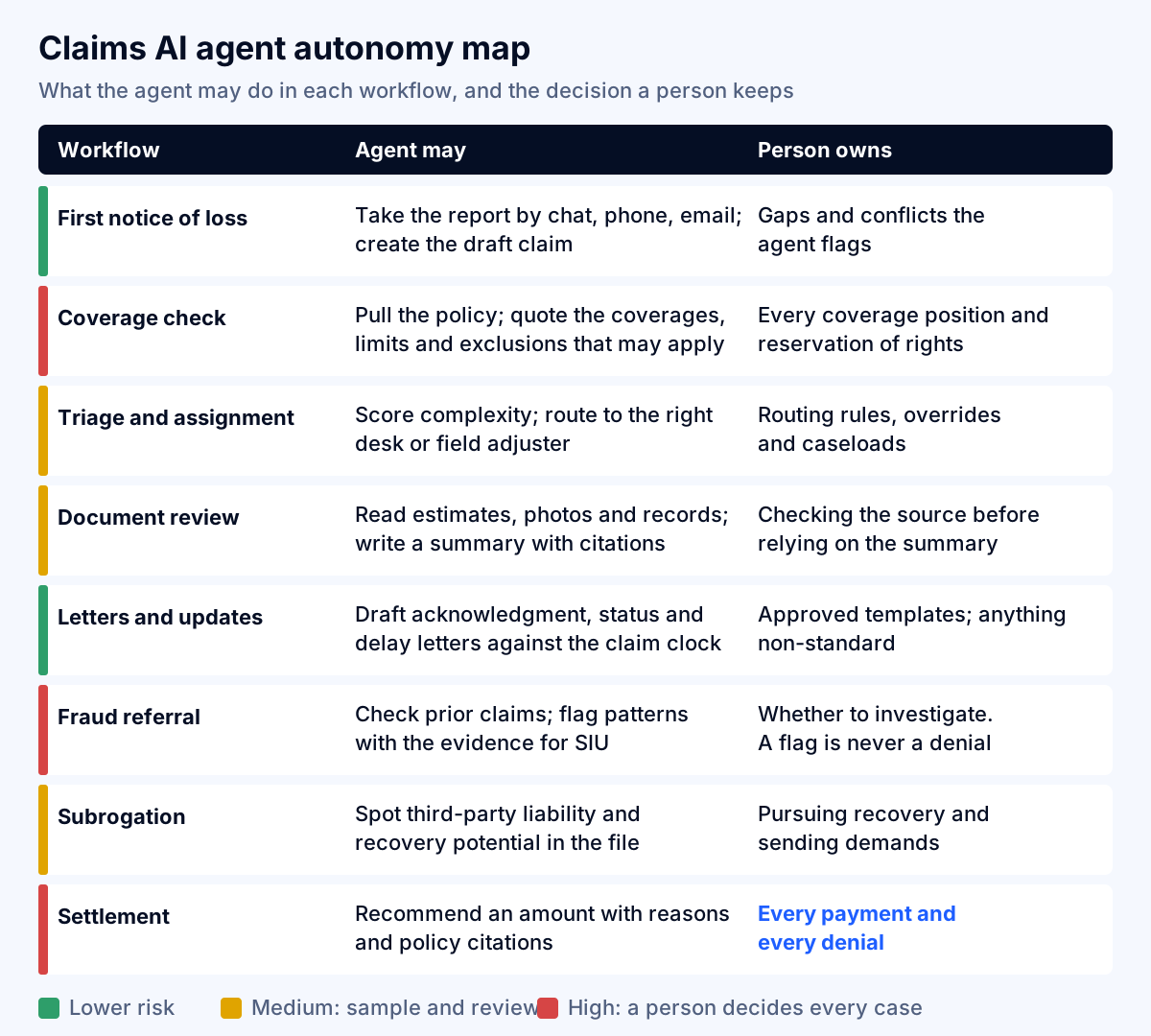
The figure below maps the workflows where agents fit best, what the agent may do in each, and the decision a person keeps. The color shows how much review each workflow needs.
1. First notice of loss intake
FNOL is the obvious starting point because it is high-volume, time-sensitive and mostly data collection. An agent can take the report through web chat, email, a portal or a voice line, ask follow-up questions based on the loss type, capture photos, check that the policy was in force on the date of loss, and create a draft claim in your claims system.
Lemonade shows what this looks like at scale. Its annual report for 2025 says that as of December 31, 2025, its AI Jim took the first notice of loss without human intervention 96% of the time. Lemonade built its operation around this from day one, so treat that as a ceiling rather than a target for a carrier with decades of legacy process.
The human job here is narrow: review the gaps and conflicts the agent flags, such as a date of loss outside the policy period or a description that does not match the photos.
2. Coverage check
The agent pulls the policy, endorsements and declarations, then lists the coverages, limits, deductibles and exclusions that may apply to the reported loss, quoting the actual policy language with page references. That alone saves an adjuster real time on every file.
It should stop there. A coverage position, a reservation of rights or a denial based on an exclusion is a legal judgment with bad-faith exposure attached. The agent's output is a briefing, not a decision.
3. Triage and assignment
Routing a claim to the right desk, field adjuster, specialist unit or straight-through lane is one of the oldest uses of models in claims. The NAIC survey found that claim assignment decisions tended to be automated, or at least augmented by models. An agent adds the ability to read the narrative and attachments rather than relying only on structured fields, so a water loss that mentions mold or a tenant gets routed differently from a simple pipe burst.
Keep routing rules, overrides and caseload balancing with your claims managers, and sample the agent's routing decisions weekly.
4. Document review and file summaries
This is where large language models outperform older tools. An agent can read a 200-page medical record, a contractor's estimate, a police report and a recorded statement transcript, then write a summary that cites the page each fact came from. It can also list what is missing: a signed proof of loss, a second estimate, a prior-loss photo.
The rule that makes this safe is citations. An adjuster should be able to click from any statement in the summary to its source. Summaries without citations invite exactly the kind of quiet error that turns into a complaint. Our guide to evaluating AI accuracy before and after launch covers how to measure this on your own files.
5. Acknowledgments, status updates and letters
Claimants call because they do not know what is happening. An agent can draft acknowledgment letters, requests for information, status updates and delay letters on schedule, using the actual open items in the file rather than boilerplate. It can also answer "where is my claim" questions from the file itself.
This workflow is lower risk because the content is factual and the templates are approved in advance. It is also where an agent most directly protects you from regulatory findings, which the claim clock section below explains.
6. Fraud referral
The Coalition Against Insurance Fraud's 2022 study, prepared by Colorado State University Global's White Collar Crime Task Force, estimated that insurance fraud costs the US $308.6 billion a year across all lines. An agent can help by checking prior claims, comparing photos and documents for signs of reuse or editing, spotting inconsistencies between the statement and the evidence, and packaging the reasons for a special investigations unit (SIU) referral.
The NAIC survey found fraud models were used mostly to refer claims for further investigation, and that is the right boundary for an agent too. A fraud flag should start an investigation by a person. It should never deny, delay or reduce a claim by itself. Model Regulation 902 does relieve an insurer of the standard 21-day decision deadline where there is a reasonable basis, supported by specific information, to suspect fraud. That reasonable basis is a human finding documented in the file, not a score.
7. Subrogation identification
Recoveries are lost when nobody notices that a third party caused the loss. An agent reading every file can flag a faulty appliance named in the narrative, a contractor's work that preceded the leak, or a rear-end collision where the other driver was at fault, then queue the file for the recovery team with the evidence attached. Pursuing recovery and sending demand letters stay with people.
8. Settlement recommendation
For simple, low-value claims, an agent can calculate a proposed amount from the estimate, the limits and the deductible, explain each line, and cite the policy provisions. A person reviews the reasoning and authorizes the payment.
Allianz's published design for food spoilage claims after storms in Australia shows this pattern. According to Allianz's November 2025 account, seven agents handle planning, security, coverage, weather confirmation, fraud checks, payout calculation and an audit summary for claims under AUD$500, and a claims professional makes the payment decision. Allianz reported an 80% reduction in processing and settlement time, from several days to one day or even hours. Its own words on the design are worth quoting: "payout decisions are never automated."
Key takeaway: Every published claims agent we could verify keeps a person on the payment decision, even for claims worth a few hundred dollars. If a vendor proposes otherwise, ask why.
Where the law draws the line on AI claim decisions
Regulation of AI in claims is arriving from three directions at once: insurance department guidance that applies to all AI use, state statutes aimed at AI denials, and ordinary claims settlement law that never mentions AI at all.
The NAIC AI model bulletin
The NAIC Model Bulletin on the Use of Artificial Intelligence Systems by Insurers, adopted in December 2023, covers the whole insurance life cycle, explicitly including claim administration and payment and fraud detection. It expects insurers to keep a written AI Systems (AIS) Program and to be able to produce documentation about any AI system on request. It also says the degree of human involvement in the final decision is one of the factors that sets how much control a use case needs.
As of the NAIC's implementation map dated October 8, 2026, 29 jurisdictions had adopted the bulletin: 27 states, the District of Columbia and Puerto Rico. North Dakota and South Carolina were added in the weeks before that update. California, Colorado, New York and Texas appear separately with their own insurance-specific regulation or guidance. Our NAIC AI model bulletin checklist turns the bulletin into a working list.
The NAIC is also preparing an examination tool. Its AI topic page says 12 states were piloting an AI Systems Evaluation Tool as of March 2026, with adoption anticipated at the 2026 Fall National Meeting. Expect examiners to arrive with a structured questionnaire about your AI inventory.
Colorado and New York
Colorado's Regulation 10-1-1 originally applied to life insurers. An amendment effective October 15, 2025 extended it to private passenger auto and health benefit plan insurers that use external consumer data and the models built on it, with full compliance due by July 1, 2026, according to Faegre Drinker's summary. New York's Circular Letter No. 7 focuses on underwriting and pricing rather than claims, but its expectations on governance, testing and vendor oversight are a useful template for any AI program a New York examiner reviews.
State laws aimed at AI denials
Health insurance moved first. Holland & Knight's review of 2026 legislation lists new laws in Alabama, Indiana, Utah, Washington, Maryland and Georgia. Indiana's HB 1271, effective July 1, 2026, bars using AI as the sole basis for downcoding a claim without a professional's review of the medical record. Washington's SB 5395 says carriers may not rely solely on AI to deny, delay or limit care in prior authorization, and Georgia's SB 544 bars AI adverse determinations without a licensed provider's review and approval.
Property and casualty is next in line, though nothing comparable has passed yet. Florida's HB 527, titled "Mandatory Human Reviews of Insurance Claim Denials," would have required a qualified human professional to make any decision to deny or reduce a claim. It passed the House 108 to 0 on March 5, 2026, then died in the Senate Rules Committee on March 13. In New Jersey, Assembly Bill 5494, introduced on September 14, 2026, would bar AI from making the final decision to deny homeowner, auto and flood claims, with penalties of up to $5,000 per violation. Both bills would still let insurers use AI for triage, assessment and approvals.
What your own documents say
The most practical lesson comes from litigation rather than statute. In Estate of Lokken v. UnitedHealth Group, plaintiffs allege that an algorithm was used in place of physicians to deny post-acute care. In February 2025, a federal court in Minnesota dismissed most claims as preempted by the Medicare Act but let the breach of contract and good faith claims proceed, because the plan documents described claim decisions as being made by clinical services staff and physicians. The allegations are unproven and the defendants dispute them.
The point for any carrier is simple. If your policy forms, claim letters or website say that adjusters or clinicians decide claims, your agent design has to make that true.
The claim clock: deadlines your agent must respect
Unfair claims settlement practices rules set the rhythm of every claim, and they are where an agent can do the most quiet good. The NAIC's Unfair Property/Casualty Claims Settlement Practices Model Regulation sets these standards, which many states adopted in some form:
- Acknowledge a claim within 15 days of notification, unless payment is made in that time.
- Reply within 15 days to other claimant communications that reasonably suggest a response is expected.
- Answer an insurance department inquiry about a claim within 21 days.
- Tell a first-party claimant within 21 days of receiving properly executed proofs of loss whether the claim is accepted or denied, or why more time is needed.
- If the investigation is still open, send a letter 45 days from the initial notification and every 45 days after that explaining why.
- Tender payment within 30 days of affirming liability when the amount is determined and not in dispute.
- Put any denial in writing and reference the specific policy provision, condition or exclusion relied on.
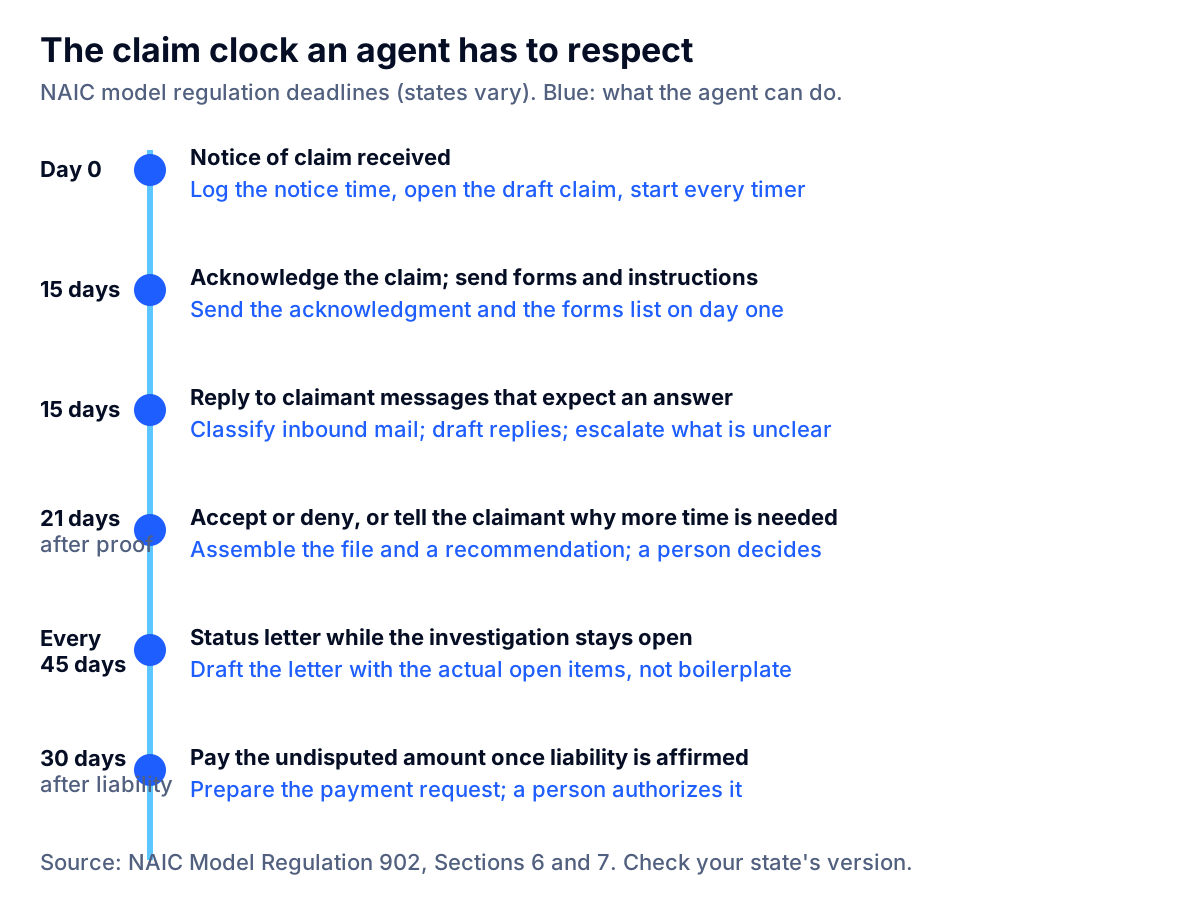
Acknowledgment and status-letter deadlines are easy to miss because they depend on people remembering dates across hundreds of open files, and every missed one sits in the claim file for an examiner to find. An agent that starts every timer at notice, drafts the right letter before the deadline and escalates files that are about to breach turns a weakness into a strength.
The flip side is important. If your agent stalls, mis-files a claimant's email or silently fails, it can miss these deadlines across hundreds of files at once. Monitor the timers independently of the agent.
Key takeaway: Build the claim clock into the agent's tools as hard data, not into its prompt as advice. Deadlines should come from your state rules table, and breaches should page a person.
Reference design for a claims AI agent
Most claims agents we would recommend for a regional carrier share the same shape.
| Layer | What it does | Typical systems |
|---|---|---|
| Channels | Where claimants and agents report losses | Phone and IVR, email, customer portal, web chat, producer portals |
| Orchestration | Plans steps, calls tools, applies guardrails | Agent framework running on your cloud account |
| Claims system tools | Read and write claim data | Claims administration API (draft claims, notes, diaries, documents) |
| Policy tools | Read-only coverage facts | Policy administration system, document store for forms and endorsements |
| Evidence tools | Facts from outside the file | Estimating platforms, weather and event data, industry claims databases |
| Human gates | Decisions only people make | Coverage positions, fraud referrals, payments, denials |
| Audit and monitoring | Proves what happened | Immutable log of every input, tool call, output and approver |
Modern claims platforms make the claims system layer easier than it used to be. Guidewire's ClaimCenter Cloud API documentation, for example, documents a full FNOL flow built on draft claims that a caller creates, updates and then submits. An agent that works through draft claims gives you a natural review point: nothing becomes a live claim until a rule or a person submits it. Older or heavily customized platforms may need an integration layer first, which is often the largest single line in the budget.
Three design choices matter more than the choice of model:
- Least privilege. The intake agent can create draft claims but cannot change reserves. The letters agent can draft but not send outside approved templates. No agent can issue a payment. Our MCP server security best practices apply directly if you expose these tools through the Model Context Protocol.
- Claimant documents are untrusted input. A submitted PDF or email can contain text written to manipulate an AI system, such as instructions to approve the claim. Keep document content separate from instructions, never let document text trigger tool calls on its own, and test with adversarial samples.
- An audit trail an examiner can follow. Log the inputs, retrieved policy language, tool calls, outputs, model version and the person who approved each decision. Our guide to AI audit trail requirements lists the fields.
Data residency belongs in the design too. Claims files contain personal, financial and often health information. Run the agent inside your own cloud account or through a provider with contractual data commitments, and check whether you need US-only processing. Anthropic, for example, charges a 1.1x multiplier for US-only inference on its newer models, according to its pricing page.
What large insurers have shown, and what it means for regional carriers
Two published examples are worth studying because they come from primary sources and include enough detail to learn from.
Allianz Project Nemo went live in Australia in July 2025, built in under 100 days according to Allianz. The scope was deliberately narrow: one claim type (food spoilage after severe weather), one country, a value cap of AUD$500, and a person on every payment. Allianz said it was exploring the same approach for other simple, high-frequency claims such as travel delays, simple auto claims and property damage.
Lemonade reported that roughly 55% of its claims were automated as of December 31, 2025, with instant or near-instant processing from start to finish, and that AI Jim took first notice of loss 96% of the time. Lemonade designed its products, policy forms and systems around automation from the start.
Three lessons transfer to a regional carrier or TPA:
- Start with one claim type, not "claims." Pick a high-volume, low-severity line where the facts are checkable, such as glass, small water losses, travel delay or food spoilage.
- Narrow scope is what makes speed possible. Allianz's 100-day timeline came from a tightly bounded problem, not from a bigger budget.
- Your legacy stack is the constraint. Lemonade's numbers come from a company built for automation. For most carriers, the integration with a decades-old claims system decides the timeline more than the AI does. Our article on moving AI pilots to production covers the usual sticking points.
What AI agents for insurance claims processing cost to run
Model usage is usually the smallest cost line. The table below is an illustrative model, not a quote. It assumes Claude Sonnet 5.5 at $2 per million input tokens and $10 per million output tokens, and Claude Opus 5.5 at $4 and $20, which are Anthropic's standard list prices as of October 2026. Token counts per claim are our assumptions for the whole life of a claim across intake, summaries, letters and the recommendation.
| Claim profile | Input tokens | Output tokens | Sonnet 5.5 cost | Opus 5.5 cost |
|---|---|---|---|---|
| Simple (glass, small property) | 40,000 | 4,000 | $0.12 | $0.24 |
| Standard property or auto | 150,000 | 10,000 | $0.40 | $0.80 |
| Complex (large files, medical records) | 600,000 | 25,000 | $1.45 | $2.90 |
For a carrier handling 10,000 claims a year split 60% simple, 30% standard and 10% complex, that is about $3,400 a year on Sonnet 5.5 or $6,700 on Opus 5.5 before prompt caching, which can cut the cost of repeated policy text sharply. Add 10% if you require US-only processing through Anthropic's API.
Compare that with the work it supports. The Bureau of Labor Statistics puts the 2025 median pay for claims adjusters, appraisers, examiners and investigators at $78,020 a year, or $37.51 an hour, before benefits. If, hypothetically, an agent saved 20 minutes of adjuster time per claim on those 10,000 claims, that would be about 3,300 hours, or roughly $125,000 in median wages alone. That figure is illustrative. Your own time studies decide the real number, and saved time only becomes savings if you redeploy it.
The real costs sit elsewhere:
- Building and integrating. Claims agents usually fall in the "action-taking agent across systems" or "regulated platform" tiers of our AI agent development cost guide, because they write to several systems and need approvals, audit logs and security testing.
- Testing on your own files. You need a labeled set of past claims, with the right answers, to prove the agent works before it touches a live claimant.
- Running and maintaining. Monitoring, prompt and policy-table updates when forms or state rules change, model upgrades and periodic re-validation for your AIS Program.
If a packaged claims product already covers your workflow well, buying can beat building. Our build vs buy AI agents decision matrix walks through that choice, and our AI vendor risk assessment questionnaire covers the diligence the NAIC bulletin expects for third-party systems.
Where claims AI agents fail
These are the failure modes to plan for, most of which apply to any agent working inside a regulated process:
- Confident coverage mistakes. The agent applies the wrong form edition, misses an endorsement, or paraphrases an exclusion more broadly than written. Fix: retrieve exact policy text with form numbers and editions, and require quotations rather than paraphrase.
- Document extraction errors. Handwritten forms, poor scans and multi-page estimates produce wrong numbers that look right. Fix: confidence thresholds, field-level citations and human review below the threshold.
- Automation creep. A recommendation that people approve 99% of the time becomes a rubber stamp, which is a de facto automated decision. Fix: track approval rates and time spent per review, and sample approved cases for quality.
- Silent timer failures. An integration breaks and letters stop going out for a week. Fix: independent deadline monitoring outside the agent.
- Injection through claimant documents. Text hidden in a PDF tries to steer the agent. Fix: treat all submitted content as data, restrict tools, and test adversarially.
- Adjuster distrust. If the summaries are wrong early, adjusters stop reading them and the investment is wasted. Fix: start with a small group, publish accuracy numbers weekly, and fix what they report.
- Disparate outcomes. Routing, fraud flags or settlement recommendations can differ by geography or demographic proxy. Fix: test outcomes for unfair discrimination as your AIS Program requires, before and after launch.
Key takeaway: Most claims agent failures are not model failures. They are missing controls: unclear permissions, no citations, no independent monitoring and reviews that quietly turn into rubber stamps.
Which claims workflow to automate first: a scoring sheet
Score each candidate workflow from 1 to 3 on the six factors below, then add them up. The factors are ours, but they reflect the NAIC bulletin's emphasis on the nature of the decision, potential consumer harm and the degree of human involvement.
| Factor | 1 point | 2 points | 3 points |
|---|---|---|---|
| Volume | Under 1,000 a year | 1,000 to 10,000 | Over 10,000 |
| Time per item today | Under 5 minutes | 5 to 30 minutes | Over 30 minutes |
| Reversibility | Hard to undo | Correctable with effort | Easy to correct |
| Consumer harm if wrong | Could delay or deny a claim | Could annoy or confuse | Internal only |
| Data readiness | Scattered, paper-heavy | Mostly digital | Digital with API access |
| Measurability | No clear right answer | Reviewable by sampling | Checkable against past files |
A total of 15 or more is a strong first candidate. Under 11, wait until you have experience. FNOL intake, status letters and file summaries tend to score highest; coverage positions and settlement usually score lowest because of reversibility and consumer harm.
A 90-day plan for your first claims agent
Days 1 to 15: choose and baseline. Pick one claim type and one workflow from the scoring sheet. Measure today's cycle time, touch time, letter timeliness and error rate. Write down which decisions stay with people.
Days 16 to 30: data and controls. Pull 200 to 500 closed claims as a test set with the correct outcomes. Map the systems and API access. Draft the AIS Program entry for this use case: purpose, data, owner, human gates, monitoring.
Days 31 to 60: build and test offline. Build the agent against draft claims or a sandbox. Run it on the test set and measure accuracy field by field. Fix the worst failure modes before anyone sees it live.
Days 61 to 90: supervised pilot. Run in shadow mode first, then with a small adjuster group approving every action. Track the same metrics you baselined. Expand only when accuracy and timeliness beat the baseline on your own data.
Fleurant AI builds working agent prototypes in one to two weeks and offers a risk-free proof of value for agent projects, which fits days 31 to 60 of this plan.
The bottom line
AI agents for insurance claims processing work best as file preparers, not decision makers. Start with intake, letters and summaries; build the claim clock into the tools; give the agent the narrowest permissions that work; keep every coverage, fraud and payment decision with a licensed person; and log everything an examiner might ask for. State law is heading toward requiring that design, and the carriers with published results already use it.
If you are weighing a first claims agent, our AI agent development team can help you score your workflows and scope a proof of value, and our AI compliance specialists can map it to your AIS Program. Talk to a specialist about your claims operation, or browse more of our work from the home page.
Frequently asked questions
Are insurance companies already using AI to review claims?
Yes, and for longer than most people think. In a 2021 NAIC survey of 193 larger private passenger auto insurers, about 88% used, planned to use or planned to explore advanced AI or machine learning, and claims was the most common area at 70%. Most of those models informed adjusters rather than deciding. What is new in 2026 is agents that read documents and take steps across systems, not just score a claim.
Can an AI agent deny an insurance claim on its own?
It should not, and in a growing number of situations it legally cannot. Several states passed laws in 2026 that stop health insurers from relying solely on AI for adverse decisions, and a New Jersey bill introduced in September 2026 would stop AI from making final denials on home, auto and flood claims. Even where no statute applies, the safe design is that the agent recommends and a licensed person decides. Confirm your states' rules with counsel.
Which claims workflow should we automate first?
Start where the work is high-volume, rule-bound and reversible: first notice of loss intake, acknowledgment and status letters, document summaries and triage. These save adjuster time without the agent ever deciding coverage or payment. Leave coverage positions, fraud decisions and settlement authority with people until you have months of evidence that the agent's recommendations are accurate on your own claims.
How much does it cost to run an AI claims agent?
Model usage is usually the small part. In our illustrative model at October 2026 list prices, a simple claim costs about 12 cents in Claude Sonnet 5.5 tokens and a complex claim with large medical or repair files about $1.45. A carrier handling 10,000 claims a year would spend a few thousand dollars on tokens. The larger costs are integrating with your claims system, testing against past files, and keeping the agent maintained.
Does the NAIC AI model bulletin apply to claims agents?
Yes. The bulletin's scope covers the whole insurance life cycle, including claim administration and payment and fraud detection, and its definition of AI covers generative systems. As of the NAIC's implementation map dated October 8, 2026, 29 jurisdictions had adopted it. Insurers there are expected to keep a written AIS Program and to produce documentation about any AI system an examiner asks about. Our NAIC AI model bulletin checklist covers the details.
Will AI agents replace insurance adjusters?
They are changing the job faster than they are eliminating it. The Bureau of Labor Statistics counted 389,700 claims adjusters, appraisers, examiners and investigators in 2025 and projects employment to decline 6% from 2025 to 2035, while still expecting about 21,600 openings a year. In practice, agents take over intake, paperwork and file assembly, and adjusters spend more of their time on judgment, negotiation and complex losses.
What systems does a claims AI agent need to connect to?
At minimum, your claims administration system, the policy administration system for coverage details, your document store and the channels claimants use (phone, email, portal and chat). Depending on the workflow it may also need estimating platforms, industry claims databases for fraud checks, payment systems and a weather or event data feed. Modern claims platforms expose APIs for this; older ones may need a careful integration layer first.
Sources
- NAIC Model Bulletin: Use of Artificial Intelligence Systems by Insurers (adopted December 4, 2023), National Association of Insurance Commissioners
- Implementation of NAIC Model Bulletin: Use of Artificial Intelligence Systems by Insurers (status as of October 8, 2026), National Association of Insurance Commissioners
- Unfair Property/Casualty Claims Settlement Practices Model Regulation (Model 902), National Association of Insurance Commissioners
- 2021 Private Passenger Auto Artificial Intelligence/Machine Learning Survey Analysis (memorandum, December 8, 2022), National Association of Insurance Commissioners
- Artificial Intelligence (insurance topic page), National Association of Insurance Commissioners
- Claims Adjusters, Appraisers, Examiners, and Investigators (Occupational Outlook Handbook), U.S. Bureau of Labor Statistics
- When the storm clears, so should the claim queue, Allianz
- Lemonade, Inc. Annual Report on Form 10-K for fiscal year 2025, U.S. Securities and Exchange Commission (EDGAR)
- The Impact of Insurance Fraud on the U.S. Economy (2022), Coalition Against Insurance Fraud
- States Continue Efforts to Regulate AI in Healthcare: A Review of Legislation Passed in 2026, Holland & Knight LLP
- New Jersey bill targets AI-powered insurance claim denials, Insurance Business
- CS/CS/HB 527 (2026): Mandatory Human Reviews of Insurance Claim Denials, The Florida Senate
- Estate of Lokken v. UnitedHealth Group, Memorandum Opinion and Order (D. Minn., February 13, 2025), Georgetown Law, Health Care Litigation Tracker
- Colorado Division of Insurance Expands AI-Related Governance and Risk Management Obligations for Insurers, Faegre Drinker Biddle & Reath LLP
- Insurance Circular Letter No. 7 (2024), New York State Department of Financial Services
- ClaimCenter Cloud API Consumer Guide (FNOL and adjudication business flows), Guidewire
- Pricing, Anthropic


