AI Agents
AI Agent Development Cost in 2026: Budgets, Run Costs and ROI
AI agent development cost in 2026, explained: build budgets by complexity, monthly model and tooling costs, a three-year TCO model and a break-even worksheet.
In this article
- What are you actually paying for when you build an AI agent?
- AI agent development cost by complexity: a tiered model
- How much does it cost to hire AI agent developers?
- What does an AI agent cost to run each month?
- The costs most AI agent estimates leave out
- Three-year total cost of ownership: a worked example
- Will an AI agent pay for itself? A break-even worksheet
- How to lower AI agent costs without cutting corners
- How to budget in stages, from prototype to production
- Next steps: turning an estimate into a budget you can defend
- Frequently asked questions
- Sources
Short answer: AI agent development cost in 2026 ranges from roughly $7,000 for a two-week prototype to roughly $120,000–$420,000 or more for a multi-agent system that operates in a regulated environment. For most small and mid-sized US companies, a production agent that handles one business workflow lands between about $30,000 and $100,000 to build. The build is only part of the bill, though. In the three-year model later in this article, the initial build is under 40% of total cost; model usage, tooling and especially the people who keep the agent accurate make up the rest.
Most pricing guides stop at a table of build ranges. This one shows the math behind every number so you can replace our assumptions with your own. You will get:
- a tiered cost model built from US Bureau of Labor Statistics wage data, with every assumption stated;
- what it costs to hire AI agent developers in-house, as freelancers or through a firm;
- a token-by-token run cost example using current list prices from Anthropic and OpenAI;
- the costs most estimates leave out, a three-year total cost of ownership (TCO) model and a break-even worksheet;
- a stage-gated budget plan that limits how much you can lose before you know the agent works.
All prices are as of September 2026. Model prices change often, so check the linked pricing pages before you finalize a budget.
What are you actually paying for when you build an AI agent?
An AI agent is software in which a large language model (LLM) decides which steps to take and which tools to call to finish a task, such as looking up an order, drafting a refund and updating the CRM. Anthropic's engineering team draws a useful line here: workflows are systems where LLMs and tools follow predefined code paths, while agents dynamically direct their own process and tool use. That distinction matters for your budget, because agents cost more to build, test and run than workflows.
The same Anthropic guide recommends "finding the simplest solution possible, and only increasing complexity when needed," and notes that this might mean not building an agentic system at all. It also warns that the autonomy of agents "means higher costs, and the potential for compounding errors." Gartner makes a similar point from the buyer's side: in its June 2025 prediction that over 40% of agentic AI projects will be canceled by the end of 2027, it says many use cases positioned as agentic today do not require agentic implementations.
So the first cost decision is not which vendor to hire. It is which kind of system the problem needs:
| System type | What it does | Relative build and run cost | Good fit |
|---|---|---|---|
| Assistant (chat over documents) | Answers questions from your knowledge base, takes no actions | Lowest | Internal help desks, policy lookup |
| Workflow with LLM steps | Fixed sequence, LLM classifies, extracts or drafts at set points | Low to medium | Invoice processing, ticket triage, document intake |
| Single agent with tools | Chooses its own steps and calls a handful of tools | Medium to high | Customer service resolution, sales research, IT requests |
| Multi-agent system | Several specialized agents coordinate on long tasks | Highest | Complex operations spanning many systems and teams |
Whatever you build, the money goes to the same buckets: discovery and design, data preparation, integrations with your systems, prompt and tool engineering, evaluation (testing the agent against real cases), security and permissions, user interface, deployment and monitoring. Integrations and evaluation are the two that most often surprise buyers.
Key takeaway: Price the problem before you price the build. If a fixed workflow with one or two LLM steps can do the job, it will usually be cheaper to build, cheaper to run and easier to audit than an autonomous agent.
AI agent development cost by complexity: a tiered model
The honest way to estimate a build is effort multiplied by rate. Effort depends on scope; rate depends on who does the work. The table below uses planning estimates of effort in person-weeks (one engineer for one 40-hour week) and prices them at two rates.
Rate assumptions:
- $93 per hour (in-house benchmark). The BLS reports a median annual wage of $135,980 for software developers as of May 2025, about $65 an hour over 2,080 hours. In the BLS Employer Costs for Employee Compensation release for June 2026, wages and salaries accounted for 70.0% of private-industry employer costs, with benefits making up the other 30.0%. Dividing $65.38 by 0.70 gives a loaded cost of about $93 an hour. The 70% share covers all private-industry workers, so treat it as an approximation for engineers.
- $150 per hour (illustrative external rate). This is an assumption, not a market statistic. External teams charge more than salary because their rates cover recruiting, management, idle time between projects and profit. Substitute the rates from the proposals you receive.
| Tier | Typical scope | Effort (person-weeks) | Cost at $93/hr | Cost at $150/hr |
|---|---|---|---|---|
| 1. Prototype / proof of value | One use case on real data, 1–2 read-only tools, tested on real past cases | 2–4 | $7,000–$15,000 | $12,000–$24,000 |
| 2. Production agent, one workflow | Retrieval over your documents, 2–3 integrations, basic approval step, evaluation set, monitoring | 8–16 | $30,000–$60,000 | $48,000–$96,000 |
| 3. Action-taking agent across systems | Writes to several systems, role-based permissions, audit logs, human-in-the-loop for risky actions, security testing | 16–32 | $60,000–$119,000 | $96,000–$192,000 |
| 4. Multi-agent or regulated platform | Several coordinated agents, compliance controls, data segregation, formal risk assessment, high availability | 32–70+ | $119,000–$260,000+ | $192,000–$420,000+ |
A person-week at $93 an hour is $3,720; at $150 it is $6,000. Figures are rounded to the nearest thousand.
What pushes a project up or down a tier
- Number and quality of integrations. A modern CRM with a documented API is a few days of work. A legacy system without an API, or one that needs a new data pipeline, can be weeks. Gartner notes that integrating agents into legacy systems "can be technically complex, often disrupting workflows and requiring costly modifications."
- Write access. An agent that only reads and recommends is far cheaper to make safe than one that issues refunds, changes records or sends messages on its own.
- Data readiness. If the answers live in clean, current documents, retrieval is straightforward. If they live in inboxes, spreadsheets and people's heads, budget for data cleanup first.
- Accuracy bar. Getting from "usually right" to "right often enough to act without review" is where evaluation effort grows fastest.
- Regulatory exposure. Healthcare, financial services and insurance add documentation, access controls, logging retention and review cycles. See the compliance section below.
- Reuse. Teams that bring existing connectors, evaluation harnesses and deployment templates cut weeks from tiers 2 and 3.
Key takeaway: Ask every vendor for effort in person-weeks by workstream, not just a total price. It is the only way to compare proposals that assume different scopes.
How much does it cost to hire AI agent developers?
This is one of the most common questions buyers ask on forums, and the answer depends on the hiring model more than on the job title.
In-house team
The BLS median for software developers is $135,980 a year as of May 2025, which becomes roughly $194,000 a year once benefits are included (using the 70% wage share above). Engineers with production experience in LLM applications, retrieval and agent evaluation are in demand and typically earn above the median. A realistic in-house team for a tier 3 agent is two or three engineers plus part-time product, security and domain expert time.
In-house makes sense when AI agents will be a long-term, core capability and you can keep the team busy after launch. The hidden costs are recruiting time, which can take months, and the risk of building a first agent with a team that has never shipped one.
Freelancers
Freelancers can be cost-effective for a tightly scoped prototype or a single integration. The risks grow with scope: one person rarely covers engineering, evaluation, security and operations, and continuity after launch is not guaranteed. If you go this route, own the code repository, cloud accounts and API keys from day one.
Development firm or specialist partner
A firm costs more per hour than salary but brings a working team immediately, reusable components and experience with the failure modes of agents. The questions that separate strong firms from weak ones:
- Will you build a working prototype on our real data before we commit to a full build?
- How will you measure accuracy, and what evaluation set will you build with us?
- Which actions will require human approval, and how are permissions scoped?
- What does it cost per month to run, at our expected volume, and how did you calculate it?
- Who owns the code, prompts, evaluation data and cloud accounts?
- What is the plan and budget for maintenance after launch?
Be wary of vendors who cannot answer questions 2 and 4 with specifics. Gartner estimates that only about 130 of the thousands of agentic AI vendors are real, with many engaged in "agent washing," the rebranding of existing chatbots, assistants and robotic process automation tools without substantial agentic capabilities.
What does an AI agent cost to run each month?
Run costs start with model usage, billed per token (a token is a chunk of text; Anthropic estimates about 0.75 English words per token). Agents use far more tokens than a chatbot answering one question, for two reasons. First, each task involves several model calls: the agent plans, calls a tool, reads the result and decides the next step. Second, every call resends the system prompt, the tool definitions and the growing conversation history.
Here is a worked example you can adapt.
Workload assumptions:
- 200 tasks per business day, about 4,400 tasks a month (for example, customer service requests an agent tries to resolve);
- 6 model calls per task;
- 8,000 input tokens and 400 output tokens per call on average.
That is 48,000 input tokens and 2,400 output tokens per task, or 211.2 million input tokens and 10.56 million output tokens a month.
Prices (standard tier, per million tokens, as of September 2026): Anthropic lists Claude Opus 5 at $5 input and $25 output, Claude Sonnet 5 at $2 and $10, and Claude Haiku 4.5 at $1 and $5. Cache hits cost 10% of the base input price. OpenAI lists GPT-6 Astra at $10 input and $50 output, and GPT-5.6 Luna at $0.20 and $1.20.
| Model configuration | Monthly input cost | Monthly output cost | Monthly total | Cost per task |
|---|---|---|---|---|
| GPT-5.6 Luna | $42 | $13 | $55 | $0.01 |
| Claude Sonnet 5 with 70% of input from cache | $156 | $106 | $262 | $0.06 |
| Claude Haiku 4.5 | $211 | $53 | $264 | $0.06 |
| Claude Sonnet 5 | $422 | $106 | $528 | $0.12 |
| Claude Opus 5 | $1,056 | $264 | $1,320 | $0.30 |
| GPT-6 Astra | $2,112 | $528 | $2,640 | $0.60 |
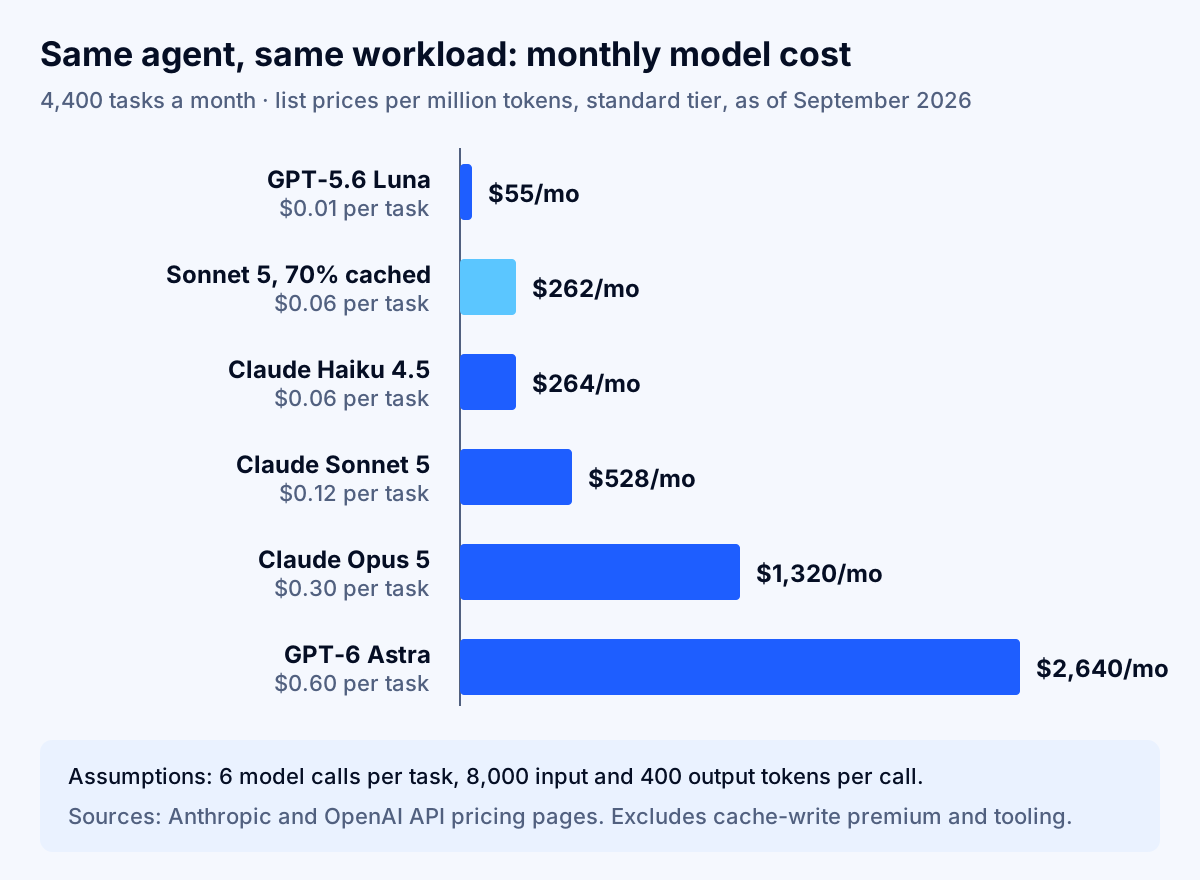
Three lessons from this table:
- Model choice swings the bill by about 48 times for the identical workload. The right model is the cheapest one that passes your evaluation set, not the most capable one available.
- Prompt caching roughly halves the cost when most of each request is repeated context. This example ignores the cache-write premium (1.25 times the input price for a five-minute cache), which adds a little back.
- At small-business volumes, tokens are rarely the biggest run cost. Even the most expensive configuration here costs less per month than a few days of an engineer's time.
Caveats that change the math
- Token counts differ by model. Anthropic notes that Claude 4.7 and later models use a tokenizer that produces approximately 30% more tokens for the same text. Measure token usage on the model you plan to use, with your real prompts.
- Batch processing is half price. Both Anthropic and OpenAI discount batch requests by 50% for work that does not need an immediate answer, such as overnight document review.
- US-only processing costs more. For Claude 4.6 and later models, Anthropic applies a 1.1 times multiplier when you require US-only inference, which some regulated buyers need.
- Server-side tools add fees. Anthropic's web search tool, for example, costs $10 per 1,000 searches on top of tokens.
The rest of the monthly run bill
| Run cost | Example price (as of September 2026) | What drives it |
|---|---|---|
| Observability and tracing | LangSmith Plus: $39 per seat per month, up to 10,000 base traces a month included | Number of engineers, trace volume, retention |
| Vector database for retrieval | Pinecone Standard: $50 per month minimum usage; Enterprise $500 minimum | Document volume, queries, uptime requirements |
| Hosting and compute | Your cloud provider's rates | Traffic, latency needs, redundancy |
| Human review | Your staff's loaded hourly cost | Share of actions requiring approval |
| Maintenance engineering | 0.1–0.25 of an engineer (our planning assumption) | Rate of change in prompts, tools, models and policies |
These tools are examples, not recommendations; open-source and cloud-native alternatives exist for each. If your agent runs on AWS, Azure or Google Cloud, the hosting line is also where cloud cost optimization pays off over time.
The costs most AI agent estimates leave out
Build-price tables tend to skip the work that separates a demo from a system you can trust. Plan for these explicitly.
Evaluation
An evaluation set is a collection of real cases with known correct outcomes that you run the agent against after every change. Building it takes domain expert time, which is usually your staff, not the vendor's. Without it, you cannot tell whether a new prompt or model upgrade made the agent better or worse. Budget for your experts to label at least a few hundred representative cases, and for engineers to automate the test runs.
Security testing and permissions
Agents that read untrusted content, such as emails, web pages or uploaded files, are exposed to prompt injection, where text in that content manipulates the model. The OWASP Top 10 for LLM Applications ranks prompt injection first for 2025 and recommends restricting the model's access privileges to the minimum necessary, requiring human-in-the-loop controls for privileged operations and conducting adversarial testing and attack simulations. Each of those is engineering time, and the more your agent can do, the more testing it needs.
Governance and compliance
For regulated companies, add risk assessment, documentation, logging retention and legal review. Many US organizations map their controls to the NIST AI Risk Management Framework, which NIST released in January 2023 for voluntary use and supplemented with a Generative AI Profile in July 2024; NIST also notes the framework is being revised. Requirements differ by industry and state, so confirm specifics with your counsel or compliance team. If this applies to you, our AI compliance services page explains how we approach it.
Change management and your team's time
Someone has to define the rules the agent follows, review escalations, answer questions from staff and decide what happens when the agent is wrong. That is internal time, and it rarely appears in a vendor quote.
Maintenance
Models are updated and retired, APIs change, policies and products change, and new edge cases appear. Anthropic's pricing page, for example, lists several older Claude models as retired. Plan for ongoing engineering capacity rather than a one-time handover.
Key takeaway: If a proposal has no line items for evaluation, security testing and maintenance, those costs have not disappeared. You will pay for them later, usually at a worse moment.
Three-year total cost of ownership: a worked example
Here is a three-year TCO for a tier 2 agent running the 4,400-task workload above on Claude Sonnet 5, at two ends of a realistic range.
Assumptions:
- Build at the external rate: $48,000 (low) or $96,000 (high).
- Model usage: $262 a month with caching (low) or $528 without (high).
- Tooling: two LangSmith Plus seats and the Pinecone Standard minimum, $1,536 a year.
- Maintenance: 0.1 (low) or 0.25 (high) of an engineer at a loaded $194,257 a year.
- Hosting, human review and internal staff time are excluded because they vary too much to generalize; add your own.
| Cost line | Low scenario | High scenario |
|---|---|---|
| Initial build | $48,000 | $96,000 |
| Model usage, 3 years | $9,432 | $19,008 |
| Tooling, 3 years | $4,608 | $4,608 |
| Maintenance engineering, 3 years | $58,277 | $145,693 |
| Three-year total | $120,317 | $265,309 |
| Build as a share of the total | 40% | 36% |
The pattern holds across most reasonable assumptions: for a small or mid-sized deployment, people cost more than tokens, and ongoing maintenance can exceed the original build. That is why the cheapest build quote is not necessarily the cheapest agent. A cleaner architecture, a good evaluation harness and sensible model routing all reduce the largest line in this table.
At much higher volumes the balance shifts. Multiply the workload by 50 and the Sonnet 5 model bill without caching becomes $26,400 a month, which is when model routing, caching and batch processing become the main cost levers.
Will an AI agent pay for itself? A break-even worksheet
Whether AI automation pays for itself is a question buyers ask constantly, and the only reliable answer is a calculation with your own numbers. Use this worksheet.
Monthly value = tasks per month × share the agent fully handles × hours saved per task × loaded hourly cost of the person who did the work
Monthly net benefit = monthly value − model costs − tooling − maintenance − added human review
Payback period (months) = build cost ÷ monthly net benefit
Example: a strong outcome
- 4,400 tasks a month; the agent fully handles 40%; each saves 12 minutes (0.2 hours).
- Loaded labor cost: $46.89 an hour, the BLS average total compensation for private-industry workers in June 2026. Use your own team's figure if you have it.
- Value: 4,400 × 0.40 × 0.2 × $46.89 = $16,505 a month.
- Run costs (high scenario from the TCO table): $528 model + $128 tooling + $4,047 maintenance = $4,703 a month.
- Net benefit: $11,802 a month. Payback on a $96,000 build: about 8 months.
Same agent, weaker outcome
- The agent fully handles only 15% of tasks.
- Value: 4,400 × 0.15 × 0.2 × $46.89 = $6,189 a month. Net benefit: $1,486 a month.
- Payback on $96,000: about 65 months, longer than most software stays unchanged.
The difference between those two outcomes is a single number, the share of tasks the agent actually resolves, and you cannot know it until the agent runs on your real cases. This is exactly why a short prototype measured against real historical tasks is the best money you can spend before committing to a full build. The worksheet also shows why Gartner recommends pursuing agentic AI only where it delivers clear value or ROI.
Key takeaway: Do not approve a full build on a projected resolution rate. Approve a prototype that measures it.
Benefits beyond labor savings are real, such as faster response times, 24-hour coverage and fewer errors, but they are harder to quantify. Count them separately so they do not inflate the payback math.
How to lower AI agent costs without cutting corners
- Start with a workflow. If the steps are predictable, hard-code them and use the LLM only where judgment is needed. You can add autonomy later where the data shows it helps.
- Route by difficulty. Send routine steps to a small, cheap model and escalate only hard cases to a larger one. In the example above, that spread is up to 48 times in price.
- Cache the repeated context. Keep system prompts and tool definitions stable so caching can apply. At a 70% cache-hit share, the Sonnet 5 bill in our example fell from $528 to $262.
- Batch what can wait. Overnight classification, document review and report drafting qualify for the 50% batch discount.
- Trim the context. Summarize long histories and retrieve only the most relevant documents instead of sending everything on every call.
- Limit the tools. Every tool definition adds input tokens to every call, and every write action adds testing. Give the agent only what the task needs.
- Reuse components. Connectors, evaluation harnesses and deployment templates from earlier projects shorten builds. This is also a fair question to ask any vendor.
- Set cost alerts per task. A loop bug that makes an agent call a model 50 times instead of 6 is a common and expensive failure. Cap steps per task and alert on anomalies.
How to budget in stages, from prototype to production
The safest budget is one released in stages, with a go or no-go decision at each gate based on measured results. It limits the amount at risk to the prototype until you have evidence.
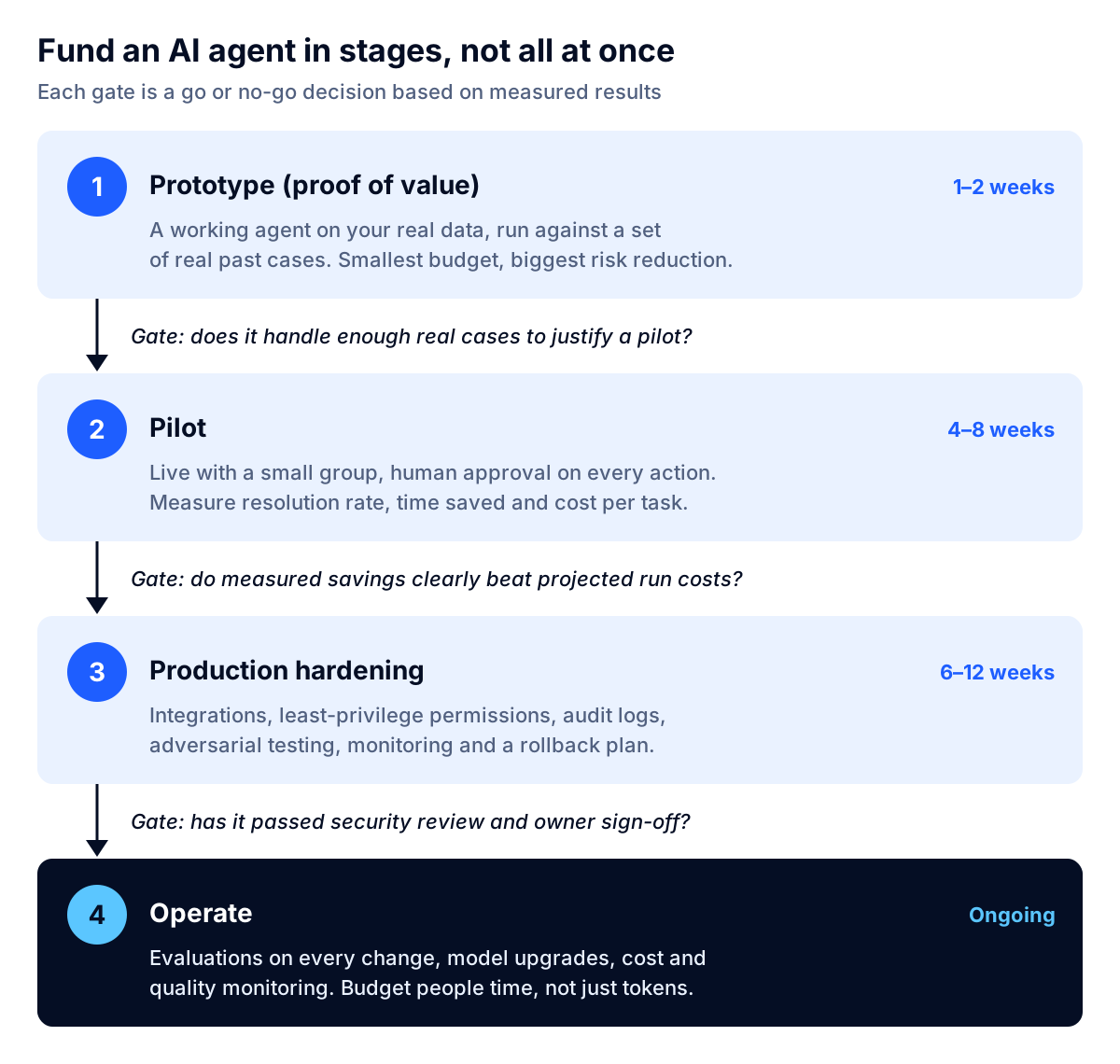
- Prototype (1–2 weeks, tier 1 budget). Build a working agent on your real data and run it against a set of real past cases. Measure the share it handles correctly and the tokens it uses per task.
- Pilot (4–8 weeks). Put it in front of a small group with human approval on every action. Measure resolution rate, time saved, escalations and cost per task in live conditions.
- Production hardening (6–12 weeks). Add the remaining integrations, least-privilege permissions, audit logs, adversarial testing, monitoring and a rollback plan. Get security and business-owner sign-off.
- Operate (ongoing). Run the evaluation set on every change, review costs monthly, and plan for model upgrades.
Plug the pilot's measured numbers into the break-even worksheet before approving stage 3. If the math does not work, you have spent a fraction of the full budget to learn that, which is a good outcome.
This is how we structure our own AI agent development engagements: a free discovery call, then working AI agent prototypes in 1–2 weeks, with a risk-free proof of value before any larger commitment. A similar staged approach works well for custom AI development projects such as fine-tuned models and retrieval assistants.
Next steps: turning an estimate into a budget you can defend
AI agent development cost is less about a single price and more about three numbers you can measure: effort to build, cost per task to run and the share of work the agent actually handles. To build a budget your leadership team will trust:
- Pick one workflow with high volume, clear rules and measurable outcomes.
- Decide whether it needs an agent at all, or whether a simpler workflow would do.
- Collect a few hundred real past cases to serve as the evaluation set.
- Fund a prototype, measure it and run the break-even worksheet with real numbers.
- Release production budget only when the pilot clears your gate, and include maintenance in year-one plans.
If the agent needs a customer-facing portal or internal dashboard around it, factor in web app development as a separate line. And if you would like a second opinion on a proposal or help scoping your first agent, talk to a specialist or explore more of what we build on the Fleurant AI home page.
Frequently asked questions
How much does it cost to build a simple AI agent?
A focused prototype that works on your real data typically takes 2–4 person-weeks, which is roughly $7,000–$24,000 depending on whether the engineers are in-house or external. A production agent for one workflow usually needs 8–16 person-weeks, or about $30,000–$96,000. These are planning estimates built from US wage data and stated hourly assumptions, so replace the rate with the quotes you actually receive.
How much does an AI agent cost to run per month?
It depends mostly on volume, model choice and how many model calls each task needs. In our worked example of 4,400 tasks a month, list-price model costs range from about $55 to $2,640 a month depending on the model. Add observability and vector database tooling, hosting and, most importantly, the engineering time needed to maintain the agent, which often costs more than the tokens.
How much does it cost to hire AI agent developers?
The US Bureau of Labor Statistics reports a median software developer wage of $135,980 a year as of May 2025. With benefits, an employer's cost is closer to $194,000 a year, or about $93 an hour. Engineers with production AI agent experience usually earn above the median, and consultancies charge more than salary because their rates also cover management, bench time and margin.
Is it cheaper to buy an AI agent platform than to build a custom agent?
Often, yes, for common use cases that an off-the-shelf product already handles well, such as standard help desk deflection. Custom development pays off when the agent must act inside your own systems, follow your specific rules, meet regulatory requirements or deliver a capability competitors cannot buy. A short prototype is a cheap way to find out which situation you are in before committing a larger budget.
Why do so many AI agent projects fail to deliver ROI?
Gartner predicts that over 40% of agentic AI projects will be canceled by the end of 2027 because of escalating costs, unclear business value or inadequate risk controls. The common pattern is funding a full build before measuring results on real cases, choosing an autonomous agent where a simpler workflow would do, and budgeting for the launch but not for evaluation, security and maintenance.
How long does it take to develop an AI agent?
A working prototype on real data can be built in 1–2 weeks. As a planning range, a pilot with a small group of users runs 4–8 weeks, and hardening an agent for production with integrations, permissions, audit logging and security testing adds roughly 6–12 weeks. Timelines stretch when data is scattered, integrations lack APIs or compliance reviews are required.
Sources
- Software Developers, Quality Assurance Analysts, and Testers: Occupational Outlook Handbook, U.S. Bureau of Labor Statistics
- Employer Costs for Employee Compensation, June 2026, U.S. Bureau of Labor Statistics
- Claude API pricing, Anthropic
- API pricing, OpenAI
- Gartner Predicts Over 40% of Agentic AI Projects Will Be Canceled by End of 2027, Gartner
- Building effective agents, Anthropic
- LLM01:2025 Prompt Injection, OWASP Gen AI Security Project
- AI Risk Management Framework, National Institute of Standards and Technology
- LangSmith pricing, LangChain
- Pinecone pricing, Pinecone