AI Compliance
NAIC AI Model Bulletin Checklist: Build an AIS Program
A NAIC AI model bulletin checklist drawn from the bulletin itself: the 26 adopting jurisdictions, what an AIS Program documents, and the evidence examiners ask for.
In this article
- What the NAIC AI model bulletin actually requires
- Which states have adopted the NAIC AI model bulletin?
- The NAIC AI model bulletin checklist
- How to decide how much control each AI use case gets
- What the bulletin means by unfair discrimination testing
- The third-party problem the NAIC's own survey exposed
- What regulators are building next: the AI Risk Evaluation Supplement
- The states that already ask for more than the bulletin
- What this costs, and when to slow down
- A 90-day plan to stand up an AIS Program
- Where to go from here
- Frequently asked questions
- Sources
This NAIC AI model bulletin checklist turns a nine-page regulatory template into the work your team actually has to do. The short version: if you hold a certificate of authority in one of the 26 jurisdictions that have adopted the bulletin, you are expected to develop, implement and maintain a written AI Systems Program (an AIS Program) covering governance, risk management controls and internal audit for every AI system that makes or supports a regulated insurance decision. You are also expected to be able to hand a market conduct examiner a specific set of documents about any single model they ask about.
Most published summaries stop at "adopt a governance framework." That is not useful when you are the person who has to write the thing. Below is the bulletin broken into a checklist you can work through, a scoring method for deciding how much control each use case gets, the list of adopting states with their bulletin numbers, what the states that went further already require, and the evidence file that Section 4 quietly defines for you.
None of this is legal advice. Confirm how your states have varied the template with your own counsel or compliance team.
What the NAIC AI model bulletin actually requires
The NAIC adopted the Model Bulletin: Use of Artificial Intelligence Systems by Insurers on December 4, 2023. It is a template. Individual insurance departments issue it on their own letterhead under authority they already had.
That authority is the important part. Section 1 names the statutes the expectations rest on: the Unfair Trade Practices Act (Model #880), the Unfair Claims Settlement Practices Act (Model #900), the Corporate Governance Annual Disclosure Act (Model #305) and its regulation (#306), the Property and Casualty Model Rating Law (#1780), and the Market Conduct Surveillance Model Law (#693). The bulletin adds no new prohibition. It restates an old one: decisions must not be inaccurate, arbitrary, capricious or unfairly discriminatory, and that holds regardless of the tools used to make them.
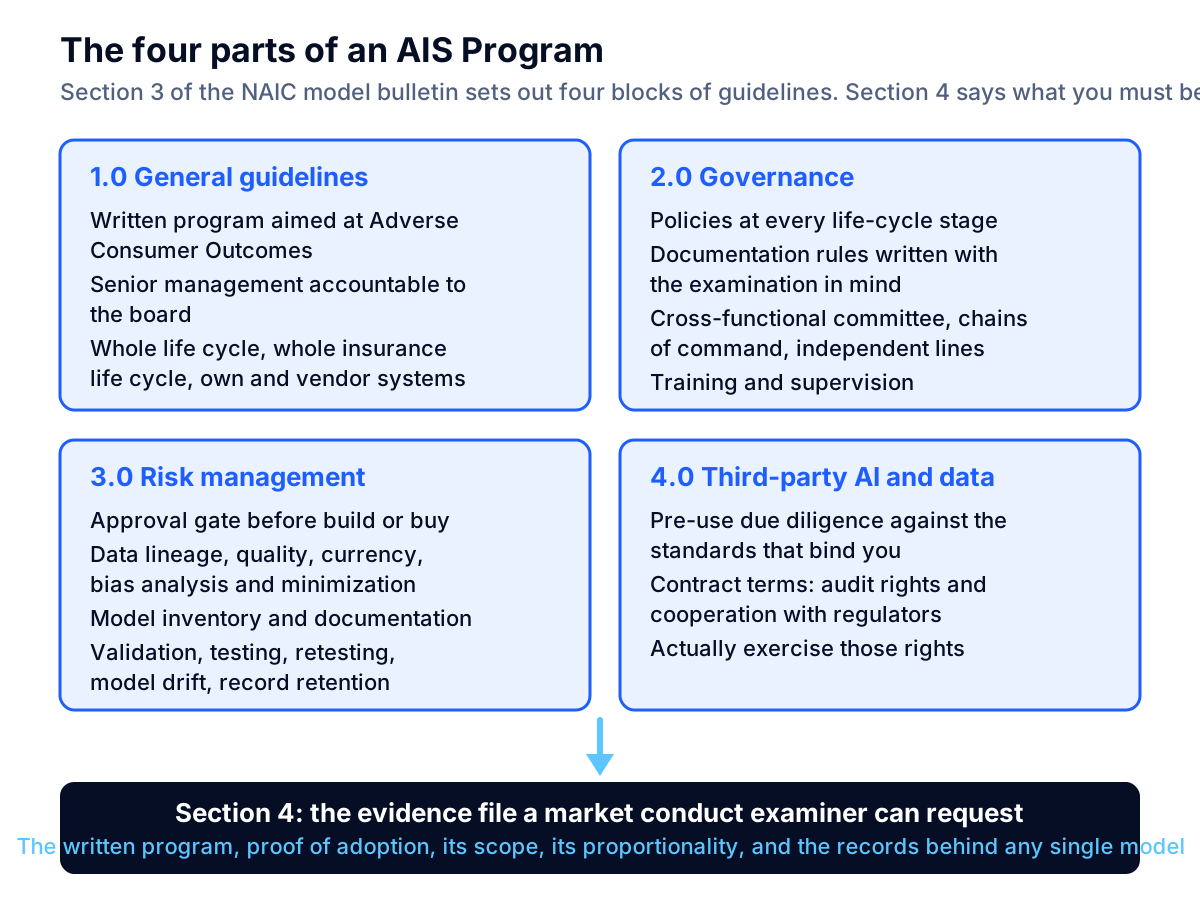
Section 3 is the operative part. Insurers are expected to develop, implement and maintain a written AIS Program for the responsible use of AI systems that make or support decisions related to regulated insurance practices, designed to mitigate the risk of what the bulletin calls an Adverse Consumer Outcome — a decision subject to regulatory standards that adversely affects a consumer in a way that violates those standards.
Section 4 then lists what a department may ask for during an investigation or market conduct action. Read in reverse, Section 4 is a document index. It tells you exactly which artifacts your program needs to produce.
Key takeaway: The bulletin does not create a new duty to use AI safely. It creates an expectation that you can prove you tried, in documents, on request.
Which states have adopted the NAIC AI model bulletin?
As of the NAIC's own implementation map dated August 31, 2026, 26 jurisdictions have adopted the model bulletin: 25 states and the District of Columbia. Four more — California, Colorado, New York and Texas — appear on the map under insurance-specific regulation or guidance rather than as bulletin adopters.
| Jurisdiction | Document | Adopted |
|---|---|---|
| Alaska | Bulletin B 24-01 | February 1, 2024 |
| Arkansas | Bulletin 13-2024 | July 31, 2024 |
| Connecticut | Bulletin No. MC-25 | February 26, 2024 |
| Delaware | Domestic and Foreign Bulletin No. 148 | February 5, 2025 |
| District of Columbia | Bulletin 24-IB-002-05/21 | May 21, 2024 |
| Hawaii | Insurance Commissioner Memorandum No. 2025-13A | December 10, 2025 |
| Illinois | Company Bulletin 2024-08 | March 13, 2024 |
| Iowa | Insurance Division Bulletin 24-04 | November 7, 2024 |
| Kentucky | Bulletin No. 2024-02 | April 16, 2024 |
| Maryland | Bulletin No. 24-11 | April 22, 2024 |
| Massachusetts | Bulletin No. 2024-10 | December 9, 2024 |
| Michigan | Bulletin 2024-20-INS | August 7, 2024 |
| Mississippi | Bulletin 2026-9 | July 22, 2026 |
| Nebraska | Insurance Guidance Document No. IGD-H1 | Issued June 11, 2024 |
| Nevada | Bulletin 24-001 | February 23, 2024 |
| New Hampshire | Bulletin Docket #INS 24-011-AB | February 20, 2024 |
| New Jersey | Insurance Bulletin No. 25-03 | February 11, 2025 |
| North Carolina | Bulletin No. 24-B-19 | December 18, 2024 |
| Oklahoma | Bulletin No. 2024-11 | November 14, 2024 |
| Pennsylvania | Insurance Notice 2024-04 | April 6, 2024 |
| Rhode Island | Insurance Bulletin No. 2024-03 | March 15, 2024 |
| Vermont | Insurance Bulletin No. 229 | March 12, 2024 |
| Virginia | Administrative Letter 2024-01 | July 22, 2024 |
| Washington | Technical Assistance Advisory 2024-02 | April 22, 2024 |
| West Virginia | Insurance Bulletin No. 24-06 | August 9, 2024 |
| Wisconsin | Insurance Bulletin | March 18, 2025 |
The pace tells you something the headline count hides. Twenty-one of those adoptions landed in 2024. Four came in 2025. Through August 31, 2026, only Mississippi had been added.
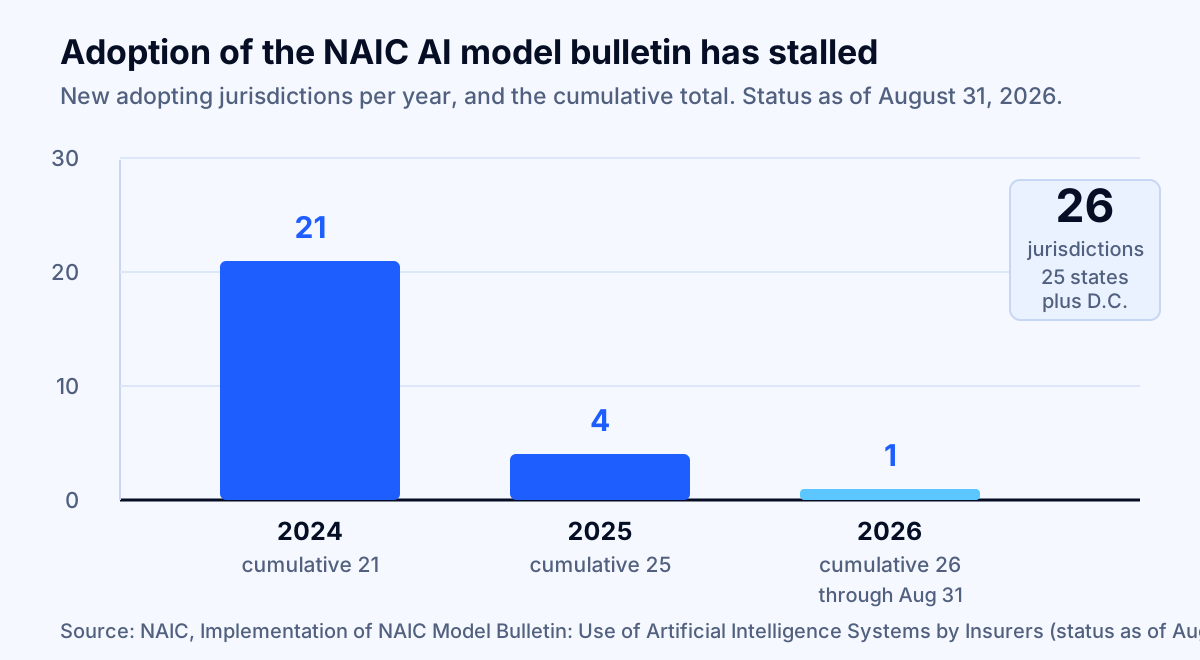
If you have been waiting for the map to fill in before starting, the map has stopped moving. Plan for the roughly 30 jurisdictions that now have something rather than for a future national sweep. And check your own state's document rather than the NAIC template: departments edit the text when they issue it, and Holland & Knight's review of the bulletin's scope notes that states have adopted it directly alongside a separate group that wrote their own rules.
The NAIC AI model bulletin checklist
Work this in order. Items are grouped to match the bulletin's own numbering so you can cite them in your program document.
1. General guidelines (bulletin 1.0)
- A single written AIS Program document exists, is dated, and has a version history.
- Its stated purpose is mitigating the risk of Adverse Consumer Outcomes, not "responsible AI" in the abstract.
- It covers governance, risk management controls and internal audit as three named areas.
- A named senior executive owns it and is accountable to the board or a board committee, with that reporting line written down.
- The program is explicitly proportionate to your use of AI, and says on what basis.
- It states whether it sits inside your enterprise risk management program or beside it.
- It names any external framework you rely on. The bulletin specifically allows the NIST AI Risk Management Framework version 1.0.
- Scope covers the whole insurance life cycle: product development and design, marketing, use, underwriting, rating and pricing, case management, claim administration and payment, and fraud detection.
- Scope covers the whole model life cycle: design, development, validation, implementation, use, monitoring, updating and retirement.
- Scope covers vendor systems as well as systems you built.
- There is a process for telling affected consumers that AI systems are in use, with the level of detail matched to the stage of the insurance life cycle.
2. Governance (bulletin 2.0)
- Policies and procedures exist for every life-cycle stage, from proposal to retirement.
- Documentation requirements are written with Section 4 in mind — that is, you decided in advance what an examiner would need.
- A cross-functional body oversees AI, with representatives from business units, product, actuarial, data science, underwriting, claims, compliance and legal.
- Scope of authority, chains of command and decision hierarchies are documented.
- Reviewers at later stages are independent of the people who built the model.
- Monitoring, auditing, escalation and reporting protocols are defined, with thresholds and named recipients.
- Ongoing training and supervision of staff who build or use these systems is in place.
- For predictive models specifically, there is a documented method for detecting and addressing errors, performance issues, outliers and unfair discrimination.
3. Risk management and internal controls (bulletin 3.0)
- An approval gate exists before any AI system is built, bought or switched on.
- Constraints and controls on automation are identified for each use case.
- Data practices cover currency, lineage, quality, integrity, bias analysis and minimization, and suitability.
- A model inventory exists, with descriptions and stated purposes.
- Each model has development and use documentation deep enough for someone else to follow.
- Assessments cover interpretability, repeatability, robustness, tuning, reproducibility, traceability, model drift, and whether those measurements are themselves auditable.
- Validation, testing and retesting are performed on implementation, including whether the training data was suitable.
- Non-public consumer information is protected, including against unauthorized access to the models themselves.
- Data and record retention periods are set.
- For predictive models, a narrative describes the model's intended goals and how it was developed and validated to meet them.
4. Third-party AI systems and data (bulletin 4.0)
- Due diligence is performed before acquiring third-party data or models, measured against the legal standards that apply to you, not to the vendor.
- Contracts provide audit rights or entitle you to audit reports from qualified auditors.
- Contracts require the vendor to cooperate with regulatory inquiries about your use of their product.
- You actually exercise those rights and keep the results.
5. Examination readiness (bulletin Section 4)
- You can produce the written program and evidence of its adoption within days, not weeks.
- You can state your program's scope, including any AI or technology you deliberately left out of it.
- You can show why the program is proportionate to your risk.
- You can produce policies, procedures, guidance and training materials.
- You can produce the model inventory limited to systems that can produce Adverse Consumer Outcomes.
- For any single model, you can produce its compliance documentation, data provenance and lineage, bias analysis, thresholds, and validation, testing and drift evaluation.
- For any vendor system, you can produce the diligence, the contract and any audits.
Key takeaway: The fastest way to fail an AI examination is not a bad model. It is a good model with no paper trail and no owner.
How to decide how much control each AI use case gets
The bulletin does not ask for the same rigor everywhere. It says controls should reflect the insurer's own assessment of risk, considering five things: the nature of the decision, the type and degree of potential harm to consumers, how much humans are involved in the final decision, how transparent and explainable the outcome is to the consumer, and how much you rely on third-party data, predictive models and AI systems.
Those five factors are a ready-made scoring rubric. Score each 1 to 3 for every use case, add them up, and let the total decide the control tier. The scoring bands below are our suggestion rather than the NAIC's, but the factors are the bulletin's own.
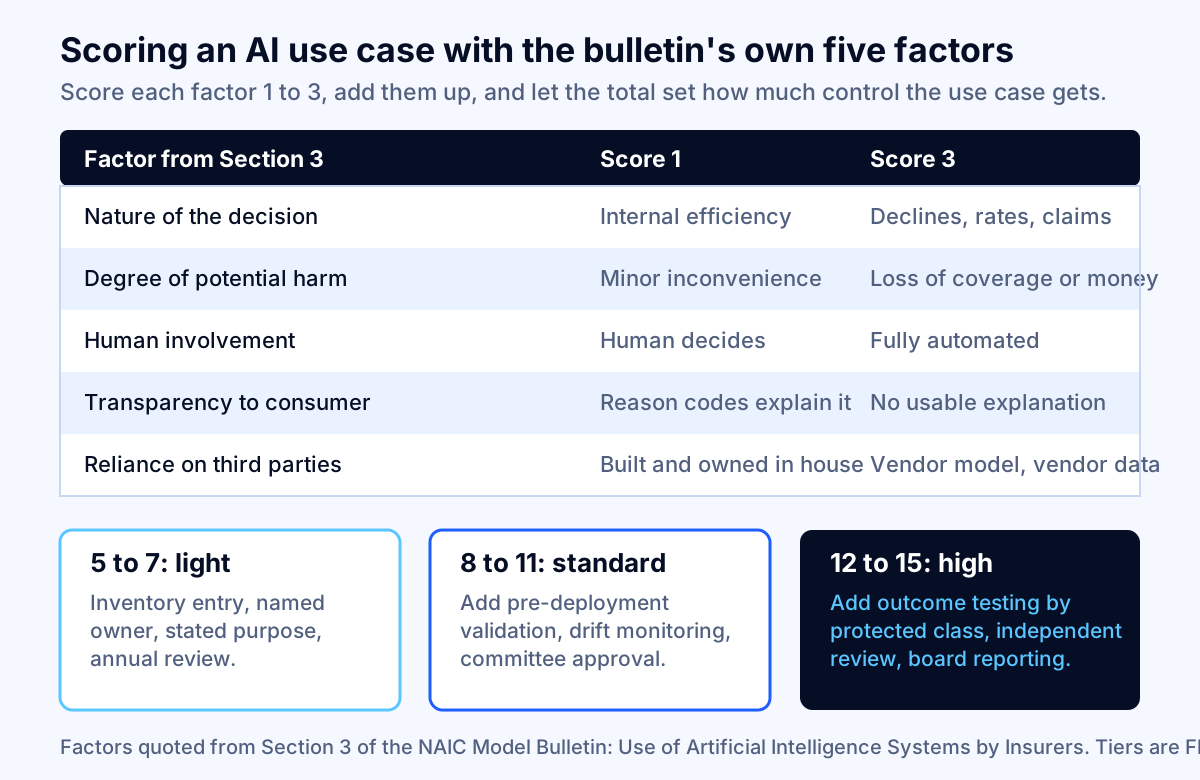
Two examples make the difference concrete.
A generative AI tool that drafts internal summaries of adjuster notes, reviewed by a human before anything is sent, scores low on almost every factor. It still belongs in the inventory with an owner and a stated purpose. It does not need protected-class outcome testing.
A vendor model that scores claims for referral to special investigations scores high on nature of decision, potential harm, third-party reliance and probably transparency. It needs everything: independent review, outcome testing, drift monitoring and a contract you can audit against.
The rubric also gives you something to say when a business unit wants a model live next month. The answer is not "no." It is "this scores 13, so here is the work."
What the bulletin means by unfair discrimination testing
This is where most programs are thinnest, and it is the part the bulletin returns to repeatedly. The NAIC Principles on Artificial Intelligence, adopted August 14, 2020 and referenced in the bulletin's first section, make the same point: AI actors must safeguard against outcomes that are unfairly discriminatory, and compliance is required whether the violation is intentional or unintentional.
The bulletin does not prescribe a test. It says to develop and use verification and testing methods that identify errors and bias in predictive models and AI systems, as well as the potential for unfair discrimination in the resulting decisions.
In practice that means three separate things that teams often collapse into one:
Input review. Are you using data that acts as a proxy for a protected class? Credit-based scores, geography, purchasing history and consumer-generated device data are the usual suspects. Colorado's regulation names exactly these categories in its definition of external consumer data and information sources.
Outcome testing. Do approval rates, rate levels, referral rates or denial rates differ across groups once legitimate risk factors are accounted for? This requires either inferred or collected demographic data, which is its own legal question in several states, and the answer differs by line of business.
Remediation and documentation. If you find a disparity, what did you do, and can you show the search for a less discriminatory alternative? New York's Insurance Circular Letter No. 7 (2024) is the most prescriptive published articulation of this in US insurance: it expects insurers to assess for disproportionate adverse effects, identify a legitimate lawful rationale where disparities appear, and document a search for less discriminatory alternatives, repeated annually. If you write to that standard, you are comfortably above the model bulletin's floor.
Note who owns the conclusion. Under the bulletin, the insurer is responsible for assuring that rates, rating rules and rating plans developed using AI techniques and predictive models are not excessive, inadequate or unfairly discriminatory. That duty does not move to the vendor that built the model.
The third-party problem the NAIC's own survey exposed
The most useful number in this area comes from the NAIC's own staff report on its health insurance AI/ML survey, fielded across 16 states from November 2024 to January 2025 with 93 responding companies.
| Finding | Share of respondents |
|---|---|
| Use AI/ML in some capacity | 84% |
| Use third-party components in their AI/ML systems | 55% |
| Use AI/ML for prior authorization approval | 68% |
| Use AI/ML for medical provider fraud detection | 51% |
| Use AI/ML for claims fraud detection | 50% |
| Use AI to deny prior authorizations | 12% |
| Use AI to infer sensitive data such as race | 14% |
| Have AI/ML governance principles modeled on the NAIC AI Principles | 92% |
| Third-party contracts contain terms limiting transparency to regulators | 13% |
Read the last two rows together. Ninety-two percent say their governance principles model the NAIC's. Thirteen percent have signed vendor contracts that would limit disclosure or transparency to regulators — the precise opposite of what bulletin item 4.2 asks for. A governance principle that your contracts contradict is not a control.
If you buy AI, the contract is the control. Three clauses do most of the work:
- Audit rights, or a right to receive audit reports from a qualified auditor, exercisable during the term and on reasonable notice.
- Regulatory cooperation, requiring the vendor to support inquiries about your use of their product, including producing documentation directly to the department where you ask them to. Colorado's regulation explicitly permits vendors to satisfy documentation requests by sending material to the Division on the insurer's behalf.
- Documentation delivery on a schedule: model cards, data provenance, validation results and change notifications, not just an annual attestation.
Renegotiating a live vendor contract is slow. Start with the two or three vendors whose models touch declines, rates or claim payments, and treat the rest at renewal. If you are designing the integration layer between those vendor models and your policy systems, the same discipline applies to the plumbing — see our notes on MCP server security and data access controls for how tool-level permissions get audited in practice.
What regulators are building next: the AI Risk Evaluation Supplement
The bulletin told insurers what to have. The NAIC is now building the instrument regulators will use to look at it.
The Big Data and Artificial Intelligence (H) Working Group ran a pilot of its AI Systems Evaluation Tool from March 2, 2026 through September 2026 with twelve states participating: California, Colorado, Connecticut, Florida, Iowa, Louisiana, Maryland, Pennsylvania, Rhode Island, Vermont, Virginia and Wisconsin. The tool is organized as four exhibits covering AI deployment, the governance risk framework, high-risk AI systems and AI data details.
The instrument has since been renamed the AI Risk Evaluation Supplement. Version 5.0 was exposed for a 30-day public comment period ending September 29, 2026. The working group's published charges for 2026 include supporting adoption of the model bulletin and developing tools and resources to help regulators review licensees' AI systems.
Two practical consequences:
The exhibits are a preview of the questions. If your program cannot populate a structured inventory of AI systems with risk classifications and governance attributes, you will be assembling that under deadline later. Build the inventory as a queryable record now, not as a spreadsheet someone maintains by hand.
"High-risk AI system" is becoming a defined category. Your internal tiering should be able to map onto whatever definition lands, which is another argument for scoring use cases on the bulletin's own five factors rather than inventing a private taxonomy.
Separately, the NAIC's Third-Party Data and Models work has narrowed its risk-based regulatory framework to focus on pricing and underwriting, and is still weighing a centralized vendor registry rather than licensure, according to Mayer Brown's summary of the Spring 2026 National Meeting. Nothing there is settled. Watch it, but do not wait for it.
The states that already ask for more than the bulletin
Four jurisdictions sit outside the bulletin count because they wrote their own rules. Two of them define the real ceiling.
Colorado. Regulation 10-1-1 (3 CCR 702-10) took effect November 14, 2023 and was amended effective October 15, 2025. It applies to insurers offering individually issued life insurance, private passenger automobile insurance and health benefit plans that use external consumer data and information sources. It is not guidance. It requires a documented governance and risk management framework with fourteen named components, board or board-committee oversight, a cross-functional governance group, an up-to-date inventory with version control, documented quantitative testing for unfair discrimination with respect to race, model drift monitoring, and an annual review. Reports go to the Division through SERFF, signed by an officer attesting to compliance, capped at ten pages. Life insurers have been filing since December 1, 2024. For private passenger automobile and health benefit plan insurers, the framework had to be available on request from July 1, 2026, with annual reports on the same date. An insurer that cannot attest has to file a corrective action plan.
New York. Circular Letter No. 7 (2024), issued July 11, 2024, applies to underwriting and pricing. It expects board and senior management responsibility for outcomes, quantitative testing using measures such as adverse impact ratios, a qualitative explanation of how the system works, annual repetition, vendor oversight with audit and cooperation rights, and disclosure to applicants of whether AI systems and external data were used, plus the information behind any adverse decision.
California and Texas also appear on the NAIC map with their own documents, which predate the model bulletin.
If you write in any of these states, build to their standard and the bulletin comes along for free. If you write in several bulletin states and one Colorado, write one program to the higher bar rather than four. Variation is a maintenance cost that compounds.
What this costs, and when to slow down
Honest trade-offs matter more here than in most compliance work, because the bulletin's proportionality language gives you real room.
Where the effort actually goes. For a mid-sized carrier with a handful of models, the program document is the smallest part. The inventory, the evidence trail and the vendor contracts are the work. Expect the first pass to surface AI you did not know you had: a marketing lead-scoring tool, a vendor's built-in triage feature, a chat assistant someone enabled inside an existing platform.
When not to build more. If your only AI is a vendor fraud score you bought three years ago, you do not need a committee, a charter and a testing lab. You need an inventory entry, a named owner, the vendor's documentation, a contract amendment and an annual review. Over-building the program is a real failure mode: it produces a binder no one maintains, which is worse evidence than a short program that is visibly alive.
Where it goes wrong. Three patterns recur. Programs written entirely by legal with no engineering input, which describe controls nobody implemented. Inventories that only list models built in house, missing the majority of what is actually deployed. And testing that is done once at launch and never repeated, which the bulletin's explicit references to retesting and model drift are designed to catch.
The federal question. Executive Order 14365, signed December 11, 2025, directs the Attorney General to establish an AI Litigation Task Force within 30 days to challenge state AI laws, directs Commerce to identify conflicting state laws within 90 days, and conditions some discretionary funding. It does not mention insurance, and it does not repeal anything. The model bulletin's foundation is unfair trade practice and rating law that long predates AI. Treat the preemption fight as a reason to monitor, not a reason to pause.
A 90-day plan to stand up an AIS Program
- Days 1–15: inventory. Ask every business unit what makes or influences decisions about applicants, policyholders or claims. Include vendor features. Record purpose, owner, data sources, whether a human decides, and which regulated practice it touches.
- Days 16–30: score and tier. Run each entry through the five factors. Publish the tiers. Most entries will land in the light tier, and that focuses everyone on the few that do not.
- Days 31–50: write the program. Draft to the checklist above, section by section, with the bulletin's numbering in the margin. Keep it short enough that people read it.
- Days 51–70: close the evidence gaps. For every high-tier use case, assemble the Section 4 file. Where documentation does not exist, that is your backlog.
- Days 71–90: vendors and governance. Send documentation requests to the vendors behind high-tier models, start contract amendments on audit rights and regulatory cooperation, hold the first governance meeting, and set the reporting cadence to the board.
Ninety days gets you a defensible program and an honest list of what is still missing. That list, maintained, is worth more to an examiner than a polished document that hides the same gaps.
Where to go from here
The bulletin is not hard to satisfy. It is hard to satisfy retroactively, because most of what it asks for is documentation that only exists if you created it while the work was happening. Teams that build the inventory and the evidence trail alongside the models spend a fraction of what teams spend reconstructing them under examination deadline.
If you are designing AI systems that touch underwriting, rating or claims, the governance work belongs in the build, not after it. That is the approach we take on AI compliance work for regulated industries, the same way an audit trail belongs in the design of any custom AI system rather than bolted on later. The pattern holds outside insurance too: our HIPAA-compliant AI development checklist makes the same argument for health data, and the analysis of SR 26-2 and bank model risk management shows how differently banking supervisors drew the line around generative AI.
Start with the inventory this week. If you want a second pair of eyes on the architecture behind a model that scores high on the rubric, talk to a specialist and we will look at it with you.
Frequently asked questions
Is the NAIC AI model bulletin legally binding?
The bulletin itself is not a law. It is a template that individual insurance departments issue under existing state statutes, and it says its goal is not to prescribe specific practices. What binds you is the underlying law it points to: unfair trade practices, unfair claims settlement practices, rating laws and market conduct authority. Failing to run an AIS Program is not itself a violation; producing an unfairly discriminatory outcome is.
How many states have adopted the NAIC AI model bulletin?
As of the NAIC's adoption map dated August 31, 2026, 26 jurisdictions had adopted it: 25 states plus the District of Columbia. Four more states (California, Colorado, New York and Texas) have their own insurance-specific AI regulation or guidance instead. Mississippi was the only new adoption in 2026 through August 31, so the map has been close to static for a year.
What is an AIS Program?
An AIS Program is the written program the bulletin expects every insurer to develop, implement and maintain for the responsible use of AI systems that make or support decisions about regulated insurance practices. It has to cover governance, risk management controls and internal audit, and it has to be proportionate to how much the insurer actually relies on AI.
Does the bulletin apply to generative AI?
Yes. The bulletin defines generative AI explicitly and its definition of an AI system includes systems that generate content such as text, images, video or sound. That is a meaningful contrast with bank supervision: SR 26-2 put generative and agentic AI outside its scope, while the insurance bulletin does not. A claims summarizer or a chat assistant that influences a regulated decision is in scope.
Do small insurers need an AIS Program?
The bulletin contains no asset or premium threshold. It applies to insurers holding a certificate of authority in an adopting state. What scales is the program, not whether you have one: the bulletin says controls should be proportionate to the insurer's use of AI and to the degree of potential harm to consumers, so a carrier with two vendor models writes a much shorter program than one running underwriting models in house.
What will a regulator actually ask for?
Section 4 lists it. The written program, evidence that it was adopted, its stated scope including AI it deliberately leaves out, evidence that it is proportionate, the underlying policies and training materials, your model inventory, documentation for the specific model under review, its data lineage and bias analysis, validation and drift testing, and, for vendor systems, the due diligence, the contract and any audits you performed.
Can we rely on the NIST AI Risk Management Framework instead?
Partly. The bulletin says an AIS Program may adopt or rely on a third-party standard such as the NIST AI Risk Management Framework version 1.0. NIST gives you the Govern, Map, Measure and Manage structure. It does not give you the insurance-specific parts: unfair discrimination testing against state standards, the rating and claims statutes, or the Section 4 evidence file. Use NIST as the skeleton and add the insurance law on top.
What should we do about the federal preemption effort?
Keep complying with state requirements. Executive Order 14365, signed December 11, 2025, directs a Justice Department task force to challenge state AI laws, but it does not repeal anything, it does not mention insurance, and the bulletin's foundation is ordinary unfair trade practice law rather than an AI statute. Confirm the position for your states with your own counsel.
Sources
- NAIC Model Bulletin: Use of Artificial Intelligence Systems by Insurers (adopted December 4, 2023), National Association of Insurance Commissioners
- Implementation of NAIC Model Bulletin: Use of Artificial Intelligence Systems by Insurers (adoption map and reference list), National Association of Insurance Commissioners
- NAIC Principles on Artificial Intelligence (adopted August 14, 2020), National Association of Insurance Commissioners
- Health Insurance Artificial Intelligence/Machine Learning Survey Results (NAIC staff report), National Association of Insurance Commissioners
- NAIC Survey Reveals Majority of Health Insurers Embrace AI, National Association of Insurance Commissioners
- Big Data and Artificial Intelligence (H) Working Group, National Association of Insurance Commissioners
- Colorado Insurance Regulation 10-1-1, Governance and Risk Management Framework Requirements (3 CCR 702-10), Colorado Secretary of State, Code of Colorado Regulations
- Insurance Circular Letter No. 7 (2024): Use of Artificial Intelligence Systems and External Consumer Data and Information Sources in Insurance Underwriting and Pricing, New York State Department of Financial Services
- AI Risk Management Framework, National Institute of Standards and Technology
- Executive Order 14365: Ensuring a National Policy Framework for Artificial Intelligence, The American Presidency Project, University of California, Santa Barbara
- NAIC Expands AI Systems Evaluation Tool Pilot Program to 12 States, Fenwick & West LLP
- US NAIC Spring 2026 National Meeting Highlights: Innovation, Cybersecurity and Technology (H) Committee Update, Mayer Brown
- The Implications and Scope of the NAIC Model Bulletin on the Use of AI by Insurers, Holland & Knight LLP