AI Agents
AI Agents for Logistics: 8 Freight Workflows, Systems and Costs
AI agents for logistics, workflow by workflow: what each freight agent does, the TMS, EDI and FMCSA systems it connects to, what it costs to run, and where it fails.

In this article
- What an AI agent actually does in a freight operation
- Eight AI agents for logistics, workflow by workflow
- Which systems a logistics AI agent must connect to
- What large logistics companies have proven, and what it means for mid-sized ones
- Carrier fraud: where agents help and where they add risk
- What AI agents for logistics cost to run
- Where AI agents in logistics fail
- Which logistics AI agent to build first: a scoring sheet
- A 90-day plan for your first logistics AI agent
- The bottom line
- Frequently asked questions
- Sources
Short answer: AI agents for logistics earn their keep in the work that arrives by email, phone and PDF: spot quotes, tenders that are not on EDI, dock appointments, status chasing, rate confirmations and proofs of delivery, carrier vetting, invoice matching and detention claims. Each of those is a narrow, repetitive job with a clear right answer most of the time, which is exactly what an agent can take over. What decides success is not the model. It is whether the agent can read and write to your transportation management system (TMS), and whether a person stays in charge of pricing, exceptions and anything involving money moving to a new account.
The evidence is no longer hypothetical. C.H. Robinson reported in June 2025 that more than 30 AI agents were deployed at scale across its network, including a quoting agent that had delivered over 1 million quotes in about 32 seconds each. Mid-sized brokers, 3PLs and shippers cannot copy that budget, but they can copy the pattern.
This guide covers eight freight workflows, the systems each one has to connect to, what the agents cost to run at October 2026 list prices, the fraud risks they create as well as reduce, and a 90-day plan for getting the first one into production.
What an AI agent actually does in a freight operation
An AI agent is software in which a large language model decides which steps to take and which tools to call to finish a task. In freight, the tools are your systems: look up the lane history in the TMS, check the carrier's authority, read the PDF attached to the email, write the order, reply to the customer.
That distinguishes an agent from two things logistics teams already have:
- Rules-based automation and EDI. A 204 load tender that arrives over EDI and creates an order automatically does not need an agent. The data is already structured and the logic is fixed.
- A chatbot. A bot on your website that answers "where is my shipment" by reading one tracking field is useful, but it does not take actions across systems.
Agents fit the gap between those two: work that is unstructured on the way in (an email saying "need a reefer Laredo to Chicago Thursday, what's your rate"), requires a few lookups and a judgment call, and ends in a structured action (a quote record, an order, a booked appointment). Freight is full of that work, which is why the industry has moved faster than most.
Key takeaway: If the input is already structured and the rules never change, use ordinary automation. If the input is a messy email, a phone call or a scanned document, an agent is the right tool.
Eight AI agents for logistics, workflow by workflow
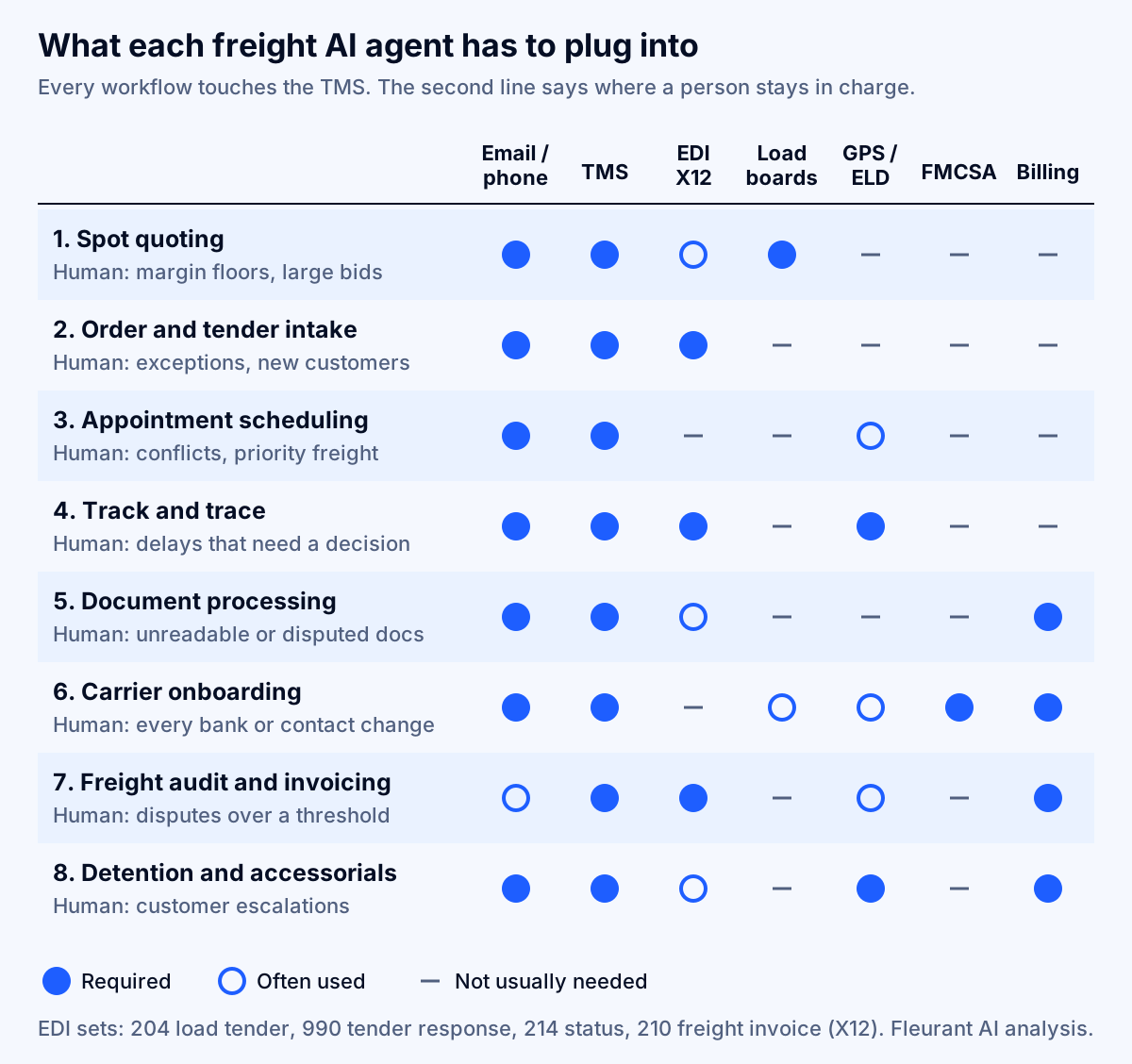
The figure below maps each workflow to the systems it must connect to and the point where a person stays in charge. Use it to scope a project before you talk to vendors: the more filled circles in a row, the more integration work.
1. Spot quoting from email
The job. Read an inbound rate request, extract origin, destination, equipment, dates and accessorials, price it from lane history and market rates, and reply within minutes. Speed matters: the first credible quote often wins the load.
Systems. Shared mailbox, TMS (customer, lane and margin history), rate data or load board feeds, and the quoting rules your pricing team already uses.
Where the person stays. Margin floors, large or unusual bids, new customers and lanes with no history. A good quoting agent returns a draft with its reasoning for anything outside the rules rather than sending it.
Evidence. C.H. Robinson's June 2025 update said its quoting agent "delivers customer-specific price quotes in just 32 seconds," with over 1 million quotes delivered.
2. Order and tender intake
The job. Turn tenders that arrive as emails, spreadsheets and PDFs into orders in the TMS, then confirm acceptance. Tenders on EDI already arrive as the X12 204, which X12 defines as the transaction used to offer "a shipment to a full load (truckload) motor carrier including detailed scheduling, equipment requirements, commodities, and shipping instructions," answered with a 990 response.
Systems. Mailbox, TMS order entry, and your EDI translator so the agent's orders and the EDI orders land in the same place with the same validation.
Where the person stays. Missing or conflicting details, new customers, hazmat and anything the validation rules reject.
Evidence. The same C.H. Robinson update described an orders agent "processing 5,500 truckload orders per day and saving 600 hours of labor daily," and said more than 75% of its less-than-truckload (LTL) orders were automated, up from 50% before the agent launched.
3. Appointment scheduling
The job. Book pickup and delivery appointments through facility portals, email and phone, then write the confirmed times back to the load. It is tedious, time-sensitive and spread across thousands of facilities with their own rules.
Systems. TMS, facility scheduling portals, email and phone, and ideally tracking data so the agent can reschedule when a truck is running late.
Where the person stays. Conflicts with no open slot, priority freight and facilities that require a human relationship.
Evidence. C.H. Robinson reported an appointments agent that "sets over 3,000 appointments daily across 43,000 locations in less than a minute."
4. Track and trace, including check calls
The job. Keep the shipment status current and tell customers before they ask. Where carriers send X12 214 shipment status messages or share GPS and electronic logging device (ELD) data, the agent watches the feed and acts on exceptions. Where they do not, it makes the check call or sends the text, records the answer and updates the load.
Systems. TMS, EDI 214, visibility or ELD feeds, phone and SMS, and customer notification channels.
Where the person stays. Any delay that needs a decision: recovering a load, re-powering, telling a customer their production line will wait.
Evidence. In a January 2026 release, C.H. Robinson said one agent "calls carriers about missed pickups and then another new AI agent decides what steps to take," that 95% of checks on missed LTL pickups had been automated, saving over 350 hours of manual work per day, and that unnecessary return trips had fallen by 42%.
5. Document processing
The job. Read rate confirmations, bills of lading, proofs of delivery, lumper receipts and carrier invoices, extract the fields, match them to the load and flag anything that does not match. This is the workflow with the clearest before-and-after, because the manual version is pure data entry.
Systems. Mailbox or document upload, TMS, and billing. Where trading partners use it, the NMFTA's eBOL API standard, now at version 2.1, lets shippers "create, update, and delete eBOLs" electronically for LTL freight, which removes the need to read a scan at all.
Where the person stays. Unreadable documents, mismatched weights or piece counts, and anything that could become a claim.
6. Carrier onboarding and fraud checks
The job. Collect the carrier packet, verify authority, insurance and safety data, compare details with what you already hold and flag anything suspicious before the first load.
Systems. FMCSA data, your carrier management tool, insurance certificates, load boards and billing. The FMCSA QCMobile API returns carrier safety and authority data in JSON by legal name, USDOT number or docket number, and requires a free API key.
Where the person stays. Every change to bank details, remit-to addresses, phone numbers or email domains. This is where fraud happens, and it is covered in its own section below.
7. Freight audit and invoicing
The job. Match carrier invoices to the rate confirmation, the delivery record and any approved accessorials, then approve, short-pay or dispute. On the customer side, build the invoice with every supporting document attached. Carriers on EDI send the X12 210, which X12 describes as providing "detail information for charges for services rendered by a motor carrier."
Systems. TMS, EDI 210, document store and accounting.
Where the person stays. Disputes above a threshold you set, and any carrier or customer relationship issue that a short-pay would trigger.
8. Detention and accessorial claims
The job. Use arrival and departure timestamps to identify detention, assemble the evidence and bill it, or check the carrier's detention charge before you pay it.
Why it matters. The American Transportation Research Institute's 2024 detention study found drivers reported being detained at 39.3% of stops in 2023, and that "while 94.5 percent of fleets charge detention fees, they are paid for fewer than 50 percent of those invoices." ATRI put the industry's losses at $3.6 billion in direct expenses and $11.5 billion in lost productivity. Much of the unpaid half is a documentation problem, which is the kind of problem an agent is good at.
Systems. Tracking or geofence data, EDI 214 timestamps, TMS, billing and customer contracts that define free time.
Where the person stays. Escalations with customers who dispute the charge.
Which systems a logistics AI agent must connect to
The matrix makes one point obvious: the TMS is in every row. If your TMS has a documented API that lets a service account read and write loads, quotes, carriers and documents, most of the eight workflows are buildable. If it does not, that limitation will set your timeline more than any model choice.
Before scoping any agent, answer these questions about each system:
| System | What to confirm before you build |
|---|---|
| TMS | Is there a read and write API? Can a service account be limited to specific actions? Are writes logged with the account that made them? |
| Email and phone | Which shared mailboxes and numbers will the agent use? Can it send from them, or only draft? How are calls recorded and disclosed? |
| EDI | Which partners send 204, 214 and 210 transactions? Will the agent's output go through the same translator and validation? |
| Load boards and rate data | Does your contract allow automated access? What are the rate limits? |
| Tracking (GPS and ELD) | Which carriers share data, through which provider, and how fresh is it? |
| FMCSA and identity data | Is the QCMobile API key in place? What other verification tools do you already pay for? |
| Billing and accounting | Can the agent create invoices and approvals as drafts that a person posts? |
Key takeaway: Integration, not intelligence, is the hard part. A capable model with read-only access to a TMS can draft. Only an agent with controlled write access can actually remove work.
Newer integration standards help here. Many teams now expose internal systems to agents through Model Context Protocol (MCP) servers, which turns each TMS action into a defined tool with its own permissions. If you go that route, read our guide to MCP server security best practices before an agent gets write access to loads or payments.
What large logistics companies have proven, and what it means for mid-sized ones
The largest brokers have moved from pilots to operations. C.H. Robinson's dated public figures are the most detailed:
| Date | What C.H. Robinson reported |
|---|---|
| June 2025 | More than 30 AI agents deployed at scale; contributed to a 30% increase in productivity since 2023 |
| June 2025 | Quoting agent: over 1 million quotes, about 32 seconds each |
| June 2025 | Orders agent: 5,500 truckload orders a day, 600 hours of labor saved daily |
| January 2026 | 95% of missed-LTL-pickup checks automated, over 350 hours saved per day, 42% fewer unnecessary return trips |
Others are following. J.B. Hunt said in a July 2026 announcement that Overroute's AI agents were in use by operators across all of its business units, describing a platform that "deploys specialized AI agents that operate inside tools freight teams already use." And on October 5, 2026, C.H. Robinson agreed to acquire RXO for an implied value of $5.8 billion, saying it expects about $300 million of net run-rate cost synergies within two years and plans to apply its "Lean AI model" to RXO's business. The deal is expected to close in the first half of 2027, subject to approvals.
The market data points the same way. Gartner forecast in April 2026 that supply chain management software with agentic AI will grow from less than $2 billion in 2025 to $53 billion in spend by 2030, and that 60% of enterprises using that software will have adopted agentic AI features by 2030, up from 5% in 2025.
What this means for a mid-sized broker or 3PL is less about matching the giants and more about margin. ATRI's July 2026 operating cost report put the average cost to operate a truck in 2025 at $2.336 per mile, the highest in the report's history, with truckload and refrigerated operating margins still below 1.0%. When the largest competitors can quote in seconds and run more loads per employee, the gap shows up in win rates and overhead, not in a press release.
Carrier fraud: where agents help and where they add risk
Freight fraud is the area where agents can do the most good and the most harm, so it deserves its own plan.
The threat is growing. Verisk CargoNet reported in January 2026 that estimated cargo theft losses in the United States and Canada surged to nearly $725 million in 2025, a 60% increase from 2024, and that confirmed cargo theft incidents rose 18%, from 2,243 to 2,646. The average value per theft rose to $273,990.
The registration system is changing. FMCSA launched Motus, its new registration system, in May 2026. The agency's announcement says it adds mandatory identity verification "utilizing government-issued IDs and digital facial scans," and its Federal Register notice says Motus will verify the identity of all new applicants and the approximately 800,000 existing registrants when they first access the system. FMCSA has also proposed retiring MC numbers in favor of the USDOT number, but its modernization FAQs say that change is still under consideration and will go through a proposed rule first. As of October 2026, MC numbers remain in use, so your agent should check both identifiers.
Brokers face stricter financial rules. Under FMCSA's broker and freight forwarder financial responsibility rule, whose remaining provisions took effect January 16, 2026, FMCSA suspends a broker's operating authority when its available financial security falls below $75,000. Losing money to a fraudulent payment is now an authority risk, not only a write-off.
Where agents help. An onboarding agent applies the same checks every time: authority status, safety data, insurance, how long the authority has existed, whether the phone and email match what was on file, and whether anything changed since the last load. People skip checks when they are busy. Software does not.
Where agents add risk. An agent that can update a carrier's bank details because an email asked it to is a fraud tool. Verisk CargoNet expects theft-by-deception groups to focus on "misdirecting shipments tendered to legitimate carriers, sidestepping compliance controls that have traditionally centered on the tendering process itself." In plain terms: vetting at onboarding is not enough, and an email from a familiar address is not proof of anything.
Rules to build in from day one:
- The agent can flag a change to remit-to, bank, phone, email domain or pickup details, but never apply one. A person confirms it through a known phone number.
- The agent cannot release a load to a carrier whose contact details changed since the rate confirmation without a person's approval.
- Every check the agent runs is logged with the data it saw, so you can show what was verified and when.
- Treat inbound emails as untrusted input. An agent that reads email can be manipulated by instructions hidden in that email, so it should never take a payment or release action on the strength of an email alone.
Key takeaway: Let agents do the checking. Never let them approve changes to where money or freight goes.
What AI agents for logistics cost to run
There are two cost lines: building and maintaining the agent, and running it. Buyers usually fixate on the second, which is the smaller one.
Running cost: model usage
The model is billed per token, a unit of roughly three-quarters of a word. Here is an illustrative quoting agent, using Claude API list prices as of October 2026. The assumptions are ours and should be replaced with your own measurements:
- Each quote request takes five model calls: classify the email, extract the shipment details, read the lane history, price it, and draft the reply.
- Each call sends about 6,000 input tokens (instructions, the email, retrieved history) and returns about 400 output tokens.
- No prompt caching or batch discount is assumed, so these figures are on the high side.
| Model mix | Cost per call | Cost per quote | 3,000 quotes a month |
|---|---|---|---|
| All five calls on Claude Sonnet 5.5 ($2 / $10 per million tokens) | $0.016 | $0.080 | $240 |
| Three simple calls on Claude Haiku 5.5 ($0.10 / $0.50), two on Sonnet 5.5 | mixed | $0.034 | $103 |
Even at the high end, the model bill is a few hundred dollars a month. Two cautions. First, Gartner predicted in August 2026 that AI inference costs per agentic workflow will increase more than fivefold through 2028, because more sophisticated workflows use far more tokens, so budget headroom and monitor usage per task. Second, voice calls for check calls and appointments add telephony and speech costs on top. Our guide to LLM API cost optimization covers caching, routing and batching, which can cut the token line substantially.
What the work costs today
Compare that with the labor it supports. The Bureau of Labor Statistics May 2025 wage data puts the median annual wage for cargo and freight agents at $52,260, across 97,670 jobs. In the June 2026 Employer Costs for Employee Compensation release, wages and salaries were 70.0% of private-industry compensation costs, so a loaded cost is roughly $74,700 a year, or about $36 an hour over 2,080 hours.
As an illustration only: if a manual spot quote takes eight minutes of an agent's time, it costs about $4.80 in loaded labor, against 3 to 8 cents in model usage. The math only becomes real when you measure your own handling time and win rate, which is why the 90-day plan below starts there.
Building and maintaining the agent
The larger cost is engineering: TMS and email integrations, pricing rules, testing against past cases, monitoring and ongoing changes as customers, carriers and systems change. Those costs depend on how many systems the agent touches and how much it is allowed to do on its own. Our AI agent development cost guide gives tiered ranges and a three-year total cost model, and how long it takes to build an AI agent covers realistic timelines.
Where AI agents in logistics fail
Gartner's supply chain team put it bluntly at its May 2026 symposium: over 80% of supply chain leaders expect funding increases with AI as the top investment, "but only 20% of warehousing and transportation AI initiatives achieve their goals." The failures are predictable:
- Bad source data. If lane history is incomplete, accessorials are recorded inconsistently and customer rules live in people's heads, the quoting agent will price badly. Clean the data the agent depends on first.
- Too much scope at once. An agent asked to quote, book, track and invoice from the first day becomes impossible to test. One workflow, measured properly, beats four half-working ones.
- No write access. Agents that can only draft into a queue still need a person to retype, and the savings disappear. Plan controlled write access from the start.
- No test set. Run the agent against several hundred past quote requests or documents with known correct answers before it touches live freight, and keep running that set after every change.
- Ignoring the people. Carrier reps and customers notice when replies are automated. Agents that are honest about being automated, transfer to a person quickly and hand off with full context keep the relationship intact.
- Treating launch as the end. Customers change contacts, facilities change portals, carriers change paperwork. Someone has to own the agent after go-live. Our guide on moving AI from pilot to production covers the ownership model that keeps agents working.
And the workforce question is real. In a Gartner survey published in February 2026, 55% of 509 supply chain leaders expected agentic AI to reduce the need to hire for entry-level positions. The entry-level roles are where future account managers learn the business, so plan how people will learn the work once agents handle the routine part of it.
Which logistics AI agent to build first: a scoring sheet
Score each candidate workflow from 0 to 2 on each row and start with the highest total.
| Factor | 0 | 1 | 2 |
|---|---|---|---|
| Volume per month | Under 200 | 200 to 2,000 | Over 2,000 |
| Share arriving unstructured (email, phone, PDF) | Mostly EDI | Mixed | Mostly unstructured |
| Clear right answer | Judgment every time | Rules cover most cases | Rules cover nearly all cases |
| TMS write access available | No API | Read-only or limited | Full API with scoped permissions |
| Measurable outcome | Hard to measure | Time saved only | Time saved plus revenue or recovered cash |
| Risk if wrong | Money or freight goes to the wrong party | Customer annoyance | Easily corrected internally |
For most mid-sized brokers and 3PLs, document processing, tender intake or spot quoting score highest. Carrier onboarding scores well on value but carries the highest risk, so it suits a second project once you have experience with controls and logging.
A 90-day plan for your first logistics AI agent
Days 1 to 15: measure the baseline. Pick one workflow from the scoring sheet. Measure volume, handling time per item, error rate and, for quoting, response time and win rate. Pull several hundred historical examples with known outcomes for a test set.
Days 16 to 30: map and secure the systems. Confirm the TMS API, mailbox access and any EDI, tracking or FMCSA connections from the table above. Create a service account with the minimum permissions the agent needs. Decide what the agent may do alone, what it drafts for approval, and what it must never do.
Days 31 to 45: build a working prototype. Build against the test set, not live freight. A focused prototype can be working in one to two weeks. Measure accuracy on the historical cases and review every miss with the people who do the work today.
Days 46 to 75: run in shadow mode, then supervised. Let the agent process live work in parallel while people keep doing it, and compare results. Then switch to supervised mode: the agent acts, a person approves. Track the approval rate and the reasons for every correction.
Days 76 to 90: go live with guardrails. Let the agent act on its own inside the rules where its accuracy has earned it, keep approvals for everything else, and set up monitoring for volume, accuracy, cost per task and escalations. Decide the next workflow based on what you measured.
If you are deciding whether to build this yourself, buy a packaged tool or combine both, our build vs buy AI agents guide works through the trade-offs with a three-year cost comparison. If your TMS lacks the API you need, a thin integration layer or a custom web application is often the fastest way around it.
The bottom line
AI agents for logistics are past the experiment stage at the largest brokers, and the work they automate (quotes, tenders, appointments, status, documents, carrier checks, invoices and detention) exists in every freight operation. The model is the cheap part. The value comes from connecting the agent to your TMS and other systems with controlled permissions, testing it on your own history, and keeping people in charge of pricing, exceptions and anything that moves money or freight.
Start with one high-volume, well-defined workflow, measure it before and after, and expand from evidence. Fleurant AI builds AI agents for operations teams, starting with a free discovery call and a working prototype in one to two weeks. If you want help scoring your workflows or mapping your systems, talk to a specialist, or see the rest of our services.
Frequently asked questions
What can AI agents actually do for a freight broker or 3PL today?
The proven jobs are the repetitive, email-and-phone ones: reading quote requests and returning a price, turning emailed or EDI tenders into orders, booking dock appointments, chasing status updates, reading rate confirmations and proofs of delivery, and checking carriers before they are onboarded. C.H. Robinson reported in June 2025 that its quoting agent had delivered over 1 million quotes, each in about 32 seconds. Pricing strategy, carrier relationships and exceptions still need people.
Will AI agents replace freight brokers or dispatchers?
They are replacing tasks faster than roles. In a Gartner survey of 509 supply chain leaders published in February 2026, 55% expected agentic AI to reduce the need to hire for entry-level positions. The work that remains is negotiation, judgment on exceptions and customer relationships. In practice, teams that adopt agents usually handle more loads per person rather than cutting experienced staff on day one.
How much does it cost to run an AI quoting agent?
Model usage is the small part. In our illustrative model, a quote that takes five model calls costs about 3 to 8 cents at Claude's October 2026 list prices, so 3,000 quote requests a month cost roughly $100 to $240 in tokens. The real costs are building the integrations to your TMS, email and rate data, testing against past quotes, and keeping the agent maintained. See our AI agent development cost guide for build ranges.
Do I need EDI to use AI agents in logistics?
No, but you need to know where EDI already works. Shippers with EDI send load tenders as X12 204 transactions and expect 990 responses, 214 status messages and 210 invoices back. Those flows are already structured, so an agent adds little there. The biggest wins are in the work that arrives by email, phone and PDF, where there is no structured feed at all.
Can an AI agent stop freight fraud and double brokering?
It can make the checks consistent: looking up a carrier's authority and safety data through FMCSA's free QCMobile API, comparing contact details against what you have on file, and flagging changes to bank or remit-to information. It cannot be the only control. Verisk CargoNet warned in January 2026 that fraud groups are shifting to misdirecting freight already tendered to legitimate carriers, so a person should confirm any change of payment or pickup details.
What systems does a logistics AI agent need to connect to?
Almost every freight agent needs read and write access to your transportation management system, plus your shared mailboxes and phone system. Depending on the workflow, it also needs EDI, load boards and rate data, GPS or ELD tracking feeds, FMCSA carrier data and your billing or accounting system. Mapping those connections before you pick a vendor is the most useful hour you can spend.
Should a mid-sized logistics company build or buy AI agents?
Buy for workflows your TMS vendor or a specialist tool already handles well, such as standard load board posting or document capture. Build when the agent has to follow your own pricing logic, work across several systems at once, or handle customer-specific rules that packaged tools ignore. Many companies do both. Our build vs buy AI agents guide has a decision matrix and three-year cost model.
Sources
- C.H. Robinson Scales Fleet of AI Agents Past 30, C.H. Robinson
- C.H. Robinson Lean AI Agents for LTL Pickup Efficiency, C.H. Robinson
- C.H. Robinson to Acquire RXO (Exhibit 99.1, Form 8-K), U.S. Securities and Exchange Commission (EDGAR)
- J.B. Hunt and Overroute announcement, July 21, 2026, J.B. Hunt Transport Services
- X12 Transaction Sets, X12
- Availability of Motus, FMCSA's New Registration System, Federal Register
- Secretary Duffy Launches New Anti-Fraud Registration System for America's Trucking Industry, Federal Motor Carrier Safety Administration
- Registration Modernization FAQs, Federal Motor Carrier Safety Administration
- QCMobile API documentation, Federal Motor Carrier Safety Administration
- Broker and Freight Forwarder Financial Responsibility; Extension of Compliance Date, Federal Register
- Cargo theft losses surge to estimated $725 million in 2025, Verisk CargoNet analysis reveals, Verisk
- New Research Documents Substantial Financial and Safety Impacts from Truck Driver Detention, American Transportation Research Institute
- New ATRI Report Details Accelerating Costs and Low Profitability Despite Cuts, American Transportation Research Institute
- eBOL API Standard, NMFTA Digital Standards Development Council
- Gartner Survey Shows 55% of Supply Chain Leaders Expect Agentic AI to Reduce Entry-Level Hiring Needs, Gartner
- Gartner Forecasts Supply Chain Management Software With Agentic AI Will Grow to $53 Billion in Spend by 2030, Gartner
- Gartner Supply Chain Symposium/Xpo Orlando, Day 3 Highlights, Gartner
- Gartner Predicts AI Inference Costs per Agentic Workflow Will Increase More Than Fivefold Through 2028, Gartner
- Occupational Employment and Wage Statistics (OEWS) Tables, May 2025, U.S. Bureau of Labor Statistics
- Employer Costs for Employee Compensation, June 2026, U.S. Bureau of Labor Statistics
- Claude API pricing, Anthropic


