AI Agents
Build vs Buy AI Agents: Decision Matrix and 3-Year Cost Model
Build vs buy AI agents, decided with numbers: an 8-factor decision matrix, a 3-year cost model for buying, hybrid and custom, and the volume where each wins.

In this article
- What "build", "buy" and "hybrid" actually mean for AI agents
- What the research says about building vs buying AI
- The build vs buy AI agents decision matrix
- What does each route cost over three years?
- How AI agent pricing meters change the build vs buy answer
- The hidden costs and risks of each route
- Build vs buy for regulated industries
- How to keep your options open after you choose
- A 30-day plan to make the build vs buy AI agents decision
- The bottom line
- Frequently asked questions
- Sources
Short answer: The build vs buy AI agents decision comes down to three things: how much of the agent's value depends on your own systems and rules, how many tasks it will handle, and whether anyone in your company can own it after launch. Buy when the job is common and the volume is modest. Build when the agent is core to how you compete, must act inside systems no vendor supports, or runs at a volume where per-use fees outgrow a fixed build cost. For most mid-sized companies the right answer is a hybrid: buy the platform, build the parts that make you different.
Most build-versus-buy articles stop at a pros-and-cons list. This one gives you two tools you can use in a meeting this week:
- An 8-factor decision matrix that turns the debate into a score, with knockout rules for the cases where scoring does not matter.
- A three-year total cost model for buying, hybrid and custom routes, using published vendor prices and US wage data, with every assumption stated so you can replace it.
In our worked example, buying is cheapest below about 5,100 conversations a month, a hybrid is cheapest from there to about 9,300, and a custom build is cheapest above that. A note on bias: Fleurant AI builds custom agents, so we have set the model up for you to check rather than trust.
What "build", "buy" and "hybrid" actually mean for AI agents
The phrase "build vs buy" hides at least five different purchases. Vendors blur them on purpose, so name the one you are evaluating before you compare prices.
| Route | What you get | Typical example | What you still own |
|---|---|---|---|
| Buy: embedded agent | Agent features inside software you already use | The AI agent in your CRM, help desk or office suite | Configuration, knowledge content, user training |
| Buy: point solution | A standalone agent for one job, often priced per outcome | Customer support agents billed per resolved conversation | Knowledge base, escalation rules, quality review |
| Configure: low-code platform | A builder for your own agents, billed by usage | Microsoft Copilot Studio, Salesforce Agentforce Builder | Agent design, testing, connectors, governance |
| Hybrid | Vendor platform or model API, plus custom integrations, rules and tests | A platform agent that calls your custom order system through your own API | Everything specific to your business |
| Build: custom | An agent written on top of model APIs or open models | Your code, your cloud account, your evaluation suite | All of it, including maintenance |
Two definitions matter for the rest of this article. An AI agent is software in which a language model decides which steps to take and which tools to call to finish a task, rather than following a fixed script. Anthropic's engineering guide draws the line between workflows, which are predefined code paths, and agents, where the model directs "its own processes and tool usage" in its guidance on building effective agents. That same guide recommends "finding the simplest solution possible, and only increasing complexity when needed," which is the most useful sentence in the whole debate: many problems sold as agent projects only need a workflow.
Total cost of ownership (TCO) is everything you pay over the life of the system: setup, licenses or usage, cloud and model fees, and the staff time to run and improve it. For AI agents, staff time is usually the largest line, whichever route you choose.
Key takeaway: "Buy" rarely means zero work. Every route leaves you owning the knowledge, the rules and the quality checks. The real question is who owns the code and the runtime.
What the research says about building vs buying AI
Four recent studies are cited constantly in this debate. Each is useful, and each is often quoted beyond what it supports.
Buying has become the default. Menlo Ventures' survey of 495 US enterprise AI decision-makers, fielded in November 2025, found that 76% of AI use cases are purchased rather than built internally, up from a 2024 split in which 47% of solutions were built internally and 53% purchased. The same 2025 State of Generative AI in the Enterprise report says 47% of AI deals reach production, compared with 25% for traditional software-as-a-service deals.
Internal builds have struggled more. MIT's Project NANDA report, The GenAI Divide: State of AI in Business 2025, found that external partnerships with "learning-capable, customized tools" reached deployment about 67% of the time, compared with about 33% for internally built tools. It is based on interviews with 52 organizations, surveys of 153 leaders and a review of over 300 public AI initiatives between January and June 2025. The authors are candid about the limits: the figures are self-reported, success definitions varied, and the gap "may reflect organizational capabilities rather than implementation approach alone." They also note there was not enough data to measure hybrid build-buy efforts.
Most organizations land in the middle. Anthropic's 2026 State of AI Agents report, based on a late-2025 survey of over 500 US technical leaders with research firm Material, found that 47% combine off-the-shelf agents with custom-built components, 21% rely entirely on pre-built agents and 20% build their own. Integration challenges were the most cited barrier, at 46%. Anthropic sells models used for custom builds, so read its framing with that in mind; the hybrid finding matches the other studies.
Many agent projects will be canceled either way. Gartner predicts that over 40% of agentic AI projects will be canceled by the end of 2027 "due to escalating costs, unclear business value or inadequate risk controls." In the same June 2025 release, Gartner warns about "agent washing," the rebranding of chatbots and robotic process automation as agents, and estimates that only about 130 of the thousands of agentic AI vendors are real.
How to read these numbers honestly
Taken together, the research says two things. First, companies without experience shipping AI tend to fail more often when they build from scratch than when they buy or partner. Second, buying does not protect you from the bigger risks: unclear value, rising costs and weak controls cancel bought projects too. None of these studies compares three-year costs, and none measures whether an agent is your competitive advantage. That is what the next two sections are for.
The build vs buy AI agents decision matrix
Score each factor from 1 to 5 for the specific workflow you are considering, not for AI in general. A 1 points toward buying; a 5 points toward building. Add the eight scores.
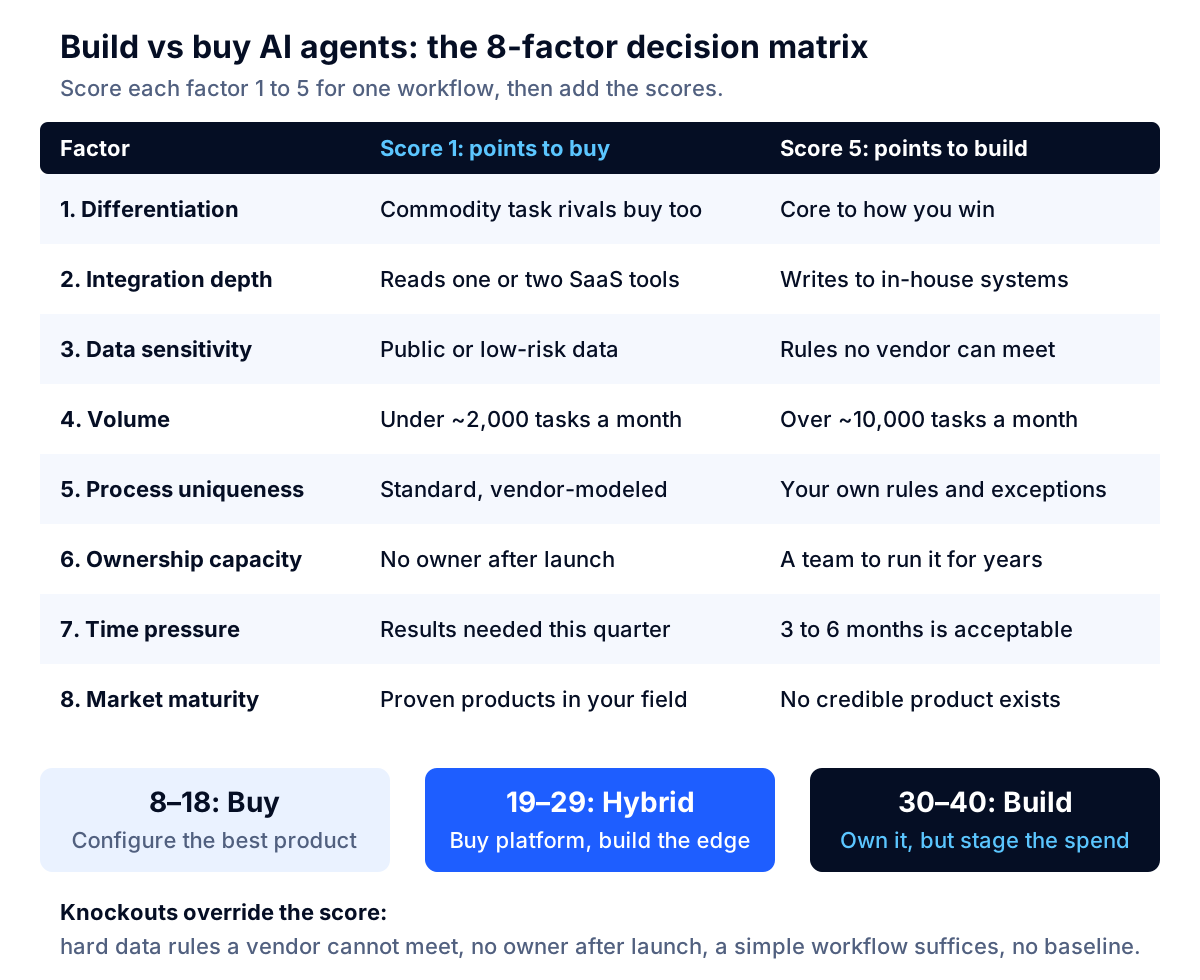
| Factor | Score 1 (buy) | Score 3 (hybrid) | Score 5 (build) |
|---|---|---|---|
| 1. Differentiation | Commodity task your competitors also buy | Better service, but not why customers choose you | Core to how you win or what you sell |
| 2. Integration depth | Reads from one or two mainstream SaaS tools | Writes to mainstream tools through documented APIs | Writes to legacy or in-house systems, or chains many systems |
| 3. Data sensitivity | Public or low-risk data | Customer data with standard contract protections | Regulated data, strict residency or no-training requirements a vendor cannot meet |
| 4. Volume | Under about 2,000 tasks a month | About 2,000 to 10,000 a month | Over about 10,000 a month, and growing |
| 5. Process uniqueness | Standard process the vendor already models | Standard process with your own exceptions | Rules, approvals and exceptions specific to your business |
| 6. Ownership capacity | No one to own it after launch | A product owner and part-time technical help | An engineering team that can run it for years |
| 7. Time pressure | Results needed this quarter | Two to three months is acceptable | Three to six months is acceptable for the right outcome |
| 8. Market maturity | Proven products with references in your industry | Products exist but need heavy configuration | No product does this credibly |
Reading the total:
- 8–18: Buy. Pick the best product, configure it well and put your effort into knowledge content and measurement.
- 19–29: Hybrid. Buy the platform or model, build the integrations, business rules and tests that encode how you work.
- 30–40: Build. Own the agent end to end, but stage the investment so a prototype proves value before the full build.
The volume thresholds in factor 4 come from the cost model in the next section. Replace them with your own crossover points once you have quotes.
Knockout rules that override the score
Some answers end the discussion regardless of the total:
- If no vendor can meet a hard data or regulatory requirement, do not buy that component, whatever the score says. Building only the regulated part (a hybrid) is often enough.
- If no one will own the agent after launch, do not build. An unowned custom agent decays as models, prompts and connected systems change. Buy, or fund ownership first.
- If a simple workflow solves the problem, build neither an agent nor a platform. Gartner's advice is to use "AI agents when decisions are needed, automation for routine workflows and assistants for simple retrieval."
- If you cannot measure success, do not commit to any route yet. Define the baseline first: volume, handling time, error rate and cost per task.
A worked scoring example
Consider a regional distributor that wants an agent to answer order-status and returns questions and to create return authorizations in its in-house order system. Scores: differentiation 2 (customers value fast answers but do not choose the distributor for them), integration 5 (it must write to an in-house system with no vendor connector), data sensitivity 2, volume 3 (about 6,000 conversations a month), process uniqueness 4 (return rules vary by product line and customer contract), ownership 3, time pressure 2, market maturity 3. Total: 24, a hybrid.
The decision that follows is specific: buy the conversational agent from the help desk or CRM platform, and build the order-system integration and return-rules logic as a service the agent calls. That is a much smaller build than a custom agent, and the company keeps the part no vendor can provide.
What does each route cost over three years?
Here is one workload priced three ways, using published list prices as of October 2026. The workload is a customer-facing service agent handling conversations that each need about three actions (for example: look up an order, check a policy, update a case).
Shared assumptions
- Staff cost. The US Bureau of Labor Statistics reports a median software developer wage of $135,980 as of May 2025. In private industry, wages are 70.0% of total compensation according to the June 2026 Employer Costs for Employee Compensation release, so a fully loaded engineer costs about $194,257 a year, or $93.39 an hour.
- External engineering rate. We assume $150 an hour for outside development. This is a planning assumption, not a quote; replace it with the rates you receive.
- Three-year horizon, with volume flat. Internal staff time on business review, change management and help desk seats is excluded because it is similar across the routes.
The three routes
Route A: Buy a point solution priced per outcome. Intercom lists its Fin AI agent at $0.99 per outcome, where an outcome counts when a customer confirms the issue is resolved, stops asking for help after Fin responds, or Fin completes a workflow. We assume 60% of conversations produce a billable outcome. Setup is 120 hours of internal time for knowledge cleanup, configuration and testing ($11,207), and ongoing administration is 0.1 of an engineer or analyst ($58,277 over three years).
Route B: Hybrid on a platform priced per action. Salesforce lists Agentforce Flex Credits at $500 per 100,000 credits, with each Agentforce action costing 20 credits, which works out to $0.10 per action, so $0.30 per three-action conversation. We assume you already license the platform, and add six weeks of external engineering ($36,000) to build custom integrations and business rules, plus 0.15 of an engineer to maintain them ($87,416 over three years).
Route C: Custom build on a model API. Twelve weeks of external engineering ($72,000), which sits in the middle of the production range in our AI agent development cost guide. Model usage on Claude Sonnet 5 at $2 per million input tokens and $10 per million output tokens, assuming four model calls per conversation at 6,000 input and 500 output tokens each: $0.068 per conversation. Hosting, logging and evaluation tooling: an assumed $750 a month. Maintenance: 0.175 of an engineer ($101,985 over three years).
Three-year cost at 5,000 conversations a month
| Cost line, 3 years | A: Buy (per outcome) | B: Hybrid (per action) | C: Custom build |
|---|---|---|---|
| Setup or build | $11,207 | $36,000 | $72,000 |
| Usage fees (vendor or model) | $106,920 | $54,000 | $12,240 |
| Hosting and tooling | Included | Included | $27,000 |
| Administration and maintenance | $58,277 | $87,416 | $101,985 |
| Three-year total | $176,404 | $177,416 | $213,225 |
| Usage as a share of total | 61% | 30% | 6% |
At this volume, buying and the hybrid cost the same, and the custom build costs about 20% more. That is a typical result in the middle of the volume range, and it is why cost alone rarely settles the decision. The structure of the costs is the more important finding: about 61% of the bought route is usage fees that scale with every conversation, while 94% of the custom route is fixed.
Where the crossover points fall
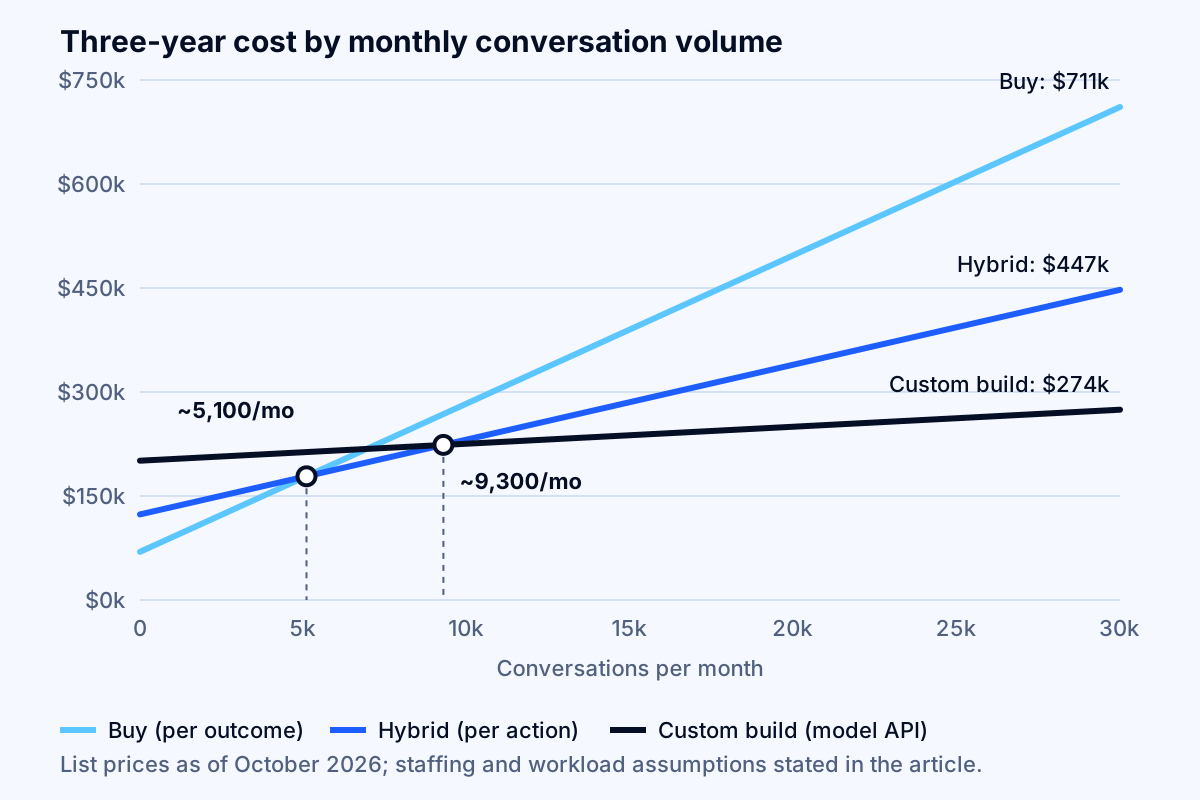
Because each route has a different mix of fixed and per-use cost, the cheapest option changes with volume:
| Monthly conversations | A: Buy | B: Hybrid | C: Custom build | Cheapest |
|---|---|---|---|---|
| 1,000 | $90,868 | $134,216 | $203,433 | Buy |
| 2,500 | $122,944 | $150,416 | $207,105 | Buy |
| 5,000 | $176,404 | $177,416 | $213,225 | Buy (tie with hybrid) |
| 10,000 | $283,324 | $231,416 | $225,465 | Custom build |
| 20,000 | $497,164 | $339,416 | $249,945 | Custom build |
In this model, buying is cheapest below about 5,100 conversations a month, the hybrid is cheapest from about 5,100 to 9,300, and a custom build is cheapest above about 9,300. At 20,000 conversations a month, the bought route costs about twice as much as the custom build over three years.
What would change these results
- The billing meter. Agentforce also offers $2 per conversation for customer-facing agents. At 5,000 conversations a month, that meter alone is $360,000 over three years, compared with $54,000 using Flex Credits at three actions per conversation. The same product can be the cheapest or most expensive option depending on how you are billed.
- Resolution rate. Outcome pricing only charges for successful conversations, which is fair, but it also means your bill rises as the agent gets better.
- Model choice and caching. A smaller model or prompt caching can cut Route C's model costs sharply; our guide to LLM API cost optimization covers the levers. At low volume, model fees are too small to matter.
- Maintenance. The largest line in the custom route is people. A team that cannot keep maintenance near a fifth of an engineer will see its crossover point move higher.
- Negotiated prices. List prices are a starting point. Enterprise discounts on per-use pricing push the crossover points up; cheaper outside engineering pushes them down.
Key takeaway: Buying converts AI into a variable cost; building converts it into a fixed cost. Below your crossover volume, variable is cheaper. Above it, fixed wins, if you can staff it.
How AI agent pricing meters change the build vs buy answer
Vendors price AI agents in at least five ways. Before comparing products, convert every quote to a cost per completed task at your expected volume.
| Pricing meter | Published example (October 2026) | What it rewards | What to watch |
|---|---|---|---|
| Per outcome | Intercom Fin: $0.99 per outcome | Paying only for results | Definition of an "outcome," and a bill that rises as quality improves |
| Per conversation | Agentforce: $2 per conversation | Simple budgeting | Long or multi-topic conversations cost the same as quick ones, in both directions |
| Per action or credit | Agentforce Flex Credits: 20 credits ($0.10) per action; Copilot Studio: $200 for 25,000 credits a month | Paying for work done | Actions per task grow as you add features; credits can expire |
| Per user | Agentforce add-ons: $125 per user per month | Predictable cost for internal agents | Paying for users who rarely use the agent |
| Per token | Claude Sonnet 5: $2 input, $10 output per million tokens | Lowest unit cost at scale | You carry the engineering and the risk of runaway usage |
Microsoft's Copilot Studio billing rates show how the credit meter works in practice: a classic (pre-written) answer costs 1 credit, a generative answer 2 credits, an agent action 5 credits, and grounding a message in your Microsoft 365 data 10 credits. At the $200 pack price for 25,000 credits, a credit costs $0.008, so an agent action is $0.04 and a tenant-grounded generative answer is $0.096. Microsoft notes that employee-facing use by staff who hold Microsoft 365 Copilot licenses is not charged credits, within fair-use limits, which can make the platform route very inexpensive for internal agents if those licenses are already paid for.
Read the enforcement terms as carefully as the price. Microsoft states that when a tenant reaches 125% of its prepaid capacity, custom agents are disabled until capacity is increased, unless you have set up pay-as-you-go billing. Salesforce states that unused Flex Credits do not roll over into the next subscription term. Neither is unreasonable, but both belong in your cost model and your operating plan.
The hidden costs and risks of each route
Risks of buying
- Meter creep. Every new feature adds actions per task. Track cost per completed task monthly, not just the invoice total.
- Agent washing. Gartner's estimate that only about 130 agentic AI vendors are real means many "agents" are chatbots with new labels. Ask for a live demonstration on your own data, not a recorded one.
- Limited fit. Off-the-shelf agents work best for processes the vendor already models. Your exceptions are where they fail, and exceptions are often where the cost sits.
- Lock-in. Your prompts, knowledge structure, test cases and conversation history can be hard to move. Negotiate export rights before you sign.
- Model changes you do not control. Vendors upgrade underlying models. Ask how you will be notified and whether you can test before a change reaches your customers.
Risks of building
- The success-rate gap. MIT NANDA's roughly 33% deployment rate for internal builds is a warning about inexperience. If your team has not shipped an agent before, budget for outside help or a smaller first scope.
- Maintenance is the real bill. In our model it is about half of the custom route's three-year cost. Evaluation, monitoring, prompt updates and integration fixes do not stop at launch.
- Security work. Agents that take actions need scoped permissions, approval steps for risky actions and protection against prompt injection. Our MCP server development cost guide prices the permissions, audit logging and security review that agents need when they connect to internal systems.
- Talent concentration. A custom agent that one engineer understands is a risk. Require documentation and a test suite as part of the build.
Risks of the hybrid route
- Two sets of limits. You inherit the platform's constraints and your own code's maintenance.
- Vendor-built customization you cannot run. Gartner predicted in September 2026 that by 2028, 70% of enterprises will abandon agentic AI built by vendor "forward-deployed engineering" teams, "trapped by soaring costs and unable to evolve it on their own." Its advice is to settle governance, intellectual property rights, knowledge transfer and an exit strategy before signing, and to execute the exit plan rather than extending the engagement.
That last point applies to any outside builder, including firms like ours. The test of a good engagement is whether your team can run and change the agent after the builders leave.
Build vs buy for regulated industries
Banks, insurers, healthcare organizations and their vendors face an extra constraint: outsourcing a task does not outsource the responsibility for it. For banks, the federal agencies' interagency third-party risk management guidance, issued by the OCC as Bulletin 2023-17 in June 2023, states that a bank's use of third parties "does not diminish its responsibility" to meet legal and safety-and-soundness requirements, and sets out a life cycle of planning, due diligence and third-party selection, contract negotiation, ongoing monitoring and termination. A bought AI agent goes through that life cycle like any other critical vendor. In September 2026 the agencies proposed replacement guidance; our AI vendor risk assessment guide summarizes what it would change and includes a 42-question due diligence questionnaire.
In practice, regulated companies should expect three things:
- Buying shifts work, not accountability. You still need documentation of how the agent decides, what data it uses and how it is tested. If the vendor cannot provide it, your compliance team will have to produce it some other way.
- The regulated part is often the part to build. A common hybrid is a bought conversational layer with a custom-built decision or data-access layer that keeps protected data inside your environment, logs every decision and enforces approval rules.
- Logging is not optional. Whichever route you choose, make sure you can reconstruct what the agent saw, decided and did. Our guide to AI audit trail requirements lists what to capture.
Requirements vary by industry and state, so confirm the specifics with your counsel or compliance team. If you need help building controls around AI, our AI compliance page explains how we approach it.
How to keep your options open after you choose
The build vs buy decision is not permanent. Volume grows, products improve and prices change. The cheapest insurance is to own the assets that make switching possible:
- Your evaluation set. A few hundred real tasks with the correct outcome, used to test any agent, bought or built. It is the single most portable asset you can create.
- Your knowledge base, in a format you control, not only inside the vendor's tool.
- Your integration layer. Expose internal systems through your own APIs or Model Context Protocol (MCP) servers, the open standard many agent platforms now use to connect to tools, so a new agent can use them without a rebuild.
- Your logs and metrics: conversation records, cost per task and resolution rates, exportable on demand.
- Contract terms: data export, notice of model changes, price protection on usage meters and transition assistance.
Set a review trigger in advance. For example: "Revisit the decision if monthly volume passes 9,000 conversations or the vendor raises per-use prices by more than 20%." That turns a future argument into a scheduled check.
A 30-day plan to make the build vs buy AI agents decision
You do not need a six-month study. A focused month gives you enough evidence.
Week 1: Define the job. Pick one workflow. Measure the baseline: monthly volume, average handling time, error rate and cost per task. Write down the systems the agent must read from and write to.
Week 2: Score and shortlist. Run the decision matrix with the people who own the process, IT and compliance in the room. Apply the knockout rules. Shortlist two products (if the score is under 30) and request pricing at your actual volume on each available meter.
Week 3: Test on your data. Run each shortlisted product, or a quick custom prototype, against 50 to 100 real past cases with known correct outcomes. Working prototypes on real data take one to two weeks for most agents; our timeline guide on how long it takes to build an AI agent explains what fits in that window.
Week 4: Model the cost and decide. Put the real quotes and test results into the three-year model. Choose the route, write down the review trigger and agree on the success metric for the first 90 days.
If you choose an outside builder, use a structured selection process; our guide on how to hire an AI agent development company includes a 30-point scorecard and the contract terms to settle first. This is also how we run our own AI agent development engagements: a free discovery call, working prototypes in one to two weeks and a risk-free proof of value before any larger commitment.
The bottom line
Build vs buy for AI agents is a decision about where your advantage lives and how your costs scale. Buy the commodity work, especially at low volume. Build what is unique, regulated or high-volume. For most mid-sized companies, a hybrid that buys the platform and builds the integrations and rules is the best balance.
Three steps to take next:
- Score your top candidate workflow on the eight-factor matrix and apply the knockout rules.
- Get pricing at your real volume on every meter the vendor offers, and rerun the three-year model with those numbers.
- Test the shortlist on 50 to 100 of your own past cases before you sign anything.
If the answer points to a custom or hybrid build, our custom AI development and AI agent teams can help you scope it, and if a bought platform's usage fees are already climbing, cloud cost optimization is where the savings usually start. Want a second opinion on your scores or a vendor quote? Talk to a specialist, or see everything we build on the Fleurant AI home page.
Frequently asked questions
Is it cheaper to build or buy an AI agent?
Buying is usually cheaper at low volume and building is usually cheaper at high volume, because bought agents charge per conversation, action or outcome while a custom agent's cost is mostly fixed. In the worked model in this article, buying wins below about 5,100 conversations a month, a hybrid wins from there to about 9,300, and a custom build wins above that. Your crossover points will differ, so rerun the model with your own quotes.
Should a small business build custom AI automation or use the AI built into its CRM?
Start with what your CRM or help desk already includes, because you are paying for that platform anyway and its agent features can be switched on in days. Build only the part the platform cannot do well, such as acting in a legacy system or applying rules unique to your business. If your volume is a few hundred items a month, a custom build rarely pays back; our guide to AI agents for small business works through that math.
What is a hybrid AI agent strategy?
A hybrid strategy buys the commodity layers and builds the parts that make you different. Typically you use a vendor platform or model API for the agent runtime and conversation handling, then build your own integrations, business rules, evaluation tests and guardrails. Anthropic's 2026 survey of over 500 US technical leaders found 47% take this approach, compared with 21% that rely only on pre-built agents and 20% that build their own.
Do bought AI tools really succeed more often than internal builds?
MIT's Project NANDA reported in July 2025 that external partnerships with customized tools reached deployment about 67% of the time, compared with about 33% for internally built tools. The authors caution that the figures are self-reported from 52 organizations and may reflect differences in the organizations rather than the approach itself. Treat it as a warning about building without experience, not proof that buying always wins.
How do I avoid vendor lock-in when buying an AI agent platform?
Keep the assets that carry your know-how portable: your knowledge base, prompts and instructions, test cases with expected answers, conversation logs and integration code. Put data export, notice of model changes and transition assistance in the contract. Building your integrations as standard Model Context Protocol servers also helps, because more than one agent platform can use them. Our MCP server development cost guide prices that work.
When should a regulated company avoid buying an off-the-shelf AI agent?
When the vendor cannot show where your data goes, whether it is used for training, how decisions are logged, or how the model is tested and changed, and you cannot close those gaps with contract terms or your own controls. Banks, insurers and healthcare organizations remain responsible for activities they outsource, so confirm the requirements with your compliance team and use a structured AI vendor risk assessment before signing.
Sources
- The GenAI Divide: State of AI in Business 2025, MIT Project NANDA
- 2025: The State of Generative AI in the Enterprise, Menlo Ventures
- The 2026 State of AI Agents Report, Anthropic
- Gartner Predicts Over 40% of Agentic AI Projects Will Be Canceled by End of 2027, Gartner
- Gartner Predicts 70% of Enterprises Will Abandon Agentic AI Built by Vendor Forward-Deployed Engineering by 2028, Gartner
- Agentforce pricing, Salesforce
- Microsoft Copilot Studio, Microsoft
- Billing rates and management: Microsoft Copilot Studio, Microsoft Learn
- Intercom pricing, Intercom
- Claude API pricing, Anthropic
- Software Developers, Quality Assurance Analysts, and Testers: Occupational Outlook Handbook, U.S. Bureau of Labor Statistics
- Employer Costs for Employee Compensation, June 2026, U.S. Bureau of Labor Statistics
- Building effective agents, Anthropic
- OCC Bulletin 2023-17: Third-Party Relationships: Interagency Guidance on Risk Management, Office of the Comptroller of the Currency


