Web & Software Development
SaaS MVP Development Cost: Feature-by-Feature Estimates
SaaS MVP development cost, feature by feature: 616 to 1,316 engineering hours, $25,000 to $132,000 by team rate, what to cut from v1 and what cheap builds cost.

In this article
- What does a SaaS MVP cost? The short answer, by who builds it
- SaaS MVP development cost, feature by feature
- Which features to leave out of v1, and what each would add
- The five things you should not cut from a SaaS MVP
- What a cheap MVP costs later
- How much does a SaaS MVP cost to run each month?
- How long does it take to build a SaaS MVP?
- Can AI coding tools or no-code cut the cost?
- How to get an accurate SaaS MVP quote
- Putting it together
- Frequently asked questions
- Sources
The short answer on SaaS MVP development cost: a typical business-to-business SaaS MVP takes 616 to 1,316 engineering hours, which works out to roughly $25,000 to $53,000 with a $40-an-hour team, $46,000 to $99,000 at $75, and $62,000 to $132,000 at $100. That assumes sign-up and login, workspaces with roles, one core workflow, subscription billing, transactional email, a small admin back office and a real security baseline, built on managed services rather than from scratch.
Most published estimates give you a range and a list of "factors." This one shows its work. You get a feature-by-feature hour model with the assumptions written down, priced at rates taken from federal wage data and published market rates. You also get the features to leave out of version one and what each would add, a three-question filter for deciding what to build, defer or cut, the five things you should never cut, and the monthly running costs from current vendor pricing pages.
The single most useful idea in the article is this: the cost of an MVP is decided less by what you build than by what you choose to build properly.
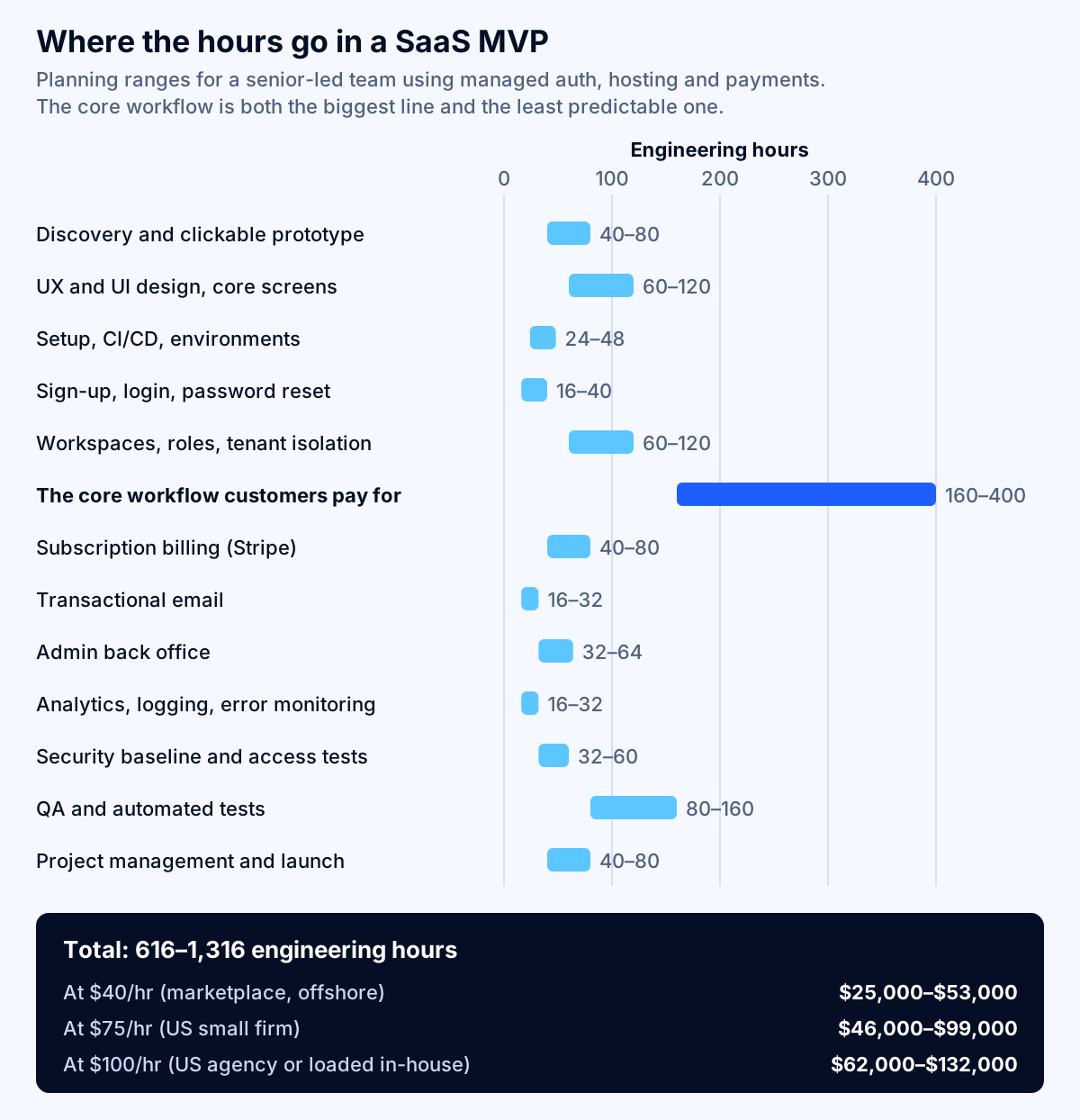
Key takeaway: The core workflow, the one thing customers pay for, is 26 to 30 percent of the hours and almost all of the uncertainty. Everything else in a SaaS MVP is well understood and can be estimated tightly. If a quote does not separate the two, you cannot tell whether it is realistic.
What does a SaaS MVP cost? The short answer, by who builds it
Hours are the stable unit. Rates vary by a factor of three or more depending on who does the work, so start by deciding which rate column you are in.
| Who builds it | Planning rate | What the rate is based on | Typical MVP cost (616–1,316 hrs) |
|---|---|---|---|
| Marketplace freelancer or offshore firm | $40/hr | Clutch's most common software firm rate is $25–$49/hr | $25,000–$53,000 |
| US small development firm | $75/hr | Clutch lists $50–$99/hr for firms in the United States | $46,000–$99,000 |
| US agency, or your own in-house team | $100/hr | Loaded in-house cost per productive hour, derived from BLS data (below) | $62,000–$132,000 |
The $100 figure deserves a word, because founders often assume an employee is cheaper than a vendor. The median annual wage for software developers was $135,980 in May 2025, according to the BLS Occupational Outlook Handbook. Wages were 70.0 percent of private-industry employer compensation costs in June 2026, with benefits making up the other 30.0 percent (BLS Employer Costs for Employee Compensation). Gross that wage up and you get about $194,000 a year of employer cost.
Divide by roughly 1,414 productive hours (2,080 paid hours minus time off, meetings and administration, as worked through in our guide on how to hire a web app developer) and a median in-house developer costs about $137 per productive hour. A mid-level web developer comes out near $101. So $100 is a fair midpoint for an in-house or US agency build, not a premium.
For context, Clutch reports that custom software projects reviewed on its platform most commonly cost $10,000 to $49,999, with an average of about $132,480 over roughly 13 months. Its data covers all project sizes, not only MVPs, but the two figures bracket this model well: the common range fits a tight scope at lower rates, and the average looks like an MVP plus its first year of iteration.
SaaS MVP development cost, feature by feature
Here is where the hours go. These are planning ranges for a senior-led team that uses managed services for authentication, hosting, email and payments, building a web application (not native mobile) for business customers.
| Work package | Hours | What is included at the low end | What pushes it to the high end |
|---|---|---|---|
| Discovery and clickable prototype | 40–80 | User interviews already done; one prototype round | Several user groups; regulated data; prototype tested with customers |
| UX and UI design | 60–120 | 10–15 screens on an off-the-shelf component library | Custom design system; data-heavy screens |
| Setup, CI/CD, environments | 24–48 | Staging and production, automated deploys | Infrastructure as code, preview environments, a second cloud |
| Sign-up, login, password reset | 16–40 | Managed auth with email and Google sign-in | Custom flows, multi-factor enforcement, migration of existing users |
| Workspaces, roles, tenant isolation | 60–120 | Invites, two roles, isolation enforced in the database | Custom roles, multiple workspaces per user, sub-accounts |
| The core workflow | 160–400 | One primary job, done end to end | Complex rules, file processing, calculations, real-time updates |
| Subscription billing | 40–80 | Hosted checkout, customer portal, webhooks, plan gating | Per-seat proration, annual invoicing, usage-based pricing |
| Transactional email | 16–32 | 5–8 templates through an email API | Branded templates, digest emails, delivery tracking |
| Admin back office | 32–64 | Look up accounts, extend trials, view as user | Refunds, manual adjustments, support tooling |
| Analytics, logging, monitoring | 16–32 | Product analytics events, error tracking, structured logs | Dashboards, alerting rules, log retention policies |
| Security baseline | 32–60 | Access-control tests, rate limits, secrets handling, dependency scanning | External penetration test support, security questionnaire prep |
| QA and automated tests | 80–160 | Tests on core workflow, billing and permissions | Broad end-to-end coverage, cross-browser testing |
| Project management and launch | 40–80 | Weekly demos, backlog, launch checklist | Multiple stakeholders, staged rollout, data migration |
| Total | 616–1,316 |
Assumptions behind the estimate
The model only holds if these are true, so check each one against your plan:
- Senior-led. At least one engineer with several shipped products makes the architecture calls. Junior-only teams bill fewer dollars per hour but tend to need more hours and more rework.
- Managed services, not custom infrastructure. Login, email, payments and hosting come from vendors. Building any of those yourself adds weeks and adds risk without adding anything customers pay for.
- One web application. No native iOS or Android apps, no browser extension, no desktop client.
- One core workflow. If you need two distinct jobs done (say, scheduling and invoicing), price two core workflows.
- A decision-maker who answers within a day. Slow decisions add calendar time and, on hourly contracts, idle time.
- No regulated data. Health records, payment card numbers stored on your systems, or financial account data change the security, hosting and compliance scope. For example, handling health data brings HIPAA obligations; our HIPAA compliant AI development checklist shows how much that adds.
Why the core workflow dominates
Everything except the core workflow has been built thousands of times. Sign-up, billing and admin screens have known shapes, mature vendor tools and predictable edge cases, so a good team can estimate them within 20 or 30 percent.
The core workflow is different because it is the part only you need. It contains your business rules, your customers' messy data and the edge cases nobody has thought about yet. That is why it carries a 2.5x range on its own, and why the most valuable thing you can do before asking for quotes is write it down: every step, every decision, every exception and what the customer sees at the end. A one-page description of the workflow usually narrows quotes more than any other single document.
Which features to leave out of v1, and what each would add
The fastest way to cut an MVP budget is to stop adding features that feel essential and are not. The table below lists the features founders most often put into version one, with planning hours and the cost at the $75 rate. The point is not that these features are bad. It is that each one is a decision you can make later with real customer evidence.
| Feature | Added hours | Added cost at $75/hr | Usually belongs in |
|---|---|---|---|
| Native iOS and Android apps | 400–900 | $30,000–$67,500 | Year one or two, if usage is mobile |
| Public API and developer docs | 60–160 | $4,500–$12,000 | After a customer asks to integrate |
| Each third-party integration | 40–120 | $3,000–$9,000 | v1 only if it is the core workflow |
| Custom report builder | 60–160 | $4,500–$12,000 | After you know which reports matter |
| Custom roles and fine-grained permissions | 40–100 | $3,000–$7,500 | When larger customers arrive |
| Enterprise single sign-on (SAML) | 24–60 | $1,800–$4,500 | When the first enterprise deal requires it |
| Usage-based or metered billing | 40–100 | $3,000–$7,500 | When pricing has been tested |
| Audit log visible to customers | 24–60 | $1,800–$4,500 | When security reviews start asking |
| AI-powered feature with evaluation | 80–240 | $6,000–$18,000 | v1 only if AI is the product |
| White-labeling and custom domains | 40–100 | $3,000–$7,500 | When resellers or agencies pay for it |
| Multi-language support | 40–100 | $3,000–$7,500 | When you sell outside one language |
| Real-time collaboration | 160–400 | $12,000–$30,000 | Rarely in v1 |
Add a few of the "small" ones, say a public API, two integrations and custom roles, and you have added 180 to 500 hours, which is 30 to 80 percent on top of a 616-hour MVP. That is how a $50,000 plan becomes an $80,000 invoice without anyone deciding it should.
If AI is part of your product, budget for its running costs as well as the build. Model API spend grows with usage, and our guide to LLM API cost optimization covers how to keep it from eating your margin. For AI-first products, see custom AI development.
A three-question filter: build, defer or cut
Run every candidate feature through these three questions, in this order.
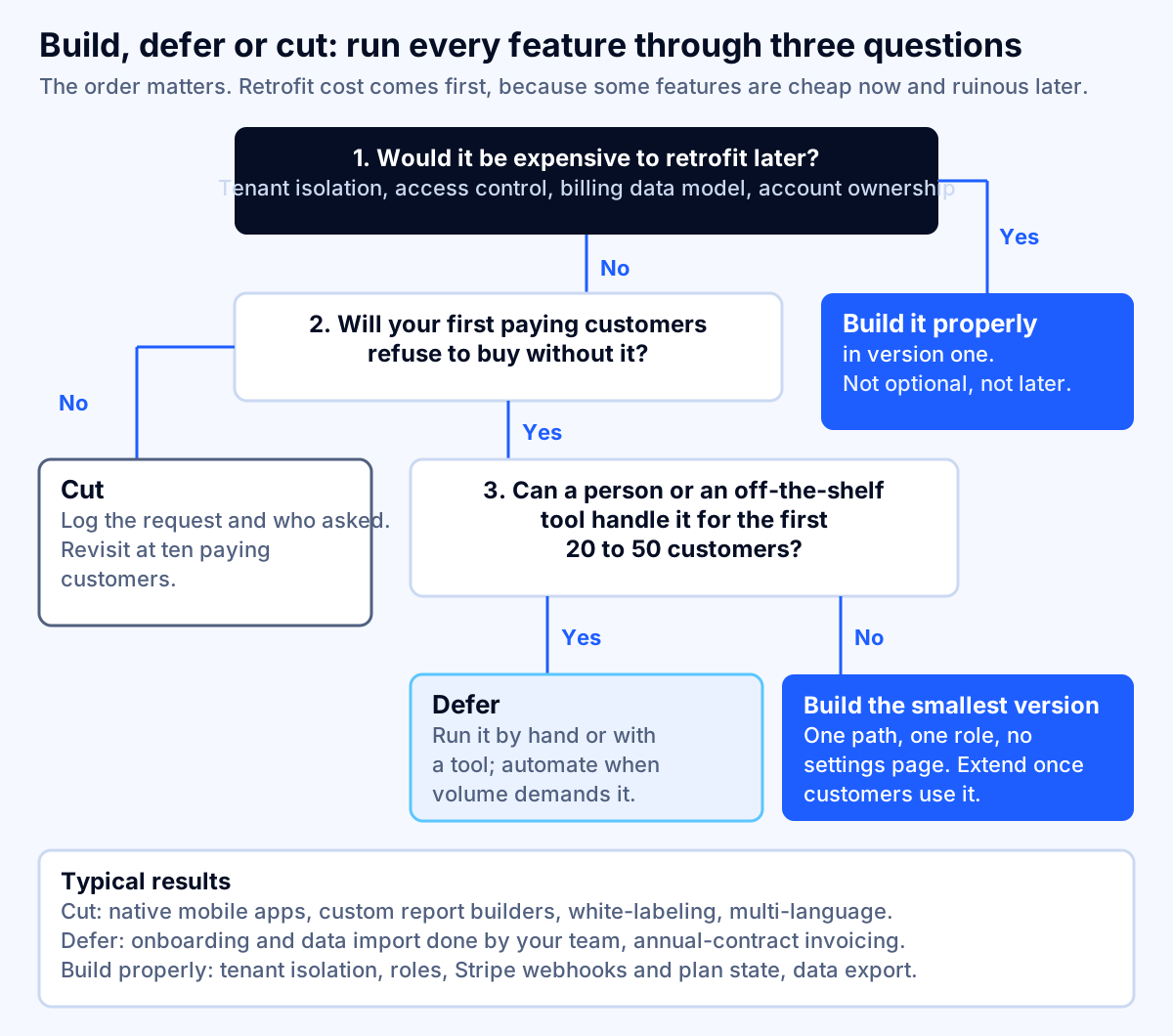
- Would it be expensive to retrofit later? If yes, build it properly now, even if no customer has asked. This is the short list in the next section.
- Will your first paying customers refuse to buy without it? Not "would they like it." Would they refuse to pay. If not, cut it, write down who asked, and revisit at ten paying customers.
- Can a person or an off-the-shelf tool handle it for the first 20 to 50 customers? If yes, defer it. Onboarding, data import, annual-contract invoicing and monthly usage reports are all jobs a founder can do by hand for months. If no, build the smallest version: one path, one role, no settings page.
The order matters because the most common MVP mistake is not building too much. It is cutting the wrong things: skimping on the invisible foundations that are cheap now and very expensive later, while gold-plating visible features nobody has paid for yet.
Key takeaway: "Minimum" applies to features, not to foundations. Cut breadth aggressively. Do not cut tenant isolation, billing state, account ownership, data export or the security baseline.
The five things you should not cut from a SaaS MVP
These are the foundations that cost little to do properly in version one and a great deal to retrofit. Each one is the subject of a familiar founder story about a cheap MVP that came back to bite.
1. Tenant isolation
In a multi-tenant product, every customer's data sits in the same database. The application must guarantee that Company A can never see Company B's records. When that guarantee lives only in application code, one forgotten filter on one query is a data breach.
This is not a theoretical risk. OWASP's Top 10:2025 ranks broken access control first and reports that 100% of the applications tested had some form of it. Its first example scenario is an attacker changing an account number in a URL to see someone else's account.
The fix is to enforce isolation in the database as well as the code. PostgreSQL's row security policies restrict which rows each user can read or change, and when row security is enabled with no policy, PostgreSQL applies a default-deny rule so no rows are visible. One detail catches teams out: table owners normally bypass row security unless the table is set to FORCE ROW LEVEL SECURITY, and superusers always bypass it. If your application connects as the table owner, your policies may do nothing. Add tests that log in as one tenant and try to read another's data, and run them on every deploy.
2. Billing state and webhooks
Payment providers tell your application what happened (a payment succeeded, a card failed, a subscription was canceled) through webhooks. If the MVP treats billing as "send them to checkout and hope," you end up with customers who stopped paying and still have access, or who paid and got locked out. Store subscription state in your own database, process webhooks idempotently, and gate features on that stored state. It is 40 to 80 hours in version one and a painful data cleanup later.
3. Account ownership
The domain, the code repository, the cloud accounts, the payment account and the email-sending account should all be owned by your company from day one, with the developer added as a member. This costs nothing and prevents the most damaging disputes. The contract matters too: copyright in code written by a contractor does not automatically pass to you. Our guide on how to hire a web app developer covers the assignment clause and the account checklist in detail.
4. Data export
Business customers ask "can we get our data out?" earlier than founders expect, often during the first security review. A CSV export of each customer's core records is a few days of work in version one. Retrofitting it after the data model has grown is much harder, and lacking it can stall a sale.
5. A security baseline you can describe
Larger customers will send a security questionnaire, and many will ask whether you have a SOC 2 report. SOC 2 is an examination performed by a CPA firm against the AICPA's trust services criteria: security, availability, processing integrity, confidentiality and privacy. You do not need the report for an MVP. You do need the habits that make it achievable later: access-control tests, secrets kept out of code, dependency scanning, error and access logging, backups you have restored at least once, and multi-factor authentication on every admin account.
What a cheap MVP costs later
Founders who built as cheaply as possible tend to report the same handful of surprises. None of them are about the hourly rate. They are about things the cheap build quietly skipped.
The rebuild
The most expensive outcome is not a slow build. It is a build that works well enough to win customers and then has to be rewritten because the foundations above were missing. A rewrite while customers are live costs more than the original build, because you are migrating real data and cannot stop shipping. If you deliberately build a throwaway to test demand, which is often wise, say so in writing, keep it small, and budget for the real build as a separate line.
Free tiers that are not for business
Two examples from current pricing pages, as of October 2026:
- Vercel's Hobby plan is free, and its pricing FAQ says it is "for personal, non-commercial use." A SaaS product charging customers belongs on Pro, at $20 per developer seat per month.
- Supabase's free plan is generous, but its pricing page states that free projects are paused after one week of inactivity. Fine for a prototype, not for a product a customer may open on a Monday after a quiet week.
Sales tax nobody planned for
Since the Supreme Court's 2018 decision in South Dakota v. Wayfair, states can require out-of-state sellers to collect sales tax without any physical presence. South Dakota's law, which the Court upheld, applied to sellers delivering more than $100,000 of goods or services into the state, or making 200 or more separate transactions there, in a year. Whether software subscriptions are taxable varies by state. Texas, for example, says that entering, storing, manipulating or retrieving a customer's data is taxable as a data processing service. Design billing so tax can be added later (Stripe Tax is priced at 0.5% per transaction on its no-code plan where you are registered), and confirm your obligations with your accountant before you cross any state's threshold.
Unowned code and accounts
Covered above, and worth repeating because it is the one problem money cannot always fix afterwards. If the person who built the MVP owns the repository, the domain or the copyright, your negotiating position on day 300 is weak.
How much does a SaaS MVP cost to run each month?
Running costs at launch are small next to the build. Payment fees and engineering time to maintain the product are the lines that grow.
| Line item | Typical starting plan | Monthly cost (as of October 2026) | Included allowance |
|---|---|---|---|
| Hosting and front end | Vercel Pro, 2 developer seats | $40 | $20 usage credit per the plan |
| Database, storage, file hosting | Supabase Pro | from $25 | 8 GB database disk, 100 GB file storage, 250 GB egress |
| Authentication | Clerk Pro | $25 ($20 billed annually) | 50,000 monthly retained users |
| Transactional email | Resend Pro | $20 | 50,000 emails |
| Error monitoring | Sentry Team | $26 (billed annually) | 50,000 errors |
| Software subtotal | about $136 | ||
| Payments | Stripe standard + Billing | 2.9% + 30¢ per card charge, plus 0.7% Billing | Per transaction |
Sources: Vercel, Supabase, Clerk, Resend, Sentry and Stripe pricing pages. Free tiers exist for most of these: Clerk's free plan includes 50,000 monthly retained users, Resend's includes 3,000 emails a month (100 a day), and Sentry's developer plan includes 5,000 errors.
Two things in that table are easy to miss.
Payment fees outgrow software costs quickly. At $10,000 of monthly recurring revenue from 200 customers paying $50, card fees are $290 plus $60 in per-charge fees, and Stripe Billing adds $70: about $420 a month, or 4.2% of revenue, roughly three times the software subtotal. International cards add 1.5% and currency conversion another 1%.
B2B features can carry their own price tags. Clerk, for example, includes one enterprise SSO connection per app on paid plans and charges $75 a month for each additional connection in its 2–15 tier; its B2B add-on with organization features is $100 a month ($85 billed annually). Check these lines for whichever vendors you choose, because the plan that looks cheapest for consumers may not be for business customers.
Then there is the engineering time to keep the product healthy: dependency updates, security patches, bug fixes and small customer requests. A reasonable planning assumption for a live MVP is 20 to 40 engineering hours a month, which is $1,500 to $3,000 a month at $75 an hour. That is separate from building new features. If cloud costs climb as you grow, our guide to why AWS bills get so high walks through the usual causes, and cloud cost optimization is the service for it.
How long does it take to build a SaaS MVP?
Using the same productive-hours assumption as above, one full-time engineer delivers about 118 productive hours a month (1,414 a year divided by 12). Two engineers deliver about 236.
| Team | Productive hours per month | 616 hours | 1,316 hours |
|---|---|---|---|
| 1 engineer + part-time designer | ~118 | ~5 months | ~11 months |
| 2 engineers + part-time designer | ~236 | ~2.5–3 months | ~5.5–6 months |
| 3 engineers + designer + project lead | ~354 | ~2 months | ~4 months |
Adding people helps less than the arithmetic suggests. The core workflow has to be designed, built and tested in sequence, and every extra person adds coordination. In practice, two strong engineers with a part-time designer is the efficient shape for most MVPs, landing at roughly three to six months from discovery to launch. Cutting scope moves the launch date far more reliably than adding headcount.
Can AI coding tools or no-code cut the cost?
Both can, in the right place. Neither changes the economics as much as the marketing implies.
AI coding assistants
AI assistants are good at boilerplate, tests, migrations and familiar patterns, which is a real share of the hours in the table above. They do not make the decisions that drive cost: what the core workflow should do, where tenant isolation is enforced, how billing state is stored.
The best controlled evidence so far is mixed. In METR's randomized study, 16 experienced open-source developers completing 246 real tasks took 19% longer when allowed to use AI tools, even though they expected a 24% speedup and afterwards believed they had been about 20% faster. METR is careful about the limits: it describes the result as a snapshot of early-2025 tools in one setting and says it does not show that AI fails to speed up most developers.
The practical lesson for a buyer: a vendor's claim that AI makes them faster is plausible for parts of the work, but should show up as a lower estimate on specific work packages, not as a vague discount. Ask which line items it reduces and by how much.
No-code and low-code
No-code builders are an excellent way to test whether anyone will pay, often in weeks. They are a weaker foundation for multi-tenant B2B software with roles, billing logic and security reviews. A sensible pattern is to validate demand on no-code, then fund a proper build once you have paying customers and a clear core workflow. If you are moving an internal process off spreadsheets rather than launching a product, our guide on when to replace spreadsheets with custom software compares off-the-shelf, low-code and custom options side by side.
How to get an accurate SaaS MVP quote
The quality of a quote depends mostly on the quality of what you send. Before you ask anyone for a price, prepare:
- A one-page description of the core workflow: steps, decisions, exceptions and the output the customer receives.
- Your user roles: who signs up, who invites whom, and what each role can and cannot see.
- Your pricing model: per seat, flat tiers or usage-based, with trial terms.
- The integrations that are truly required for launch, and the ones that are not.
- Your build, defer or cut list, so vendors quote the same scope.
- Constraints: regulated data, required launch date, the budget ceiling.
Then judge quotes on structure, not just the total:
- Good sign: hours broken out by work package, with the core workflow separate and assumptions listed.
- Good sign: a paid, fixed-price discovery phase that produces a written scope you own, whether or not you continue with that vendor.
- Good sign: testing, security and launch appear as line items, not as "included."
- Red flag: a single number with no breakdown.
- Red flag: a quote far below the others with the same scope. Something has been left out, and you will find out what later.
- Red flag: the vendor wants to host the code or own the accounts.
On contract structure: a fixed price works when the scope is written down to the screen and acceptance test. Time and materials with a weekly cap and weekly demos usually suits an MVP better, because you will learn things in the first month that change the plan. Whichever you choose, tie payments to working software you can log into, not to elapsed time.
Putting it together
A realistic SaaS MVP development cost is 616 to 1,316 engineering hours, multiplied by the rate of whoever builds it: roughly $25,000 to $53,000 at $40 an hour, $46,000 to $99,000 at $75, and $62,000 to $132,000 at $100. The core workflow is the biggest and least predictable piece, so describing it well is the cheapest way to get an accurate number.
Cut features hard, using the build, defer or cut filter, but never cut the foundations: tenant isolation, billing state, account ownership, data export and a security baseline you can describe. Budget about $136 a month for a managed software stack at launch, around 4% of revenue for payments, and 20 to 40 engineering hours a month to keep the product healthy.
If you would like a second opinion on a scope or a quote, Fleurant AI's web app development team builds SaaS products for US companies, and a specialist replies within one business day. You can talk to a specialist about your MVP, or see everything we do on the home page.
Frequently asked questions
How much does it cost to build a SaaS MVP?
For a typical business-to-business SaaS MVP with sign-up, workspaces and roles, one core workflow, subscription billing and an admin back office, plan on 616 to 1,316 engineering hours. That is roughly $25,000 to $53,000 at $40 an hour, $46,000 to $99,000 at $75, and $62,000 to $132,000 at $100. Clutch's pricing data puts the most common custom software project at $10,000 to $49,999, which matches a tightly scoped build at lower rates.
Can I build a SaaS MVP for under $10,000?
Sometimes, but usually not as a multi-tenant product you can charge companies for. Under $10,000 buys either a no-code build, a single-user tool without workspaces and roles, or a low-rate freelancer working on a narrow scope. Those can be the right way to test demand. Budget separately for the rebuild if it works, because tenant isolation and billing state are hard to bolt on afterwards.
How long does it take to build a SaaS MVP?
With two full-time engineers and a part-time designer, 616 to 1,316 hours is roughly three to six months of calendar time, including discovery and launch. Adding engineers shortens it less than you would expect, because the core workflow has to be designed and tested in sequence. Scope cuts move the date far more reliably than headcount.
What features should a SaaS MVP include?
Sign-up and login, workspaces with at least two roles and enforced tenant isolation, the one workflow customers pay for, subscription billing, transactional email, an internal admin view, error monitoring and data export. Leave out native mobile apps, custom report builders, white-labeling, public APIs and most integrations until paying customers ask for them by name.
What are the monthly costs of running a SaaS MVP?
A typical managed stack starts around $136 a month as of October 2026: Vercel Pro with two seats at $20 each, Supabase Pro from $25, Clerk Pro at $25, Resend Pro at $20 and Sentry Team at $26. Payment fees are usually larger: Stripe's standard 2.9% plus 30 cents per card charge, plus 0.7% for Stripe Billing, is about 4.2% of revenue at a $50 average price.
Do AI coding tools make an MVP cheaper to build?
They help most with boilerplate, tests and well-trodden patterns, and least with the decisions that drive cost. In METR's 2025 randomized study, experienced developers took 19% longer with AI tools on real tasks while believing they were faster. METR calls that a snapshot of early-2025 tools, so treat vendor discounts for AI as a negotiating point, not a law of nature.
Should I pay a fixed price or hourly for an MVP?
Fix the price of discovery and a written scope first, then choose. A fixed price works when the scope is written down to the screen and acceptance test, and the vendor has priced the risk in. Time and materials with a weekly cap works better when you expect to learn and change direction, which is most MVPs. Either way, own the repository and cloud accounts from day one.
Sources
- Software Developers, Quality Assurance Analysts, and Testers: Occupational Outlook Handbook, U.S. Bureau of Labor Statistics
- Employer Costs for Employee Compensation, June 2026, U.S. Bureau of Labor Statistics
- Software Development Pricing Guide, Clutch
- Pricing and fees, Stripe
- Pricing, Supabase
- Pricing, Vercel
- Pricing, Clerk
- Pricing, Resend
- Pricing, Sentry
- A01:2025 Broken Access Control, OWASP Top 10:2025
- Row Security Policies, PostgreSQL Documentation
- South Dakota v. Wayfair, Inc., 585 U.S. 162 (2018), Legal Information Institute, Cornell Law School
- Data Processing Services are Taxable (Publication 94-127), Texas Comptroller of Public Accounts
- SOC 2 and the Trust Services Criteria, AICPA & CIMA
- Measuring the Impact of Early-2025 AI on Experienced Open-Source Developer Productivity, METR


