Custom AI
On-Premise LLM Deployment Cost: The Real 5-Year Math
On-premise LLM deployment cost modeled line by line: hardware, power, staffing and the utilization you need before buying GPUs beats paying per token.
In this article
- What "on-premise" actually means, and the four options people confuse
- What drives on-premise LLM deployment cost in 2026
- How much capacity do you actually get? Measured numbers, not vendor claims
- The five-year cost model, line by line
- The break-even that matters is utilization, not headcount
- Sensitivity: what actually moves the number
- When on-premise is the right answer anyway
- What goes wrong, and the licensing trap
- A five-step way to decide in three weeks
- The bottom line
- Frequently asked questions
- Sources
Short answer: the on-premise LLM deployment cost for a production-grade node is roughly $876,000 over five years — eight GPUs, the server around them, power, cooling, support and the engineering time to keep it running. Hardware is only about $200,000 of that. And the number that decides whether it was worth it is not headcount or hardware price: it is utilization. That eight-GPU node has to stay about 65% busy, around the clock, for five years before it beats what Amazon charges to run the same open-weight model as an API.
Most guides to this question compare your own GPUs against frontier API prices like GPT-5 or Claude Opus. That comparison always favors buying, and it is wrong, because you are not running a frontier model on your own hardware. You are running an open-weight model, and you can rent exactly that model per token for cents.
This article gives you the model that makes the honest comparison: sizing tiers with measured throughput from MLPerf Inference v6.0, every cost line with a cited input, a break-even in utilization rather than users, and a sensitivity table showing what actually moves the number. Then it covers the cases where you should buy hardware anyway, because the reason is a contract clause or an air gap, not a spreadsheet.
What "on-premise" actually means, and the four options people confuse
"On-premise" gets used for four very different things, and mixing them up is the single biggest source of bad budgets.
- Your own hardware in your own building. You buy GPUs, rack them in your server room, and own the power, cooling, physical security and lifecycle. This is what this article costs out.
- Your own hardware in a colocation facility. You still own the GPUs. Someone else owns the building, power and cooling, and bills you per kilowatt.
- Rented GPU instances in your cloud account. You pay hourly for someone else's GPUs but run your own model inside your own virtual private cloud. Nothing leaves your account, but you own nothing.
- An open-weight model bought per token. Amazon Bedrock, Microsoft Foundry and Google Vertex AI all serve open-weight models under enterprise terms. You get the same model weights with none of the capacity risk.
Options 3 and 4 are what most buyers actually need when they say "we cannot send our data to OpenAI." We compared licensed seats against a private deployment in private LLM vs ChatGPT Enterprise; that article covers the control argument in depth. This one is narrower: when does owning physical hardware make financial sense, and what does it really cost?
Key takeaway: Data privacy is available at every tier. Physical ownership buys you an air gap, a specific building, and per-token economics at very high volume. It does not buy you privacy that a cloud tenant cannot also provide.
What drives on-premise LLM deployment cost in 2026
Six lines. In ascending order of how much they usually surprise people.
GPUs, and the 2026 price shock
The practical inference card for a mid-sized company right now is the NVIDIA RTX PRO 6000 Blackwell Server Edition: 96 GB of GDDR7, 1,597 GB/s of memory bandwidth, PCIe Gen 5, dual-slot, and up to 600 W configurable board power. Ninety-six gigabytes is the number that matters, because it holds a 120-billion-parameter model in 4-bit precision with room for the key-value cache.
The price has moved violently. NVIDIA raised the list price to $16,000 in August 2026, the third increase since it launched at $8,565 in March 2025, passing through $13,250 in June 2026. Vendors attribute the rise to the GDDR7 memory shortage. Street prices above list are common, and marketplace listings well above $20,000 were easy to find in September 2026.
Two consequences for your budget. First, any cost model you read that was built in 2025 understates hardware by roughly half. Second, get written quotes with a validity date before you commit to a business case, and price the sensitivity of the plan to another increase.
The 141 GB HBM3e cards — H200 SXM at up to 700 W and H200 NVL at up to 600 W — and the Blackwell data center parts are quoted through channel partners rather than listed publicly. Expect low-to-mid six figures for an eight-GPU HGX system and get three quotes.
The server around the GPUs
GPUs do not run on their own. You need a chassis with enough PCIe Gen 5 lanes and power, two CPUs, 512 GB to 2 TB of RAM, NVMe for model weights, and fast networking. Published starting prices give you the floor: Thinkmate's eight-GPU RTX server configurations start at $31,201 before any GPU is added. A realistic production configuration lands closer to $38,000, plus another $12,000 for rack PDUs, a top-of-rack switch, cabling and a spare card.
Power and cooling
Eight 600 W GPUs plus the host is about 5.7 kW at the rack. That is not the figure you pay for. Cooling, power distribution and losses multiply it: the Uptime Institute 2026 Global Data Center Survey reports an industry-wide annual average PUE of 1.52, falling to 1.36 when larger facilities are weighted by capacity. At 1.52, 5.7 kW of IT load becomes about 8.7 kW of facility load, or roughly 75,900 kWh a year.
The US commercial average price of electricity was 14.53 cents per kWh in July 2026, up 3.4% year over year. That is about $11,000 a year. Your state will differ by a factor of two or more in both directions.
If you cannot host 8.7 kW of facility load in a 42U rack in your own building — and many office server rooms cannot, which is why Uptime reports a "growing number of operators now reporting peak rack densities of 30 kW or higher" — you go to colocation. CBRE put the average monthly asking rate for a 250 kW to 500 kW requirement in primary North American markets at a record $196.25 per kW per month at the end of 2025, with vacancy at a record low 1.4%, and reported asking rates for that tier rising another 4.3% in the first half of 2026. Model $205 per kW per month, commit about 8 kW with headroom, and you are at roughly $19,700 a year for space, cooling and power capacity. Check whether metered electricity is included or billed separately; it varies by contract.
Software
You can run this entirely on open source. vLLM gives you PagedAttention, continuous batching, chunked prefill and prefix caching, FP8, MXFP4, NVFP4, INT8, INT4, GPTQ, AWQ and GGUF quantization, tensor, pipeline, data, expert and context parallelism, and an OpenAI-compatible API server. That last point matters more than it sounds: it means your application code barely changes when you move between your own GPUs and a hosted API.
If you want a vendor-supported stack instead, NVIDIA AI Enterprise lists at $4,500 per GPU per year, $13,500 for three years, or $18,000 per GPU for a five-year subscription, with a perpetual license at $22,500 per GPU including five years of support. On eight GPUs that is $144,000 over five years — comparable to the whole server. It buys you support, not throughput. Decide deliberately.
Hardware support and lifecycle
Budget a five-year support contract at roughly 12% of hardware capex, and be honest about the depreciation window. Amazon, which buys more servers than anyone, disclosed in its fiscal 2025 Form 10-K that estimated useful lives for servers and networking equipment are "Five to six years," and that effective January 1, 2025 it shortened its estimate for a subset of them "from six years to five years," citing "the increased pace of technology development, particularly in the area of artificial intelligence." If the largest buyer in the world is amortizing AI servers over five years, do not build a seven-year business case.
People, which is the whole story
This is the line that decides the outcome. Someone has to size the deployment, build the serving stack, run load tests, manage model upgrades, patch drivers and CUDA, handle capacity and queueing, wire up monitoring and logging, and be reachable when inference stops at 2 a.m.
Price it with published data rather than a guess. The BLS median annual wage for software developers was $135,980 in May 2025, and $99,130 for network and computer systems administrators. In the June 2026 Employer Costs for Employee Compensation release, wages and salaries averaged 70.0% of private-industry employer compensation costs, so a fully loaded developer costs about $194,257 a year and a systems administrator about $141,614. Note also that more than half of Uptime's respondents in 2026 reported difficulty finding qualified candidates.
How much capacity do you actually get? Measured numbers, not vendor claims
Almost every on-premise cost article skips this, which makes the rest of its math meaningless. You cannot compute cost per token without throughput, and throughput depends on the model, the precision, the context length, the concurrency and the latency you will accept.
There is now a public, audited source. MLPerf Inference v6.0, released on April 1, 2026 with submissions from 24 organizations, added a benchmark based on the open-weight gpt-oss-120b model. The results below are single-node, "available" systems from the closed division, in the Server scenario, which holds submissions to latency limits of 3,000 ms time to first token and 80 ms per output token for gpt-oss-120b, and 2,000 ms and 200 ms for Llama 2 70B. Figures are output tokens per second for the whole system.
| System | Model | Server throughput | Submitter |
|---|---|---|---|
| 2× RTX PRO 6000 Blackwell Server Edition | Llama 2 70B | 6,953 tokens/s | HPE |
| 4× RTX PRO 6000 Blackwell Server Edition | gpt-oss-120b | 6,687 tokens/s | HPE |
| 8× RTX PRO 6000 Blackwell Server Edition | gpt-oss-120b | 14,259 tokens/s | HPE |
| 10× RTX PRO 6000 Blackwell Server Edition | gpt-oss-120b | 17,738 tokens/s | HPE |
| 8× H200 SXM 141 GB | gpt-oss-120b | 24,103 tokens/s | Red Hat |
| 8× H200 NVL 141 GB | Llama 2 70B | 29,085 tokens/s | Dell |
Three things to take from this table. Scaling is roughly linear but not free — doubling from four to eight GPUs gave 2.13× on gpt-oss-120b, while going from eight to ten gave only 1.24×. HBM-based H200 systems deliver about 1.7× the gpt-oss-120b throughput of the same number of GDDR7 cards, which is what you are paying the HBM premium for. And these are tuned, audited submissions by vendor performance teams. Your first deployment will do less. Plan on 50% to 70% of these numbers until your own load test says otherwise.
The five-year cost model, line by line
Here is the model. Four configurations, every input cited, all figures in US dollars as of September 2026.
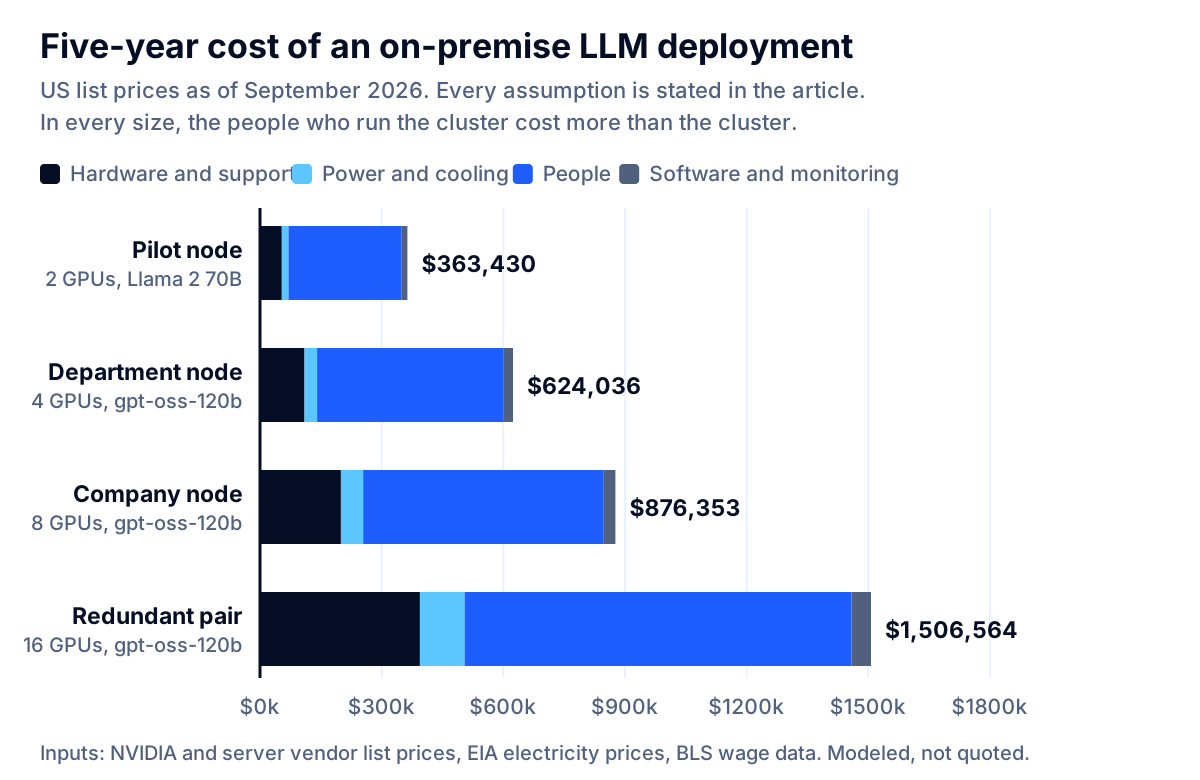
Assumptions. GPUs at the $16,000 list price. Chassis, CPU, RAM, NVMe and networking at the vendor starting prices above plus a realistic uplift. Five-year hardware support at 12% of capex. Power at 14.53 cents per kWh with a PUE of 1.52, running 8,760 hours a year (you pay for idle GPUs). Staffing as a fraction of fully loaded BLS wages. Software, monitoring, logging and backup at $3,000 to $9,600 a year for an open-source stack. Five-year horizon, no financing cost, no volume discount, no NVIDIA AI Enterprise. Months are 730 hours.
| Line | Pilot (2 GPUs) | Department (4 GPUs) | Company (8 GPUs) | Redundant pair (16 GPUs) |
|---|---|---|---|---|
| Hardware capex | $48,000 | $98,000 | $178,000 | $352,000 |
| 5-year hardware support | $5,760 | $11,760 | $21,360 | $42,240 |
| Power and cooling, 5 years | $16,445 | $30,955 | $55,139 | $110,278 |
| People, 5 years | $278,225 | $459,321 | $591,854 | $954,046 |
| Software and monitoring, 5 years | $15,000 | $24,000 | $30,000 | $48,000 |
| Five-year total | $363,430 | $624,036 | $876,353 | $1,506,564 |
| Equivalent monthly cost | $6,057 | $10,401 | $14,606 | $25,109 |
| Staffing assumption | 0.30 FTE | 0.50 FTE | 0.65 FTE | 1.05 FTE |
| Measured throughput | 6,953 tok/s | 6,687 tok/s | 14,259 tok/s | 14,259 tok/s |
| Capacity per month at 100% | 18,272M tokens | 17,574M tokens | 37,472M tokens | 37,472M tokens |
| Cost per million output tokens at 100% use | $0.33 | $0.59 | $0.39 | $0.67 |
The redundant pair assumes one node serving and one on standby, so it doubles the cost without adding capacity. That is what high availability costs, and it is the correct comparison against a managed API that already has it.
Key takeaway: People are 63% to 77% of every total. Electricity is 4% to 7%. If your business case spends three pages on power efficiency and one paragraph on staffing, it is backwards.
The break-even that matters is utilization, not headcount
Per-seat software scales with headcount. Per-token APIs scale with usage. Your own hardware scales with neither — it scales with capacity you commit to in advance. So the only break-even that means anything is: what share of this node do I keep busy?
The honest benchmark is the same model bought per token. Amazon Bedrock lists gpt-oss-120b at $0.15 per million input tokens and $0.60 per million output tokens, with gpt-oss-20b at $0.07 and $0.20, DeepSeek v3.2 at $0.62 and $1.85, Qwen3 Next 80B at $0.15 and $1.20, and Mistral Large 3 at $0.50 and $1.50. Identical weights, no capacity risk, no procurement.
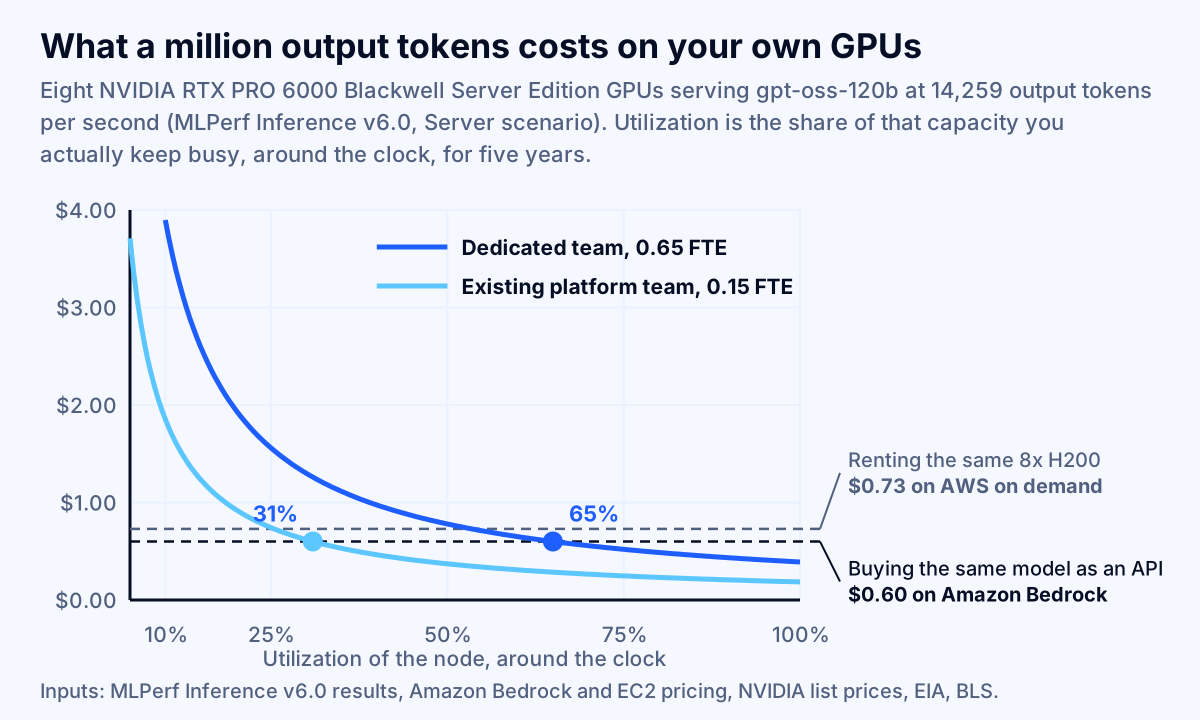
| Configuration | Break-even volume vs $0.60 per million output tokens | As share of capacity |
|---|---|---|
| Pilot, 2 GPUs | 10,095M output tokens/month | 55% |
| Department, 4 GPUs | 17,334M output tokens/month | 99% |
| Company, 8 GPUs | 24,343M output tokens/month | 65% |
| Redundant pair, 16 GPUs | 41,849M output tokens/month | 112% |
The four-GPU node essentially never wins, and the redundant pair cannot win at all, because the human cost barely shrinks when the hardware does. This is the opposite of what most buyers assume: starting small makes the per-token economics worse, not better.
Now put 24 billion output tokens a month in human terms. Assume a heavy internal assistant: 12 messages per user per working day, 21 working days, 700 output tokens per answer, so about 176,000 output tokens per user per month.
| Users | Output tokens/month | Share of the 8-GPU node | Bedrock cost for the same traffic |
|---|---|---|---|
| 200 | 35M | 0.09% | $21/month output, $45 input |
| 1,000 | 176M | 0.47% | $106/month output, $227 input |
| 5,000 | 882M | 2.4% | $529/month output, $1,134 input |
You would need roughly 138,000 employees using that assistant before the eight-GPU node beat Bedrock's list price. No mid-sized company is in that conversation. Human chat traffic does not justify buying GPUs — ever.
Machine traffic can. The same 24 billion output tokens a month is about 12.2 million document extractions at 2,000 output tokens each, 4.9 million generated report sections at 5,000, or 487,000 agentic runs at 50,000 output tokens. Continuous document pipelines, claims and invoice processing, code generation at scale, synthetic data generation and long-running AI agents can reach those volumes. Chat cannot.
Renting the hardware is not the shortcut either
Suppose you skip procurement and rent the same GPUs. AWS p5en.48xlarge is eight H200 141 GB cards at $63.296 an hour on demand in US East (N. Virginia), which is $46,206 a month at 730 hours. At the MLPerf-measured 24,103 output tokens per second, that node produces 86.8 million output tokens an hour, so even at 100% utilization you are paying $0.73 per million output tokens — more than Bedrock charges for the same model on someone else's fully utilized fleet. Reserved capacity and savings plans reduce this, but the shape of the answer does not change.
That is worth sitting with. At list prices, in September 2026, on-demand GPU rental for open-weight inference is more expensive per token than the managed API. Owning the hardware can undercut both, but only if you keep it saturated.
Sensitivity: what actually moves the number
Same eight-GPU node, one input changed at a time.
| Scenario | Five-year total | Cost per million output tokens at 100% | Break-even utilization |
|---|---|---|---|
| Base case, 0.65 FTE dedicated | $876,353 | $0.39 | 65% |
| You already run a platform team, 0.15 FTE marginal | $417,031 | $0.19 | 31% |
| Dedicated owner plus on-call rotation, 1.25 FTE | $1,432,803 | $0.64 | 106% |
| Plus NVIDIA AI Enterprise on 8 GPUs | $1,020,353 | $0.45 | 76% |
| GPUs bought at $30,000 street each | $1,001,793 | $0.45 | 74% |
| Electricity at 32 cents per kWh | $942,649 | $0.42 | 70% |
| Real throughput at 60% of MLPerf | $876,353 | $0.65 | 108% |
| Existing platform team and 60% of MLPerf | $417,031 | $0.31 | 52% |
Read the second row carefully, because it is the most useful line in this article. If you already operate a Kubernetes platform with an on-call rotation, and adding GPU inference is a marginal 0.15 FTE rather than a new 0.65 FTE commitment, the five-year cost drops by more than half and the break-even falls to 31% utilization. The decision is mostly about whether you already have the team, not about the hardware.
Read the seventh row just as carefully. If your real deployment hits only 60% of the audited MLPerf throughput — which is a normal first result — the break-even moves past 100% and the node can never pay back against the managed API. Load-test before you buy, not after.
Electricity, meanwhile, moves the total by 7% across a fourfold change in price. It is not the story.
When on-premise is the right answer anyway
None of the above says never. It says the justification is rarely cost. These are the reasons that hold up.
A contract clause rules out external cloud providers. If you handle controlled unclassified information under a Department of Defense contract, DFARS 252.204-7012(b)(2)(ii)(D) requires that if you use an external cloud service provider to store, process or transmit covered defense information, you "shall require and ensure that the cloud service provider meets security requirements equivalent to those established by the Government for the Federal Risk and Authorization Management Program (FedRAMP) Moderate baseline." The CMMC program rule took effect on December 16, 2024, and the DFARS acquisition rule putting CMMC into contracts took effect on November 10, 2025. For many small defense suppliers, keeping the model inside an already-assessed enclave is simpler than expanding the assessment boundary. Confirm the specifics with your counsel; this is a scoping decision, not a purchase decision.
You need a genuine air gap. Classified environments, industrial control networks and some clinical systems have no route to the internet at all. No cloud tenancy solves that.
Latency to on-site systems. A model that inspects camera frames on a production line, or drives a voice interface in a building with unreliable connectivity, may need to sit physically next to the equipment. Round trips to a region hundreds of miles away are not always acceptable.
Data that cannot leave a building or jurisdiction. Some customer contracts and some non-US data residency commitments are written about physical locations, not cloud regions.
You already have the capacity. If you have racks, power, a refresh budget and a platform team, the marginal case is far stronger — see the sensitivity table.
Very high, very steady machine volume. If you are running a document or agent pipeline at a sustained 20 billion output tokens a month, buy the hardware. The math finally works.
Notice that four of those six are constraints, not savings. That is the honest summary of the on-premise case, and it is why most regulated-industry AI programs end up with a cloud tenancy for the bulk of the work and a small on-premise footprint for the part that genuinely cannot move.
What goes wrong, and the licensing trap
One enthusiastic engineer. The most common failure is a deployment built by one person who leaves. Everything after that is archaeology. If you cannot name two people who can rebuild the serving stack, you have bought a liability.
Model churn. Open-weight models are replaced every few months, and the good ones grow. A model that fits in 96 GB today may not next year. On a managed API, upgrades arrive. On your hardware, every upgrade is a project with testing, revalidation and a rollback plan — and in regulated environments a model change can trigger revalidation whoever hosts it.
Capacity you bought in advance. Your GPU bill is identical on the day nobody logs in. This is the same trap as over-provisioned cloud, which is why cloud cost optimization pays back fastest on AI workloads: the fix is usually consolidating workloads onto capacity you already pay for, not buying more. If you are comparing against a cloud bill you cannot fully explain, start with the baseline table in why is my AWS bill so high — the scaffolding around a workload often costs more than the workload.
Procurement time. Ordering, delivery, rack space, power and network approvals, and a security review commonly take 8 to 16 weeks in a mid-sized company. The software is two weeks. Plan around the long pole.
Licenses that are not as open as they look. Read the model license before you build a product on it. OpenAI's gpt-oss-120b is Apache 2.0, 117 billion parameters with 5.1 billion active, MXFP4-quantized, and documented to run on a single 80 GB GPU. Clean. Meta's Llama 4 license is not a standard open-source license: it requires a separate license from Meta if your products exceed "700 million monthly active users," requires you to "Prominently display 'Built with Llama'", and requires that you "include 'Llama' at the beginning of any such AI model name" for models you train from it. Fine for an internal tool, potentially awkward for a product you sell.
A five-step way to decide in three weeks
You do not need a six-month evaluation. You need one measurement.
Step 1: Measure demand, in tokens. Instrument the workload you actually intend to run — not a hypothetical — and record input and output tokens per request and requests per hour, including the peak hour. If you cannot measure it yet, build the prototype on a hosted API first. This single number decides the whole question, and almost nobody has it before they call a hardware vendor.
Step 2: Pick the model and prove it is good enough. Build an evaluation set of 100 to 300 real cases with graded answers, and score the candidate open-weight model against the frontier model you would otherwise use. If the open-weight model fails your evaluation, the cost comparison is irrelevant, because on-premise only ever offers open weights.
Step 3: Load-test on rented GPUs. Rent the same GPU class for a week and run your real traffic shape at your real context length and latency target. Record achieved output tokens per second. Compare it to the MLPerf figures above. That ratio is the most important assumption in your business case.
Step 4: Compute your break-even utilization. Divide your five-year total by 60 for an equivalent monthly cost, divide that by the per-million price of the same model on a managed API, and divide the result by your measured monthly capacity. If the answer is above about 60%, and your traffic is not continuous machine volume, stop. Use the API.
Step 5: Name the constraint, if there is one. If the numbers say API but a contract clause, air gap or residency commitment says otherwise, write the clause down and buy hardware for that workload only. Keep everything else in the cloud tenancy. Splitting it this way is almost always cheaper and faster than forcing every use case through one deployment.
This is the sequence we use when clients ask us to compare on-premise against hosted options, and the prototype in step 3 is normally where the answer becomes obvious — which is why we build working prototypes in one to two weeks before anyone signs off on infrastructure.
The bottom line
On-premise LLM deployment costs roughly $363,000 to $1.5 million over five years depending on size, and about two-thirds to three-quarters of that is people, not silicon. Hardware prices rose sharply through 2026, so any model built before this year understates capex. Measured against the same open-weight model bought per token, an eight-GPU node needs to stay about 65% busy around the clock to break even — a bar that human chat traffic misses by two orders of magnitude and that continuous machine pipelines can clear.
Buy hardware when a constraint requires it, when you already have the team and the rack, or when you have a sustained machine-scale workload and a load test to prove the throughput. Otherwise, run the open-weight model on someone else's fully utilized GPUs and put the saved capital into the retrieval, permissions, evaluation and logging work that determines whether the system is actually any good. That work is the same either way, and it is where custom AI development earns its return.
If you want a second opinion on your own numbers — your token volume, your model choice, your break-even — talk to a specialist. Bring your measured demand from step 1 and the conversation will take twenty minutes instead of three months. You can also browse the rest of our writing on AI costs and architecture, including a line-by-line budget for custom model development and what a RAG chatbot really costs to run.
Frequently asked questions
How much does an on-premise LLM deployment cost?
Under the assumptions in this article, a two-GPU pilot node costs about $363,000 over five years, an eight-GPU production node about $876,000, and a redundant pair of eight-GPU nodes about $1.5 million. Hardware is the smallest part of those totals. The engineering time to run the cluster is 63% to 77% of the five-year cost, which is why small deployments have the worst cost per token.
Is running an LLM on your own hardware cheaper than paying per token?
Only at high, sustained utilization. An eight-GPU node serving gpt-oss-120b has to stay about 65% busy around the clock for five years before it beats Amazon Bedrock's list price for the same model. A chat assistant for 1,000 employees uses roughly 0.5% of that capacity, so it will never get close. Continuous batch and agent workloads can.
What does a single enterprise inference GPU cost in 2026?
NVIDIA raised the list price of the RTX PRO 6000 Blackwell Server Edition 96 GB to $16,000 in August 2026, its third increase since it launched at $8,565 in March 2025, which vendors attribute to the GDDR7 memory shortage. Street prices above list are common. H200 and B200 systems are quoted rather than listed, so get three quotes before you budget.
How much electricity does an on-premise LLM server use?
An eight-GPU node drawing 5.7 kW at the rack becomes about 8.7 kW of facility load at the 1.52 average PUE reported in the Uptime Institute 2026 survey, or about 75,900 kWh a year. At the July 2026 US commercial average of 14.53 cents per kWh that is roughly $11,000 a year. Real, but only about 6% of the five-year total.
Do I need on-premise hardware to keep data private?
Usually not. Amazon Bedrock, Microsoft Foundry and Google Vertex AI all let you run models inside your own cloud account with contractual and technical controls on retention. Physical on-premise hardware is the answer when you need an air gap, when the data cannot leave a specific building, or when a contract clause rules out external cloud providers. Confirm the specifics with your counsel or compliance team.
Are open-weight models really free to use commercially?
Licenses differ and you should read them. OpenAI's gpt-oss-120b is Apache 2.0 with no usage conditions. Meta's Llama 4 license requires a separate license from Meta above 700 million monthly active users, requires you to display "Built with Llama", and requires derived model names to begin with "Llama". Those terms are usually fine for internal tools and matter more for products you ship.
How long does it take to stand up an on-premise LLM?
The software is the fast part. A working prototype on rented GPUs takes 1 to 2 weeks. The slow parts are procurement, rack space, power and network approvals, and a security review, which commonly take 8 to 16 weeks in a mid-sized company. Prototype in the cloud first so hardware arrives against a load test rather than a guess.
Sources
- RTX PRO 6000 Blackwell Server Edition, NVIDIA
- NVIDIA H200 Tensor Core GPU, NVIDIA
- NVIDIA AI Enterprise Pricing, NVIDIA
- MLCommons Releases New MLPerf Inference v6.0 Benchmark Results, MLCommons
- MLPerf Inference Rules (benchmark scenarios and latency constraints), MLCommons
- MLPerf Inference v6.0 results, summary_results.json, MLCommons
- Amazon Bedrock Pricing, Amazon Web Services
- Amazon EC2 P5 Instances, Amazon Web Services
- Amazon EC2 On-Demand Pricing, Amazon Web Services
- API Pricing, OpenAI
- Electricity Monthly Update, U.S. Energy Information Administration
- Uptime Institute 16th Annual 2026 Global Data Center Survey, Uptime Institute
- The growing PUE advantage of larger data centers, Uptime Intelligence
- North America Data Center Trends H2 2025, CBRE
- North America Data Center Trends H1 2026, CBRE
- Software Developers, Quality Assurance Analysts, and Testers, U.S. Bureau of Labor Statistics
- Network and Computer Systems Administrators, U.S. Bureau of Labor Statistics
- Employer Costs for Employee Compensation, June 2026, U.S. Bureau of Labor Statistics
- Amazon.com, Inc. Form 10-K for fiscal year 2025, U.S. Securities and Exchange Commission
- openai/gpt-oss-120b model card, Hugging Face
- Llama 4 Community License Agreement, Meta
- DFARS 252.204-7012 Safeguarding Covered Defense Information and Cyber Incident Reporting, U.S. General Services Administration, Acquisition.gov
- Defense Federal Acquisition Regulation Supplement: Assessing Contractor Implementation of Cybersecurity Requirements, 90 FR 43560, Federal Register
- Cybersecurity Maturity Model Certification (CMMC) Program, 89 FR 83092, Federal Register
- vLLM documentation, vLLM
- NVIDIA RTX Servers, Thinkmate
- Nvidia doubles RTX PRO 6000 Blackwell's MSRP to a staggering $16,000, Tom's Hardware