Build vs Buy
Custom Field Service Software Cost in 2026: Build vs Rent
Custom field service software cost in 2026: published build ranges, running fees, three-year totals and the monthly spend where building starts to pay back.

In this article
- What does custom field service software cost in 2026?
- What drives the cost of each module?
- What does it cost to maintain custom software?
- Is custom software cheaper than ServiceTitan?
- At what monthly software spend does building pay back?
- Why do custom quotes differ so much, and what changed?
- How long does it take to build and switch?
- When should you not build custom software?
- What should a custom software quote include?
- What should you do next?
- Frequently asked questions
- Sources
Short answer: custom field service software cost runs from a few thousand dollars for one narrow workflow to $300,000 or more for a full platform built by a development shop, based on the ranges developers publish as of November 2026. The build is only half of it. You also pay every month for someone to keep it running. For a contractor, building pays back only when the subscriptions you would cancel cost more each month than the build and its upkeep spread over three years. At our own published prices, that line is about $2,500 to $4,400 a month of replaced software, depending on company size and scope.
We build this kind of software, so read this as a vendor's article with its work shown. We have no client yet and will not quote anyone's savings. Every outside price is linked to its source, and every assumption is written down so you can swap in your own.
What does custom field service software cost in 2026?
Custom field service software costs anywhere from $5,000 to more than $300,000 to build, and the gap mostly reflects scope and who does the work. The table below is the at-a-glance version.
| Route | One-time cost | Ongoing cost | Who published the figure |
|---|---|---|---|
| Narrow build, one block at a time | $5,000 to $50,000 | Hosting, fixes and changes, quoted separately | Adeocode, a developer |
| One major piece (technician app, dispatch system, quoting and portal) | $30,000 to $120,000 each | Support contract, not included | SoftProgrammer, a developer |
| Full platform with inventory and integrations | $120,000 to $300,000 or more | Support contract, not included | SoftProgrammer |
| Your own in-house developer | Salary from day one | About $194,000 a year per developer, loaded | Our arithmetic on BLS data |
| Fleurant AI Operations Stack | $18,000 (three modules) or $32,000 (five or more) | $2,000 to $3,500 a month by company size | Our published prices |
| Connect what you already have | $7,500 | $750 a month | Our published prices |
Two cautions before you use any of these. First, no neutral survey of contractor build costs that we know of exists, so every range above comes from someone who sells the work, ourselves included. Second, the ranges describe different things. A $30,000 technician app that sits on top of your current system is not a $30,000 replacement for it.
Key takeaway: ask what the number includes. A quote that covers building but not hosting, fixes, app store updates or text messages is not comparable with a subscription.
What drives the cost of each module?
The cost is driven by how many parts you replace and how many exceptions each part has to handle. A home services operation usually splits into six modules, and each has its own cost drivers.
| Module | What it typically replaces | What makes it expensive |
|---|---|---|
| Scheduling and dispatch | Field service platform, scheduling tool | Skills and certification rules, multi-day jobs, emergency reshuffles, maps and drive time |
| Quoting and estimates | Estimate builder, e-signature, forms | Price book size, good-better-best options, financing, commercial bid formats |
| Invoicing and collections | Invoicing module, payment reminders | Deposits, progress billing, partial payments, purchase order numbers |
| Customer records and history | CRM, review tool | Duplicate cleanup, multiple sites per customer, equipment history |
| Field app | Technician app seats | Working offline, photo uploads, signatures, two phone platforms |
| Reporting and dashboards | BI add-on, spreadsheets | How many systems the numbers come from, and how clean they are |
SoftProgrammer's published ranges give a sense of relative size: $35,000 to $90,000 for a technician mobile app with offline sync, $50,000 to $120,000 for a work order and dispatch system, $30,000 to $80,000 for quoting, invoicing and a customer portal, and $40,000 to $100,000 for asset and maintenance management. They are one developer's estimates, and we have not seen the projects behind them.
Three things move a quote more than the module list does.
Offline behavior. Technicians work in basements, attics and crawl spaces with no signal. An app that has to complete a job, take photos and invoice without a connection, then sync without creating duplicates, is a much larger piece of engineering than a web page on a phone. Decide this before you collect quotes.
Integrations. Each outside system (accounting, payments, payroll, call tracking, a supplier catalog) is its own small project with its own way of failing. A build with two integrations and one with seven are different jobs.
Your exceptions. Specialty billing, warranty work, service agreements with different coverage levels and crews that split across jobs are where custom software earns its price. They are also where scope grows after signing. Write each exception down before the quote, not during testing.
What does it cost to maintain custom software?
Maintenance is the cost buyers underestimate, because it does not end when the build does. It has three layers: outside services billed by use, platform rules that force updates, and the people who fix things.
Outside services billed by use
The metered fees are real but usually small at contractor scale. Here is what the main providers publish, read on November 26, 2026.
| Service | Published price | Worked example for a 25-person shop |
|---|---|---|
| Text messages (Twilio, US long code) | $0.0083 per segment, plus carrier fees of roughly $0.0035 to $0.005 | 3,000 outbound segments a month: about $35 to $40 |
| Business text registration (A2P 10DLC) | $46 one-time standard brand, $15 campaign vetting, $1.50 to $10 a month per campaign | $61 once, then $120 a year at most for one campaign |
| Maps and routing (Google) | Geocoding and basic routes: first 10,000 requests a month free each, then $5 per 1,000 | Often $0 at this size, unless the app recalculates constantly |
| QuickBooks API | Builder tier is not charged, with a cap of 500,000 CorePlus credits a month | $0 for a private connection inside that cap |
| Apple developer account | $99 a year | $99 a year |
| Google Play developer account | $25 one time | $25 once |
The text message assumption (3,000 segments) is ours: about 120 a person a month. A shop that sends appointment reminders, on-the-way notices and review requests on every job could send far more, so count your own. Hosting is not in the table because it depends on photo volume and design. Ask for it as a separate line.
Card processing is not in the table either, because custom software does not change who processes the card. You still pay a processor a percentage of each payment, as you do now.
Platform rules that force updates
A mobile app is never finished, because Apple and Google keep raising the minimum. Since April 28, 2026, apps uploaded to Apple's App Store Connect must be built with Xcode 26 or later and the iOS 26 SDK. Since August 31, 2026, new apps and updates on Google Play must target Android 16 (API level 36) or higher. Existing Android apps that fall too far behind stop being offered to new users on newer devices.
Those dates move every year. A custom field app that nobody is paid to update will keep working on today's phones for a while and then fail you on the day you hand a new technician a new one.
The people who fix things
Somebody has to answer when dispatch will not load at 6:30 in the morning. That is the largest maintenance cost, and it is the one to get in writing. The options are a support contract with the developer, an hourly arrangement, or your own hire.
For scale on the last option: the U.S. Bureau of Labor Statistics reports a median wage of $135,980 for software developers in May 2025. In June 2026, wages were 70 percent of what private employers spent on compensation, with benefits the other 30 percent. Dividing the median by 0.70 gives about $194,000 a year for one developer, before equipment, recruiting or the problem of what happens when that person leaves. Few contractors with under 100 employees should plan on this route.
If you use a developer's support contract, ask for four things: the monthly fee, the hours it includes, the response time for a system that is down, and whether app store updates are inside the fee or billed on top.
Is custom software cheaper than ServiceTitan?
Custom software is sometimes cheaper than ServiceTitan and rarely cheaper than Jobber or Housecall Pro, if you compare the field service platform alone. The difference is the size of the bill you are replacing.
Over three years, using published prices for 25 users:
| Option | Three-year cost | Basis |
|---|---|---|
| Jobber Plus, 25 users | $29,484 | $529 a month for 15 users after the first year, plus $29 for each extra user, annual billing. Above 15 users is our extrapolation. |
| Housecall Pro MAX, 25 users | $32,184 | $299 a month for 8 users, plus $35 for each extra user, annual billing |
| ServiceTitan, 15 technicians | $135,000 to $270,000 | Not published. $250 to $500 per technician per month is a competitor's third-party estimate. |
| Fleurant AI, three modules, up to 30 employees | $90,000 | $18,000 plus 36 months at $2,000 |
| Fleurant AI, five or more modules, up to 30 employees | $104,000 | $32,000 plus 36 months at $2,000 |
| Development shop, full platform | $174,000 to $435,000 | $120,000 to $300,000 build, plus our assumed 15 percent of build per year for support |
| One in-house developer | About $583,000 | Three years at the loaded figure above |
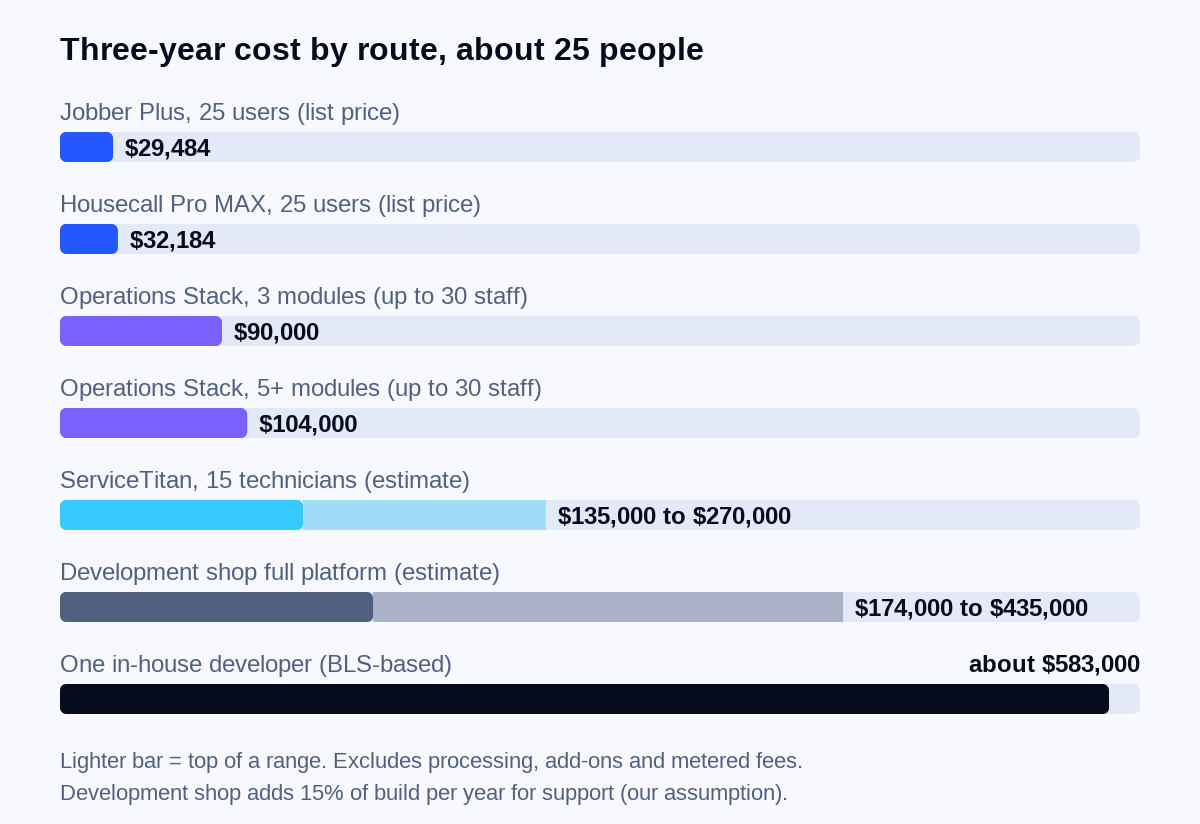
Read the table with its limits in view. The subscription rows leave out onboarding, add-ons and card processing. The build rows leave out metered fees and your team's time to switch. ServiceTitan's own pricing page shows packages but no numbers, so a written quote beats any estimate, and our ServiceTitan pricing guide lists what to ask for. For the tier-by-tier detail on the other two, see Jobber vs Housecall Pro vs ServiceTitan costs.
The plain reading: at 25 users, three years of Jobber or Housecall Pro costs about a third of our smallest Operations Stack, and far less again than a development shop platform. If one of them does what you need, rent it.
At what monthly software spend does building pay back?
Building pays back when the monthly subscriptions you will actually cancel exceed the build price plus operating fees, divided by the number of months you are measuring. Over 36 months at our published prices, the break-even line looks like this.
| Operations Stack | Three-year total | Replaced software needed to break even |
|---|---|---|
| Three modules, up to 30 employees | $90,000 | $2,500 a month |
| Five or more modules, up to 30 employees | $104,000 | about $2,890 a month |
| Five or more modules, 31 to 60 employees | $131,000 | about $3,640 a month |
| Five or more modules, 61 to 100 employees | $158,000 | about $4,390 a month |
The monthly band is set by company size, not by seats, and it is reviewed once a year at renewal, never mid-term, so a new hire never changes the invoice mid-year. Compare that with per-user pricing, where each hire adds to the bill the month they start.
Payback in months is the build price divided by the monthly gap between what you cancel and what you start paying. For a company of up to 30 employees:
| Replaced software per month | Payback, three modules ($18,000) | Payback, five or more ($32,000) |
|---|---|---|
| $2,000 or less | Never | Never |
| $2,500 | 36 months | 64 months |
| $3,400 | about 13 months | about 23 months |
| $5,000 | 6 months | about 11 months |
The payback columns assume the three-module scope really does cancel that much, which is the assumption to test hardest. A bigger scope costs more to build and should cancel more subscriptions.
Run the same method on any quote, including ours:
- List the subscriptions the new software would let you cancel. Leave out accounting, payroll, payment processing and anything with a regulatory filing, which we never replace and which most builders should not either.
- Total their monthly cost at next year's headcount, not last year's.
- Subtract the new monthly fee, plus metered fees such as text messages if they are billed to you.
- Divide the build price by what is left. That is payback in months.
- If the answer is more than about 24 months, treat the project as a decision about how you want to work, not as a saving.
Do not put office hours saved into step 3. They may be real, but they only become money if someone's hours change or you take on more work with the same people. Be skeptical of that line in any vendor's model, including ours.
Key takeaway: count only the software you will truly cancel. The most common error in a build case is crediting the project with subscriptions that survive it.
Why do custom quotes differ so much, and what changed?
Quotes differ because builders sell different things under the same name: a lump-sum bespoke platform, hours billed in blocks, or a standard set of modules adapted to your shop and then operated for you. Adeocode, which sells the block approach, reports that lump-sum development shop quotes for work it would price at $5,000 to $50,000 commonly reach $75,000 or more. That is a competitor's claim about other developers, so weigh it accordingly.
Our prices sit well below the full platform ranges above, and you should ask why. The honest answer has three parts.
AI agents do much of the build and most of the routine maintenance. That changes the labor cost of writing and looking after business software. It does not remove the need for a person to understand your operation, review the work and answer when something breaks.
The scope is fixed and narrower. Modules are priced and delivered one at a time, and we do not rebuild accounting, payroll or payment processing.
You rent part of it. You own your data and your software instance. You rent the agent fleet that operates, monitors and maintains it. The monthly fee includes hosting, backups, operation, monitoring, fixes, 2 TB of storage and four hours of changes a month; past those it is $175 an hour and $20 per terabyte a month. If you cancel, you get 60 days of read-only access and a full export, and source code escrow is available on request.
That third part is a real trade-off. A development shop that hands you the code and walks away leaves you free and unsupported. An operated service leaves you supported and dependent. Choose knowing which risk you prefer.
Support limits matter too. Ours is next business day for normal issues and four hours for urgent ones, with no overnight coverage. If your business runs emergency calls through the night, ask every builder, and every platform, what happens at 2 a.m.
How long does it take to build and switch?
Expect a first working piece in one to four months and a full replacement over a quarter or more, with parallel running on top. SoftProgrammer's guide says a first version covering work orders, dispatch and a mobile app typically takes three to four months. Our published timeline is a first module live in 30 days and a full stack in 90.
The calendar that matters more is yours. Three rules reduce the risk of a bad switch:
- Never cut over in peak season. Count back from your busiest month and be finished, or not started.
- Run each module beside the old tool for two weeks before you cancel anything. You pay twice for those weeks, and it is cheap insurance.
- Move the field app last. Office staff can absorb a change at a desk. A technician learning a new app in a driveway cannot.
Check your current contract end dates before you set the schedule. A build that finishes three weeks after an auto-renewal can mean another year of the subscription you meant to cancel. Put each notice deadline in a calendar now.
When should you not build custom software?
Do not build when a published-price platform already does the job, when your software bill is small, or when nobody on your side can own the project. Each of these is common.
Your whole software bill is under about $1,500 a month. The arithmetic above does not work. Buy the right tier of a platform.
Your problem is the gaps, not the platform. If the platform is fine but someone re-types jobs into accounting, connect the two instead. A Connector is $7,500 to build and $750 a month, which is $34,500 over three years, and it keeps every tool your team already knows. Measure the double data entry first to see whether the hours justify it.
You are missing one or two features. A bolt-on tool or a workaround may cost less than any build. Price the workaround in hours per week first. Our guide to replacing spreadsheets with custom software shows how, and the customer portal article is a case where the portal you already pay for is usually the cheaper answer.
Nobody can give it time. A build needs a dispatcher or office manager who can explain how a job really moves, test each piece and say no to extras. If that person has no spare hours this quarter, wait.
You want it because you are angry at a renewal price. That is a good reason to get numbers, not a reason to sign. Anger fades faster than a build contract.
What should a custom software quote include?
A usable quote states the scope, the fixed price or rate, the monthly cost, the ownership terms and what happens when you leave. Use this checklist on every builder.
- Scope by module, with each integration named and each exception you wrote down marked in or out.
- Price basis: fixed fee or hourly, what triggers a change order, and the payment schedule tied to working software.
- Monthly cost, with hosting, support hours, response times and app store updates stated.
- Metered fees: who pays for text messages, maps, storage and any AI usage, and whether there is a markup.
- Offline behavior in the field app, described in plain words and demonstrated before final payment.
- Ownership of code and data. Do not assume paying for software makes it yours. The U.S. Copyright Office explains that commissioned work is "made for hire" only in nine listed categories with a signed written agreement, and software is not on that list. Get a written assignment or license terms, and have a lawyer read them. This is not legal advice.
- Exit terms: export format, how long you keep access, cost of export, and handover documents.
- Migration: which history comes across (jobs, customers, equipment, photos, open estimates, service agreements) and who cleans it.
- Proof: a working demonstration of something similar, and references. If a builder has none yet, as we do not, the price and payment terms should reflect that.
- The stop point: what you have, and can use, if you end the project after the first module.
If you are choosing a person rather than a firm, how to hire a web app developer covers the interview and contract questions in more detail. If the build you have in mind is mainly a customer database, start with what a custom CRM costs, and if you are weighing AI features in particular, see build vs buy for AI agents.
What should you do next?
Get your own numbers before you get a quote. The custom field service software cost that matters is not a market range; it is your replaced subscriptions against one written price.
This week, list every subscription with its seats, monthly cost and contract end date. Mark the ones a new system would let you cancel, then run the five-step payback method above. If the replaced total is under $2,000 a month, stay where you are or connect what you have. If it is well above the break-even line for your size, collect two or three quotes and hold each to the checklist.
If you would rather have that done for you, a Stack Audit is $2,500, takes one to two weeks and is credited in full against a build started within 90 days. It covers your subscriptions, the places data gets typed twice, the overlap between tools and a costed replacement plan. You can also read how the Operations Stack works or talk to a specialist.
If you'd like one clear, practical take on the software that runs your business each month, subscribe to the Fleurant AI Briefing: one email a month, unsubscribe any time.
Frequently asked questions
How much does custom field service software cost to build?
Published developer ranges run from about $5,000 to $50,000 for a narrow build in blocks, $35,000 to $120,000 for a single major piece such as a technician app or dispatch system, and $120,000 to $300,000 or more for a full platform. Those are vendors' own figures, not a survey. Fleurant AI publishes fixed build prices of $18,000 for three modules and $32,000 for five or more, plus a monthly operating fee.
Is custom software cheaper than ServiceTitan?
It can be at larger sizes. ServiceTitan publishes no price, and a competitor's estimate of $250 to $500 per technician per month puts 15 technicians at $45,000 to $90,000 a year. Against Jobber or Housecall Pro list prices, about $10,000 a year for 25 users, building usually costs more. Compare your own quote and only the tools a build would actually replace.
How long does custom field service software take to build?
One developer's published guide says a first version with work orders, scheduling and a technician app typically takes three to four months, with a full platform rolled out in phases. Fleurant AI's published timeline is a first module live in 30 days and a full stack in 90. Add parallel running and avoid cutting over in your peak season.
What does it cost to maintain custom software every month?
Budget three layers: third-party fees such as text messages, which can be under $100 a month at 25 people; hosting; and a person or service that fixes breakage and keeps the mobile app acceptable to Apple and Google. The last is the largest. Ask any builder for a written monthly figure and what it includes, in hours.
Do I own the code if I pay a developer to build it?
Not automatically. U.S. Copyright Office guidance says commissioned work counts as work made for hire only in nine listed categories with a signed agreement, and computer software is not one of them. Put a written copyright assignment or a clear license in the contract, and ask a lawyer to check it.
Should a small contractor build custom software?
Usually not if the whole software bill is under about $1,500 a month. A list-price platform is cheaper, and a connection between the tools you already have may solve the real problem. Building starts to make sense when the subscriptions you would cancel cost more each month than the build and operating fee spread over three years.
Sources
- Custom Field Service Software: When to Build Beyond ServiceTitan and Jobber, SoftProgrammer (a software developer)
- What Custom Field Service Software Actually Costs in 2026, Adeocode (a software developer)
- Software Developers, Quality Assurance Analysts, and Testers, U.S. Bureau of Labor Statistics
- Employer Costs for Employee Compensation, June 2026, U.S. Bureau of Labor Statistics
- Jobber pricing, Jobber
- Housecall Pro pricing, Housecall Pro
- ServiceTitan packages, ServiceTitan
- ServiceTitan pricing analysis 2026, Projul (a competing vendor)
- SMS pricing in the United States, Twilio
- Pricing and Fees for A2P 10DLC Service, Twilio Support
- Google Maps Platform pricing list, Google
- Intuit App Partner Program FAQ, Intuit Developer
- Apple Developer Program enrollment, Apple
- Upcoming requirements, Apple Developer
- Get started with Play Console, Google
- Meet Google Play's target API level requirement, Android Developers
- Circular 30: Works Made for Hire, U.S. Copyright Office