AI Compliance
AI Hiring Compliance by State: The 2026–2027 Employer Checklist
AI hiring compliance by state, checked against the official texts: NYC bias audits, Illinois notice, California, Colorado, Connecticut, Texas and New Jersey.

In this article
- AI hiring compliance by state: the at-a-glance table
- Which laws apply to your company?
- When does a tool count as an "automated employment decision tool"?
- New York City Local Law 144: the bias audit rules
- How to run an adverse impact test on your own data
- Illinois: notice and effect-based liability in force since January 2026
- California: three overlapping rule sets
- Colorado and Connecticut: notice regimes that start in 2027
- Texas, New Jersey, Maryland and the federal picture
- What should an AI hiring notice say?
- Vendor contracts: what to require from AI hiring vendors
- A 30-day AI hiring compliance plan
- Common mistakes in AI hiring compliance
- The bottom line on AI hiring compliance by state
- Frequently asked questions
- Sources
AI hiring compliance by state comes down to a short list of laws as of November 2026. New York City is the only US jurisdiction that requires an independent bias audit. Illinois requires notice and bans AI that has a discriminatory effect. California already treats AI vendors as an employer's agents and wants four years of records, with two more laws arriving in 2027. Colorado and Connecticut start notice and explanation duties in 2027. Texas and New Jersey reach AI through discrimination law. Federal discrimination law applies everywhere, whoever wrote the tool.
The rules differ in detail, but the work behind them is mostly the same: know which tools touch employment decisions, tell people before you use them, keep a human who can actually change the outcome, test for adverse impact, and keep the records. This guide gives you the state-by-state table, a worked impact-ratio test, one notice that covers all of the notice laws, the vendor contract terms that matter and a 30-day plan.
Most guides ranking for this question are tool vendors' summaries, and several are already out of date. They still describe Colorado's 2024 law, which was replaced before it took effect, or call Illinois's withdrawn notice rules "adopted." We checked each law against its official text where one was available and dated everything. This is general information, not legal advice: confirm your obligations with employment counsel.
AI hiring compliance by state: the at-a-glance table
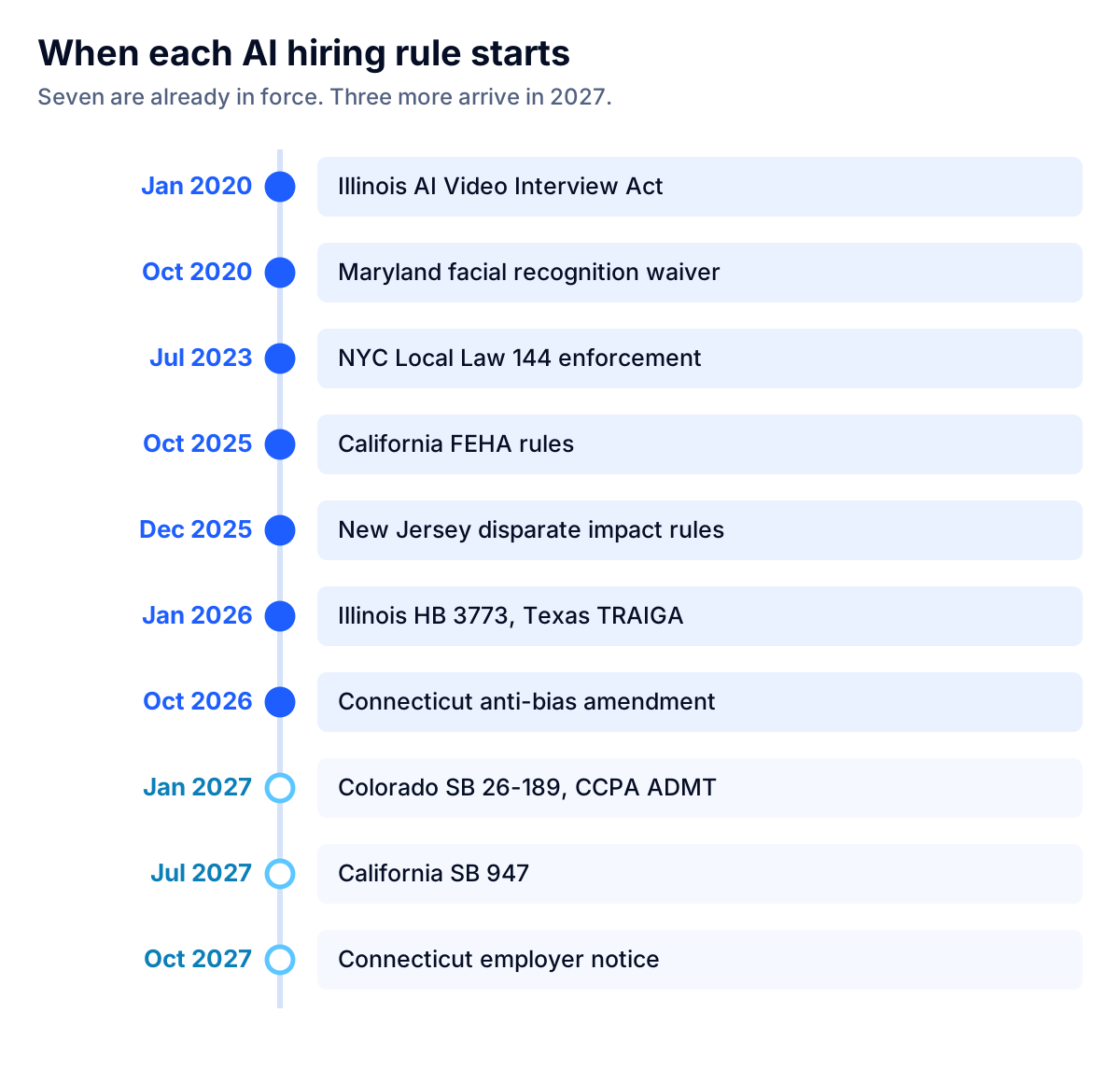
AI hiring compliance by state means meeting eleven separate rules across seven states and New York City, and seven of them already apply. The table lists each law with its start date and the main thing it asks an employer to do.
| Jurisdiction and law | Applies from | Covers | Main employer duty | Enforced by |
|---|---|---|---|---|
| New York City, Local Law 144 | Enforced since July 5, 2023 | Hiring and promotion screening for jobs in the city | Bias audit within one year before use, public summary, notice 10 business days ahead | City Department of Consumer and Worker Protection |
| Illinois, HB 3773 (Human Rights Act) | January 1, 2026 | Recruitment through discharge | Notice; no AI with a discriminatory effect; no zip codes as a proxy | Department of Human Rights and the courts |
| Illinois, AI Video Interview Act | January 1, 2020 | AI analysis of recorded video interviews | Explain, get consent, limit sharing, delete within 30 days on request | Statute (no agency rulemaking) |
| Maryland, Labor and Employment 3-717 | October 1, 2020 | Facial recognition during interviews | Signed consent waiver | Statute |
| California, FEHA automated-decision rules | October 1, 2025 | All employment decisions | No discriminatory effect; vendors can be agents; keep records four years | Civil Rights Department and the courts |
| New Jersey, N.J.A.C. 13:16 | December 15, 2025 | Employment and other areas | Disparate impact rules apply to automated tools | Division on Civil Rights |
| Texas, TRAIGA (HB 149) | January 1, 2026 | Any AI system | No AI built or used with intent to discriminate | Attorney general |
| Colorado, SB 26-189 | January 1, 2027 | Consequential decisions, including employment | Notice, adverse-outcome explanation, correction, human review, three-year records | Attorney general |
| California, CCPA ADMT regulations | January 1, 2027 | Significant decisions, including hiring, by CCPA businesses | Pre-use notice, opt-out or appeal, risk assessment | California Privacy Protection Agency |
| California, SB 947 | July 1, 2027 | Discipline and termination | Human corroboration, notice at the time of the decision | Labor Commissioner |
| Connecticut, SB 5 (Public Act 26-15) | October 1, 2027 for notice | Hiring through discharge | Written notice before the decision, AI interaction disclosure | Attorney general |
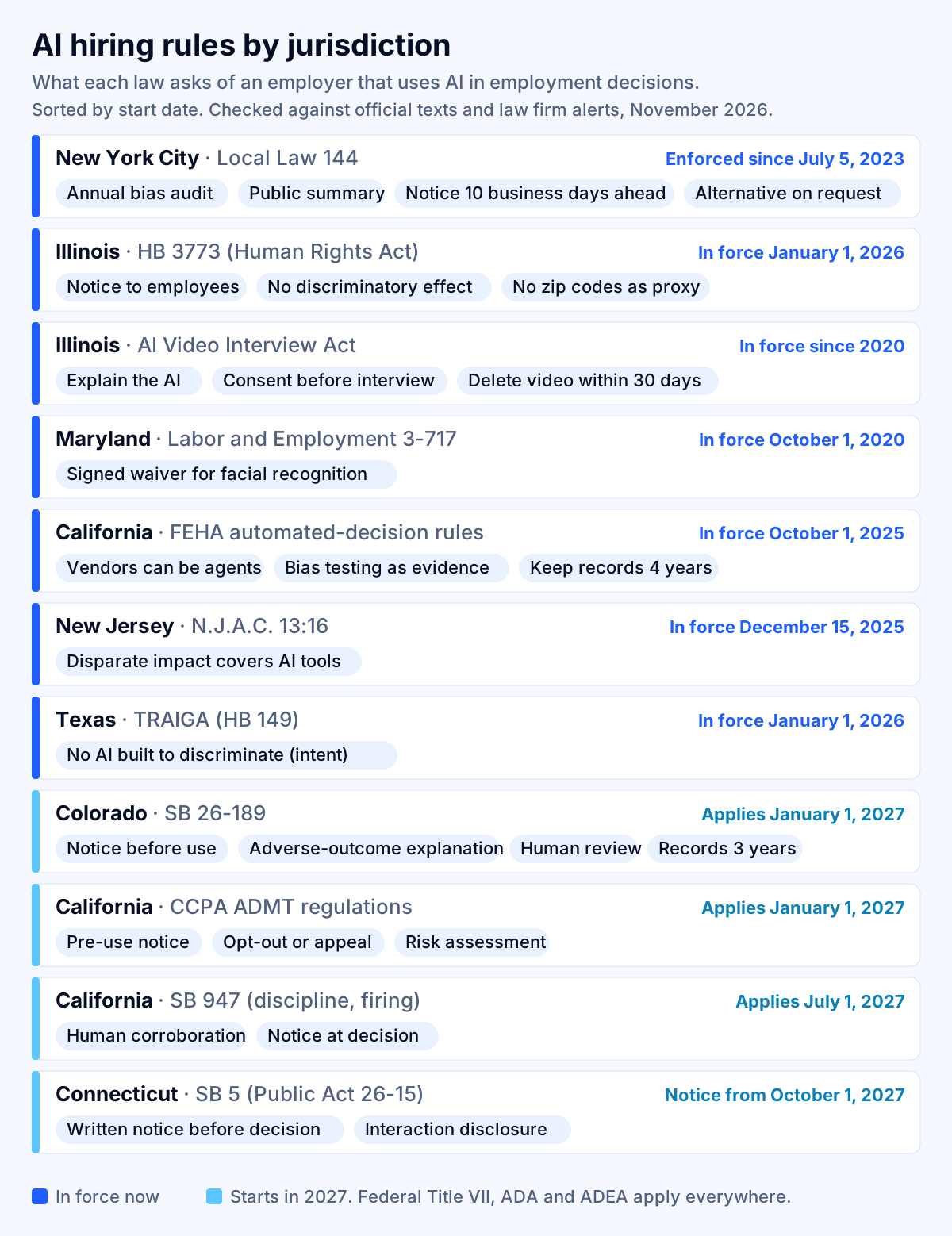
Three points stand out. First, only one law, New York City's, requires an audit. Everywhere else, testing is evidence you will want, not a filing you must make. Second, the trigger is almost never "uses AI." Each law has its own test for how much the tool shapes the decision, and those tests decide whether a given workflow is covered. Third, discrimination law applies whether or not a specific AI law does. Title VII of the Civil Rights Act, the Americans with Disabilities Act and the Age Discrimination in Employment Act apply to selection procedures however they are built.
Key takeaway: If you hire in several states, build to the strictest common denominator: a notice that meets the New York City, Illinois, Colorado, California and Connecticut content lists, a documented human review, an annual adverse-impact test and four years of records.
Which laws apply to your company?
The laws that apply depend on where your candidates and employees live or work, not on where your company is headquartered. Start with these five questions for each tool.
- Where are the jobs and the people? New York City's law covers screening for employment decisions "within the city," and its notice goes to candidates and employees who reside there. Colorado's act treats Colorado employees and Colorado-resident applicants as consumers. Connecticut's law applies to anyone "doing business in Connecticut" that uses a covered tool on Connecticut individuals, and Cooley notes that it does not define "doing business," so multistate employers should assume coverage for remote workers until that is clarified.
- Which decision does the tool touch? Hiring and promotion are in every law. Discipline and termination are covered in Illinois, Colorado, Connecticut and California, and California's SB 947 covers only those two. Scheduling and productivity monitoring are excluded from Connecticut's definition but count under California's CCPA rules when they set pay or allocate work.
- How much does the tool shape the outcome? This is the scope test, and it differs by law (see the next section).
- What does the tool analyze? Video interviews trigger Illinois's 2020 consent law. Facial recognition in interviews triggers Maryland's waiver. Zip codes are banned as a proxy in Illinois.
- How big is the company? Most of these laws have no size threshold. The CCPA rules are the exception: they apply only to CCPA "businesses," which means, for example, annual gross revenue above $26,625,000 (the figure in effect since January 1, 2025), as our CCPA ADMT regulations guide explains.
The answer is per workflow, not per product. One applicant tracking system can run a covered resume ranker in one requisition and a simple scheduling tool in another. Inventory the workflows.
When does a tool count as an "automated employment decision tool"?
A tool is covered when its output plays a real part in the decision, and each law draws that line differently. A spreadsheet or spam filter is excluded everywhere. A score that sorts the applicant pile is covered almost everywhere.
| Law | Covered when the tool... | Practical reading |
|---|---|---|
| New York City Local Law 144 | Issues a "simplified output" that substantially assists or replaces discretionary decisions | The city's rule limits this to three cases: the output is the only factor, it is weighted more than any other criterion, or it is used to overrule other factors, including human judgment (Ogletree) |
| Illinois HB 3773 | Is "artificial intelligence" used in a covered employment decision | Broad: the statute's definition covers any machine-based system that infers outputs such as predictions or recommendations, including generative AI |
| California FEHA rules | Is a computational process that makes or helps make an employment decision | Broad: resume screening for terms or patterns, ad targeting, assessments and interview scoring are listed examples |
| California CCPA ADMT | Replaces or substantially replaces human decisionmaking | Out of scope if a qualified human reviews the output and other information and has authority to change the decision |
| Colorado SB 26-189 | Materially influences a consequential decision | The draft rules presume influence when a manager picks the top scorer, unless there is evidence of an independent basis |
| Connecticut SB 5 | Is a substantial factor in, or materially influences, an employment decision | Cooley reads "materially influence" as broader than New York City's test |
The New York City test is the narrowest, which is why some employers concluded their tools were not covered there. The state laws that follow it are broader. A ranking that a recruiter only "considers" may escape New York City's definition and still be covered in Connecticut and Colorado, and it is plainly AI under Illinois's definition.
The safest way to read these tests is to ask what the recruiter does with the output. If candidates below a cutoff are never read by a person, the tool is deciding. If the recruiter reads every file and the score is one input among several, document that, because documented review is what narrows coverage in New York City, California and Colorado.
New York City Local Law 144: the bias audit rules
New York City prohibits employers and employment agencies from using a covered tool unless it had a bias audit "conducted no more than one year prior to the use," and a summary of the results and the tool's distribution date are posted on their website first. That is the text of Administrative Code section 20-871. The city's Department of Consumer and Worker Protection began enforcing it on July 5, 2023.
What the audit must contain
The audit must be done by an independent auditor and must calculate selection or scoring rates and impact ratios by sex, by race and ethnicity, and by the intersection of the two. According to Ogletree's summary of the final rule:
- An auditor is not independent if it was involved in using, developing or distributing the tool, is employed by the employer or the vendor, or has a material financial interest in either.
- An auditor may leave out a category that makes up less than 2% of the audit data, but must justify it.
- Several employers may rely on one audit of the same tool based on historical data, but only if each provided its own historical data to the auditor or has never used the tool.
- Test data is allowed only when there is not enough historical data for a statistically significant audit.
- The posted summary must include the data source, the number of people in an unknown category, applicant counts, selection or scoring rates and impact ratios, and must stay up for at least six months after the tool's last use.
Notice and data requests
Each candidate or employee who resides in the city must be told, at least 10 business days before use, that a tool will be used, which job qualifications and characteristics it will assess, and that they may request an alternative selection process or accommodation. Information about the data collected, its source and your retention policy must be on your website or provided within 30 days of a written request.
Penalties and the enforcement record
Penalties are up to $500 for a first violation and $500 to $1,500 for each later one. Each day a tool is used out of compliance is a separate violation, and each missed notice is another. The law adds that it does not limit a candidate's right to sue.
Enforcement has been light so far. The New York State Comptroller's December 2025 audit found the department received two complaints between July 2023 and June 2025. When it reviewed 32 companies, it identified one instance of noncompliance, while the Comptroller's auditors reviewing the same companies found at least 17 instances of potential noncompliance. The report made six recommendations, including proactive identification of noncompliance. Treat the light record as a reason to fix gaps now, not as permission to ignore them.
How to run an adverse impact test on your own data
An adverse impact test compares how often each group gets through a step, and you can run a first version in a spreadsheet. New York City requires the calculation; everywhere else it is the evidence that shows you tested and acted.
The method has three steps:
- Selection rate per group: the number advanced divided by the number assessed.
- Impact ratio: each group's rate divided by the highest group's rate.
- Flag: under the federal Uniform Guidelines, a selection rate "less than four-fifths (4/5) (or eighty percent)" of the highest group's rate will generally be regarded by federal enforcement agencies as evidence of adverse impact.
Here is a worked example with illustrative numbers for one resume-screening step:
| Group | Assessed | Advanced to interview | Selection rate | Impact ratio |
|---|---|---|---|---|
| Men | 600 | 300 | 50.0% | 1.00 |
| Women | 400 | 160 | 40.0% | 0.80 |
| Applicants aged 40 and over | 350 | 126 | 36.0% | 0.70 (vs. under 40) |
| Applicants under 40 | 650 | 334 | 51.4% | 1.00 |
In this example, sex sits right at the four-fifths line and age falls below it. Age is not a category New York City requires, but it is protected under the federal ADEA and the state laws, and it is the claim at the center of the Mobley v. Workday case. Test it.
Three cautions keep the test honest. The four-fifths rule is a rule of thumb: the same regulation says smaller differences can still be adverse impact when they are statistically and practically significant, and large differences on small numbers may not be. Run the test per step (knockout questions, ranking cutoff, assessment), because a tool can look fine overall and fail at one gate. And when a ratio falls below 0.80, record what you did next: a job-relatedness review, a changed cutoff or a less discriminatory alternative. That record is what California's and Connecticut's evidence rules reward.
Illinois: notice and effect-based liability in force since January 2026
Illinois makes it a civil rights violation to use AI in employment decisions in a way that "has the effect of subjecting employees to discrimination," to use zip codes as a proxy for protected classes, or to fail to give notice that you use AI. Those duties come from Public Act 103-0804, which amended section 2-102 of the Illinois Human Rights Act and took effect January 1, 2026.
The covered decisions are broad: recruitment, hiring, promotion, renewal of employment, selection for training or apprenticeship, discharge, discipline, tenure and the terms, privileges or conditions of employment. The standard is the effect of the tool, not the intent behind it. That is the opposite of Texas.
The rules gap
The statute told the Department of Human Rights to adopt rules on when, how and how quickly notice must be given. The department published proposed rules on May 15, 2026 and, on June 2, 2026, announced it was "withdrawing and postponing" them to allow "continued collaboration with other state agencies," according to Ogletree's report. We found no refiled version in the sources we checked as of November 2026. Some pages still describe the rules as adopted. They are not.
The statute did not wait for the rules, so employers still owe notice. The withdrawn draft is the best guide to what the department expects. According to Hinshaw's summary of the draft, it would have required:
- Notice to current employees annually and within 30 days of adopting a new or substantially updated AI system, and notice to applicants in the job posting.
- Content naming the AI product and its developer, the decisions it influences, its purpose, the data categories it processes, a contact person and the right to request a reasonable accommodation.
- Posting in handbooks, the usual physical notice location, the intranet or website, and job postings.
- Four years of retention for AI notices and disclosures.
Building to the draft costs little and is easy to defend. If the final rules differ, you adjust a template.
The 2020 video interview law
Illinois's separate Artificial Intelligence Video Interview Act still applies to Illinois-based positions. Before asking for a recorded interview that AI will analyze, you must tell the applicant, explain how the AI works and what general types of characteristics it evaluates, and get consent. You may share the videos only with those whose expertise or technology is needed to evaluate them, and you must delete them within 30 days of the applicant's request. If you rely solely on the AI analysis to decide who gets an in-person interview, you must report race and ethnicity data to the Department of Commerce and Economic Opportunity each year by December 31.
California: three overlapping rule sets
California regulates AI hiring three ways, and meeting one does not satisfy the others. The anti-discrimination rules already apply. A privacy rule and a labor rule follow in 2027.
FEHA automated-decision rules (since October 1, 2025). The Civil Rights Council's regulations apply existing anti-discrimination law to automated-decision systems. McDermott's summary highlights three points that matter for vendor management: liability can extend to an employer's agents, including third-party vendors; anti-bias testing is "relevant evidence" in defending discrimination claims, judged on its recency, scope, results and the employer's response; and employers must keep automated-decision records, including inputs, outputs, criteria and test results, for at least four years.
CCPA automated decisionmaking technology rules (from January 1, 2027). For CCPA-covered businesses, using ADMT for a significant decision, which includes hiring, allocating work, pay, promotion, demotion and termination, requires a pre-use notice, an opt-out or an allowed exception, access rights and a risk assessment. For hiring, the opt-out can be replaced by a human appeal, or by the hiring exception when the tool is used solely to assess ability to do the job and works as intended without unlawful discrimination. Our CCPA ADMT guide has the exception matrix by decision and a sample notice.
SB 947, the No Robo Bosses Act (from July 1, 2027). Signed September 30, 2026, it covers discipline and termination, not hiring. According to DLA Piper, an employer may not rely solely on an automated decision system for those decisions. When it primarily relies on one, a human must corroborate the output, and the employer must give a stand-alone written notice when it informs the employee of the decision. The law does not define "primarily relies." Violations carry a civil penalty of $500 each.
Colorado and Connecticut: notice regimes that start in 2027
Colorado and Connecticut both start employer notice duties in 2027, with no bias audit required in either state.
Colorado SB 26-189 (decisions on or after January 1, 2027). SB 26-189 replaced the 2024 Colorado AI Act before that law took effect. Employers that use automated decision-making technology to materially influence an employment decision about a Colorado employee or resident applicant must give notice before use, explain an adverse outcome within 30 days, allow data correction, offer meaningful human review and keep compliance records for at least three years. Enforcement of the original law was paused by a federal court order in the X.AI v. Weiser case pending rulemaking. Our Colorado AI Act compliance guide covers the draft rules, including the presumption that a manager who picks the top scorer was materially influenced.
Connecticut SB 5 (Public Act 26-15). Governor Lamont signed it on May 27, 2026. Cooley's analysis sets out the employer duties:
- From October 1, 2026: the Connecticut Fair Employment Practices Act now says that using an automated tool is not a defense to a discrimination claim, and the human rights commission or a court may consider anti-bias testing or "similar proactive efforts." Employers filing a WARN notice must also say whether layoffs relate to AI or another technological change.
- From October 1, 2027: before using a covered tool to make, or as a substantial factor in making, an employment decision, the employer must give the affected person written notice of the tool's use, its purpose, the nature of the decision, the tool's trade name, the categories of personal data analyzed and how they are assessed, the data sources and a contact. Employers must also say plainly when someone is interacting with such a tool, such as an interview chatbot, unless that would be obvious.
- Enforcement: only by the attorney general under the state's unfair trade practices law, with no private right of action, and a 60-day cure opportunity for violations through December 31, 2027.
Texas, New Jersey, Maryland and the federal picture
Three more states reach AI hiring through narrower rules, and federal law sits under all of them.
Texas. TRAIGA, in force since January 1, 2026, prohibits developing or deploying AI "with the intent to unlawfully discriminate against a protected class," and says disparate impact alone does not prove intent. Its consumer provisions exclude the employment context. For most Texas employers, the practical duty is to document what each hiring tool is for and how it was tested, so intent is easy to rebut. Our Texas AI law guide covers the attorney general's investigative demands.
New Jersey. The Division on Civil Rights' disparate impact rules at N.J.A.C. 13:16 took effect December 15, 2025. Morgan Lewis notes that they explicitly identify automated decision-making tools as potential sources of disparate-impact liability, with the example of a tool trained on a workforce that "may systematically favor candidates who resemble incumbent employees." The rules apply a three-step framework: the complainant shows a disproportionate effect, the employer shows the practice is necessary to achieve a substantial, legitimate, nondiscriminatory interest, and the complainant can still win by showing a less discriminatory alternative.
Maryland. Since October 1, 2020, an employer may not use a facial recognition service to create a facial template during an applicant's interview without a signed waiver stating the applicant's name, the interview date, the consent and whether the applicant read the waiver (section 3-717).
Federal law. Executive Order 14281, signed April 23, 2025, set a policy to "eliminate the use of disparate-impact liability in all contexts to the maximum degree possible" and told agencies to deprioritize enforcing it, including under Title VII. That changes what federal agencies pursue, not the statutes. Private plaintiffs can still bring disparate impact claims, and state agencies in New Jersey, Illinois and California are moving the other way. In Mobley v. Workday, a federal court in the Northern District of California authorized notice to applicants aged 40 and over who applied through Workday's platform since September 24, 2020, with a March 7, 2026 opt-in deadline. The case shows that vendors are defendants too, and it is a reason to test for age.
What should an AI hiring notice say?
One well-built notice can satisfy most of these laws if it includes every element any of them requires. Write it once, then deliver it through each channel the strictest law requires: job postings, the careers page, the application flow, and handbooks or the intranet for employees.
| Notice element | Required or expected by |
|---|---|
| That an automated tool or AI is used, and for which decisions | New York City, Illinois, Colorado, Connecticut, California CCPA |
| Tool name and developer or vendor | Connecticut (trade name), Illinois draft rules |
| Purpose of the tool | Connecticut, Illinois draft, California CCPA |
| Job qualifications and characteristics assessed | New York City |
| Categories of personal data and how they are assessed, plus data sources | Connecticut, Illinois draft, New York City (on request) |
| How to request an alternative process or accommodation | New York City, Illinois draft |
| How to opt out or appeal, where available | California CCPA |
| Contact person | Connecticut, Illinois draft |
| Timing | New York City: at least 10 business days before use; Connecticut: before the decision; Illinois draft: in the job posting and within 30 days of a new tool |
A sample paragraph, to adapt with counsel:
We use [tool name], provided by [vendor], to help review applications for this role. It assesses [qualifications and characteristics, such as required certifications and years of relevant experience] using information from your application and [other sources]. A member of our recruiting team reviews every recommendation before any decision. You can ask for a different review process or an accommodation, or ask what data we use and how long we keep it, by contacting [name, email].
Keep each version dated. When the tool, the data or the decision changes, update the notice and record when it went out.
Vendor contracts: what to require from AI hiring vendors
Your contract should make the vendor supply everything you need to comply, because almost every law puts the duty on the employer. Colorado and Connecticut require developers to give deployers the information they need, but a contract makes it specific and enforceable. Ask for these in writing:
- Audit support. A current independent bias audit for New York City use, with the data source and date, and either your own historical data included or a statement of why test data was used.
- Your data, your test. Export of per-candidate inputs, scores and outcomes, so you can run adverse impact tests on your own applicants by sex, race and ethnicity, and age.
- Model change notice. Advance notice of material changes to the model or scoring, since a "substantially updated" system triggered new notice under Illinois's draft rules, and New York City audits apply to a tool's distribution date.
- Notice content. The trade name, purpose, data categories, data sources and assessment logic you must disclose in Connecticut, Colorado and Illinois.
- No proxies. A representation that the tool does not use zip codes or other known proxies for protected classes, and that it does not infer protected characteristics.
- Video and biometrics. Deletion within 30 days on request, limits on sharing videos, and no facial templates without your Maryland waiver process.
- Records. Retention of logs for at least four years, available to you on request and during litigation holds.
- Cooperation and allocation. Help responding to regulators and candidates, and a clear allocation of responsibility, which Connecticut allows by binding contract.
Our AI vendor risk assessment guide has a full due-diligence questionnaire you can extend with these items.
A 30-day AI hiring compliance plan
Most employers can get to a defensible baseline in about a month by working from inventory to evidence. This plan assumes one HR owner, one legal reviewer and help from IT.
| Week | Work | Output |
|---|---|---|
| 1 | Inventory every tool that touches recruiting, screening, interviewing, promotion, discipline or termination, including ATS knockout rules and AI features inside existing software | Tool list with vendor, version, decision supported, locations of candidates and employees |
| 1 | Map each tool to the laws that apply, using the scope tests above | Coverage matrix per workflow |
| 2 | Pull 12 months of outcomes and run adverse impact tests per step for sex, race and ethnicity, and age | Impact ratio table with actions for anything below 0.80 |
| 2 | Commission or update the New York City bias audit for any covered tool used for city jobs | Audit report and posted summary |
| 3 | Draft one master notice and publish it in postings, the careers page, handbooks and the intranet | Dated notice versions |
| 3 | Define the human review step: who reviews, what they read, their authority to override, and how decisions are logged | Written review procedure |
| 4 | Amend vendor contracts and set retention to at least four years | Contract addenda, retention settings |
| 4 | Add the AI hiring rules to your AI acceptable use policy so managers do not paste candidate data into general chat tools to rank people | Updated policy |
Then put three dates on the calendar: January 1, 2027 for Colorado and the CCPA rules, July 1, 2027 for SB 947, and October 1, 2027 for Connecticut's notice. Rerun the adverse impact test at least once a year and whenever the vendor changes the model.
Common mistakes in AI hiring compliance
The most common mistakes come from reading one law and assuming it covers the rest.
- Treating the New York City audit as nationwide compliance. It covers sex and race and ethnicity for city jobs. It says nothing about age or disability, notice in Illinois or Connecticut, or California records.
- Assuming a human in the loop ends the analysis. A reviewer who cannot override, or does not have time to read, fails California's test and invites Colorado's presumption.
- Relying on the vendor's audit alone. An audit of other employers' data may not reflect your applicant pool, and New York City lets you rely on it only in limited cases.
- Missing the AI inside ordinary software. Knockout questions, auto-ranking and AI summaries inside an applicant tracking system are tools too. Our guide to AI audit trail requirements shows what to log for each one.
- Waiting for Illinois's rules. The statute has applied since January 1, 2026.
- Ignoring discipline and termination. Illinois, Colorado, Connecticut and California's SB 947 all reach decisions after hire, including productivity-based discipline.
The bottom line on AI hiring compliance by state
AI hiring compliance by state is less about any single law than about one evidence trail that serves all of them: an inventory, a notice, real human review, adverse impact tests and four years of records. New York City needs the audit on top. Illinois needs the notice now. California, Colorado and Connecticut add explanation, corroboration and notice rules through 2027. If you build the evidence once, each new law becomes a template change rather than a project.
If you want help inventorying your hiring tools, setting up adverse impact testing or building the logging and review workflow, our team that builds and operates it does this work for companies in regulated industries, starting with a free discovery call. You can also talk to a specialist about your own tools, or see everything Fleurant AI builds.
If you'd like one clear, practical take on AI, software and cloud decisions each month, subscribe to the Fleurant AI Briefing: one email a month, unsubscribe any time.
Frequently asked questions
Which states require a bias audit for AI hiring tools?
As of November 2026, no state requires one. New York City's Local Law 144 is the only US law that mandates an independent bias audit, done no more than one year before the tool is used, with a public summary. California's FEHA rules and Connecticut's SB 5 treat anti-bias testing as evidence a regulator or court may weigh, and Illinois, New Jersey and Colorado make the results of a discriminatory tool your problem, which is why many multistate employers audit anyway.
Is the employer or the AI vendor responsible for compliance?
Mostly the employer. New York City, Illinois, Colorado, Connecticut and California put the notice and anti-discrimination duties on the employer that uses the tool. Vendors carry some duties too: Colorado and Connecticut make developers supply the information employers need, and California's FEHA rules treat vendors acting for an employer as its agents. In the Mobley v. Workday case, applicants are suing the vendor directly. Put the split in your contract.
Does Illinois HB 3773 apply if we do not have final IDHR rules?
Yes. Public Act 103-0804 took effect January 1, 2026, and makes it a civil rights violation to use AI that has the effect of discriminating, to use zip codes as a proxy for protected classes, or to fail to give notice. The Department of Human Rights withdrew its proposed notice rules in June 2026 and had not refiled them in the sources we checked. The statutory duty still applies, so give a reasonable notice now.
Do NYC Local Law 144 rules apply to companies based outside New York City?
They can. The law covers employers and employment agencies that use an automated employment decision tool to screen candidates or employees for jobs or promotions in the city, wherever the company is headquartered. Notice is owed to candidates and employees who reside in the city, at least 10 business days before use. If you hire for New York City roles, check every screening tool against the definition.
Does a human reviewer take a tool out of these laws?
Sometimes, and only if the review is real. Under New York City's rule, a tool is covered when its score is the sole factor, outweighs other criteria or overrules human judgment. California's CCPA rules require a reviewer who understands the output, analyzes it and has authority to change the decision. Colorado's draft rules presume influence when a manager picks the top scorer. A reviewer who approves hundreds of rankings an hour will rarely qualify.
What records should we keep for AI hiring tools?
Keep at least four years of tool inputs, outputs, selection criteria, notices and test results. That is California's FEHA minimum for automated-decision records, and it also covers Colorado's three-year rule and Illinois's proposed four-year rule for notices. Keep New York City bias audit summaries posted for at least six months after a tool's last use, and hold records longer when a complaint or lawsuit is pending.
Did the federal government preempt state AI hiring laws?
No. Executive orders cannot repeal state laws. Executive Order 14281 (April 2025) told federal agencies to deprioritize disparate-impact enforcement, and a December 2025 order targets state AI laws through litigation and funding. Title VII, the ADA and the ADEA still apply, private plaintiffs can still sue, and every state and city law in this article stays in force until a court or legislature says otherwise.
Sources
- Local Law 144 of 2021 (Automated Employment Decision Tools), full text, New York City Council
- Automated Employment Decision Tools (AEDT), NYC Department of Consumer and Worker Protection
- Enforcement of Local Law 144: Automated Employment Decision Tools (Report 2024-N-6), Office of the New York State Comptroller
- New York City Adopts Final Rules on Automated Decision-Making Tools, AI in Hiring, Ogletree Deakins
- Public Act 103-0804 (HB 3773), amending the Illinois Human Rights Act, Illinois General Assembly
- Illinois Postpones Proposed Regulations on AI in Employment, National Law Review (Ogletree Deakins)
- Illinois Adopts AI-in-Employment Regulations: What Employers Must Know for 2026, Hinshaw & Culbertson
- Artificial Intelligence Video Interview Act (820 ILCS 42), Illinois General Assembly
- Labor and Employment section 3-717 (facial recognition in interviews), Maryland General Assembly
- HB 1202 (2020), enrolled bill, Maryland General Assembly
- California's new AI rules under FEHA take effect October 1, 2025, McDermott Will & Schulte
- California enacts SB 947: What employers need to know about the No Robo Bosses Act, DLA Piper
- CCPA regulations (including Article 11, automated decisionmaking technology), California Privacy Protection Agency
- SB 26-189 Automated Decision-Making Technology, Colorado General Assembly
- Connecticut's AI Rules Take Shape: What Employers and Developers Need to Know, Cooley
- New Jersey Codifies Existing Disparate Impact Rules, Morgan Lewis
- HB 149 (Texas Responsible Artificial Intelligence Governance Act), enrolled text, Texas Legislature
- 29 CFR 1607.4, Uniform Guidelines on Employee Selection Procedures (four-fifths rule), eCFR
- Restoring Equality of Opportunity and Meritocracy (Executive Order 14281), The White House
- Federal Court Authorizes Notice in Lawsuit Challenging AI Hiring Software, Wiggins Childs