AI Compliance
CCPA ADMT Regulations Compliance: The January 1, 2027 Checklist
CCPA ADMT regulations compliance by January 1, 2027: which tools are in scope, opt-out exceptions by decision, a sample pre-use notice and an eight-week plan.

In this article
- What CCPA ADMT regulations compliance requires by January 1, 2027
- Who has to comply with California's ADMT rules?
- What counts as ADMT under section 7001(e)?
- Is your tool in scope? Twelve common examples
- Which ADMT opt-out exceptions apply to each decision?
- How do you write a CCPA pre-use notice?
- What must an ADMT access response include?
- When are CCPA risk assessments due for AI tools?
- What should you ask ADMT vendors?
- How do the ADMT rules overlap with SB 947, FEHA and Colorado?
- What does ADMT compliance cost, and how is it enforced?
- An eight-week plan to January 1, 2027
- Bottom line
- Frequently asked questions
- Sources
CCPA ADMT regulations compliance comes down to one question per tool: does software make a hiring, pay, promotion, termination, lending, housing, education or healthcare decision about a California resident without real human involvement? If yes, and your company is covered by the California Consumer Privacy Act, then by January 1, 2027 you need three things in place: a pre-use notice, an opt-out or a qualifying exception, and a way to answer access requests.
As of November 9, 2026, that is less than eight weeks away. One date may already have passed: if you launched a covered tool during 2026, its risk assessment was due before launch.
This guide works from the regulation text rather than summaries of it. You get a scope test, a table sorting common tools, an exception matrix by decision type, a sample notice, vendor questions, a logging map and an eight-week plan. It also covers what changed in September 2026, when Governor Newsom signed SB 947, which guides written before then cannot cover. This is general information, not legal advice, so confirm your position with counsel.
What CCPA ADMT regulations compliance requires by January 1, 2027
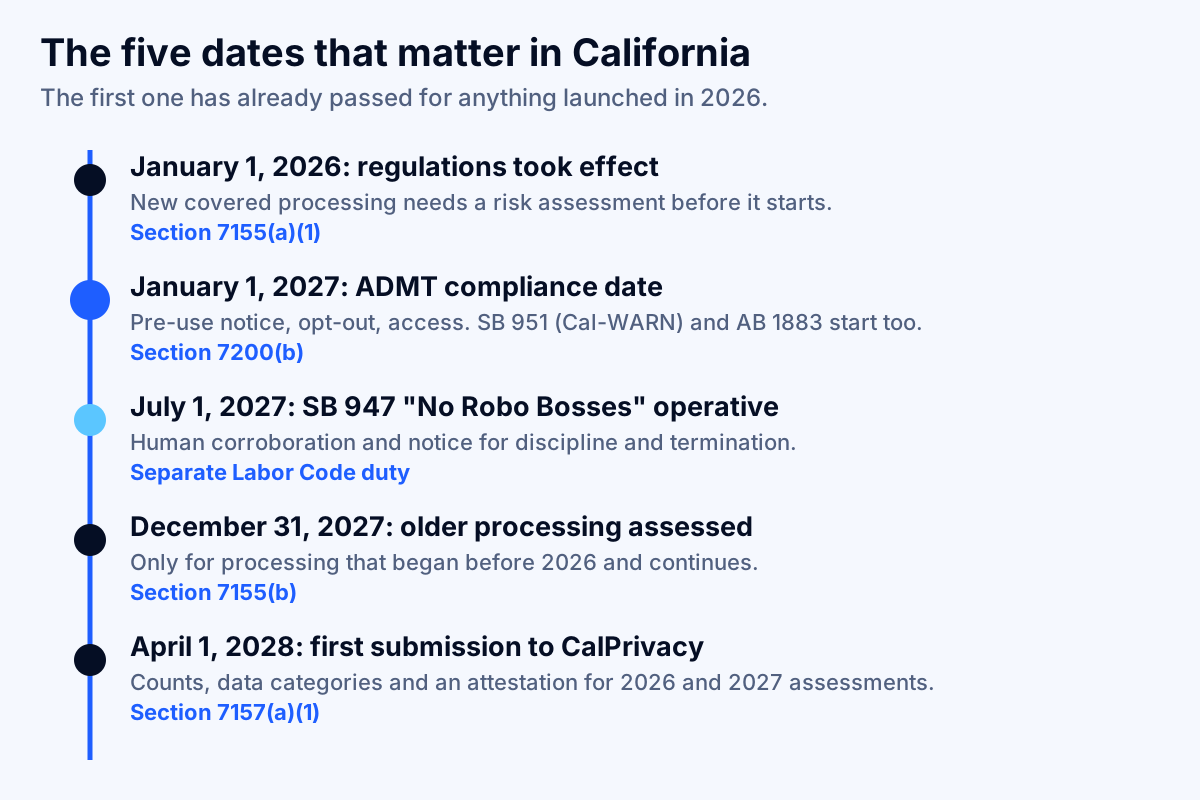
Article 11 of the CCPA regulations (sections 7200 to 7222) sets three duties for automated decisionmaking technology, or ADMT, and Article 10 adds a fourth. Section 7200(b) applies them to tools already running: a business using ADMT for a significant decision before January 1, 2027 must comply no later than that date.
| Duty | What you must do | Section | When |
|---|---|---|---|
| Pre-use notice | Tell people the specific purpose, their rights and how the tool works, at or before collection | 7220 | January 1, 2027 |
| Opt-out | Offer two or more ways to opt out, unless an exception applies | 7221 | January 1, 2027 |
| Access | Explain the purpose, logic, output and outcome on request | 7222 | January 1, 2027 |
| Risk assessment, new processing | Conduct and document it before starting | 7150, 7155(a)(1) | Since January 1, 2026 |
| Risk assessment, older processing | Complete it for processing begun before 2026 that continues | 7155(b) | December 31, 2027 |
| Submission to the agency | Report counts and categories, with an attestation | 7157(a)(1) | April 1, 2028 |
The California Privacy Protection Agency, which now also goes by CalPrivacy, completed this rulemaking when the Office of Administrative Law approved it on September 22, 2025. As of November 2026 its regulations page lists no proposed package changing these rules. So the January date is not waiting on anything.
Who has to comply with California's ADMT rules?
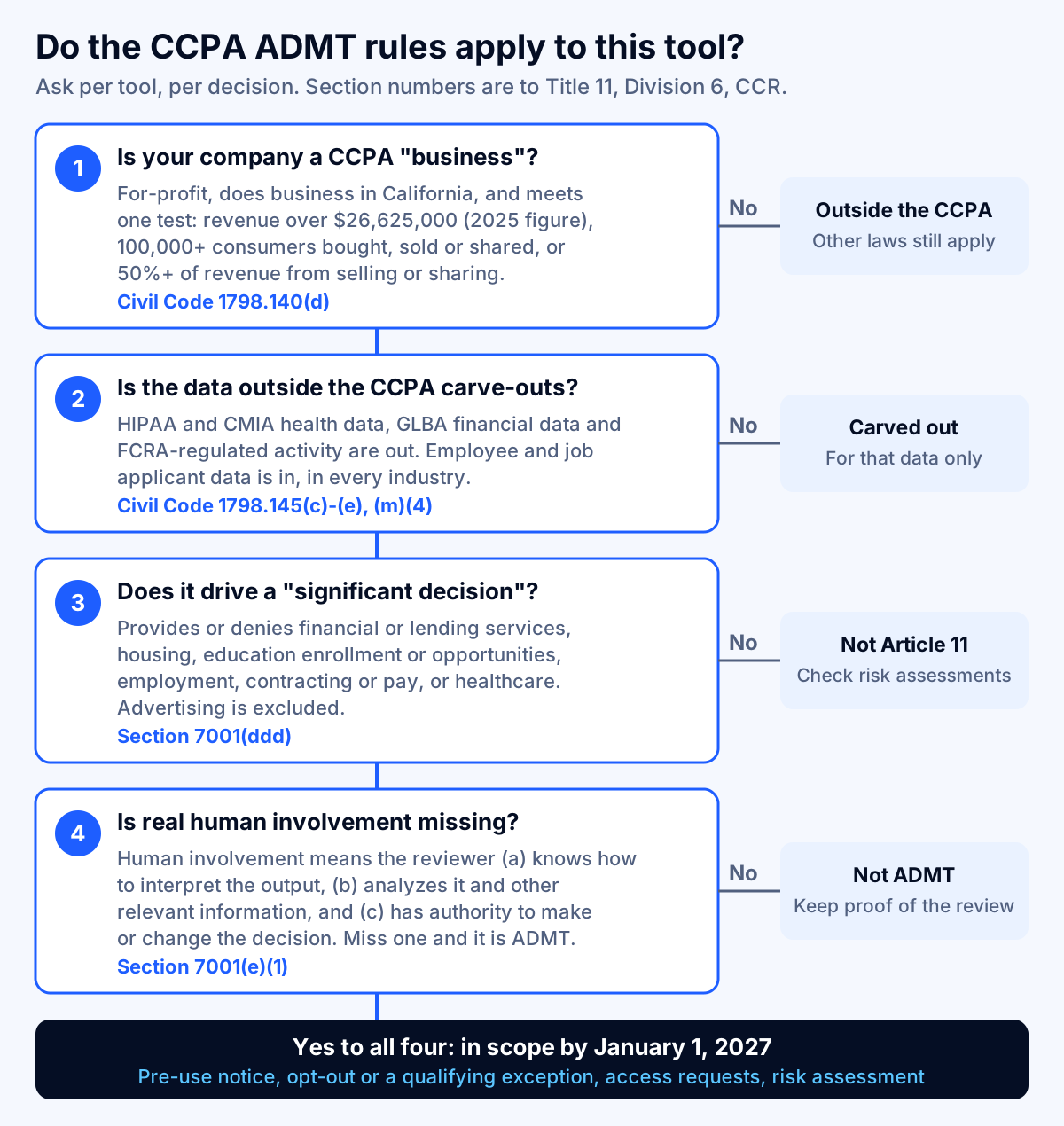
A company has to comply if it is a CCPA "business" and uses ADMT for a significant decision about a California resident. Civil Code section 1798.140(d) defines a business as a for-profit entity doing business in California that meets at least one test:
- Revenue: annual gross revenue above $26,625,000, the figure in effect since January 1, 2025. The statute requires another adjustment on January 1 of each odd-numbered year, so recheck this in January 2027.
- Volume: buys, sells or shares the personal information of 100,000 or more consumers or households a year.
- Data sales: derives 50% or more of annual revenue from selling or sharing personal information.
The agency's own estimate is that 10% of covered businesses, or 5,233 firms, will have ADMT duties. The agency says narrowing the ADMT definition and limiting the rules to significant decisions significantly reduced that number.
Employees and applicants count
California residents count as consumers even when they are your employees or job applicants. The workforce exemption in section 1798.145(m) became inoperative on January 1, 2023. This is why the regulations' examples are full of resume screeners and work allocation tools, and why a company with few California consumers can still have real exposure through its California staff.
The regulated-industry carve-outs are about data, not companies
The CCPA excludes certain data and activities: protected health information and medical information (1798.145(c)), activity regulated by the Fair Credit Reporting Act (1798.145(d)) and personal information subject to the Gramm-Leach-Bliley Act (1798.145(e)). A bank's underwriting file may fall outside the CCPA. Its applicant-tracking system does not.
Section 7271 makes the point for insurers directly: claim data subject to the Insurance Code is outside the CCPA, while an insurer's employee and job applicant data stays inside it. For most regulated firms, the practical ADMT work therefore starts in HR rather than in the core product. Map this with counsel, since the exemptions turn on exactly how each data set is held and used. Our guides on GLBA and generative AI and the HIPAA AI checklist cover the federal side.
What counts as ADMT under section 7001(e)?
ADMT is any technology that processes personal information and uses computation to replace, or substantially replace, human decisionmaking. It does not have to be AI. Littler's analysis notes that even a simple rule-based screen, such as a filter for a certification, may qualify. Inventories built by asking "where do we use AI?" will miss those.
"Substantially replace" has a precise meaning: using the output to make a decision without human involvement. Under section 7001(e)(1), human involvement requires a reviewer who:
- Knows how to interpret and use the output.
- Reviews and analyzes the output and any other relevant information.
- Has authority to make or change the decision based on that analysis.
All three are required. Thompson Coburn's reading is that a rubber-stamp approval does not qualify, and neither does a process where nobody can override the model. Volume is the practical test here. If one recruiter "reviews" 800 ranked applicants in an hour, you would have a hard time showing analysis of other relevant information.
The rule also excludes web hosting, storage, firewalls, spam filters, spellcheckers, calculators, databases and spreadsheets, but only if they "do not replace human decisionmaking." A spreadsheet formula that automatically rejects applicants is not safe just because it lives in a spreadsheet.
What counts as a significant decision?
A significant decision provides or denies one of five things, as defined in section 7001(ddd):
| Category | What the regulation includes | Notable limit |
|---|---|---|
| Financial or lending services | Credit or loans, transmitting or exchanging funds, deposit or checking accounts, check cashing, installment plans | Data may be carved out by GLBA or FCRA |
| Housing | Homes, residences and sleeping places, including temporary occupancy | Decisions based solely on vacancy or receipt of payment are excluded |
| Education | Admission, credentials, suspension and expulsion | |
| Employment and contracting | Hiring; work allocation for employees; pay, bonuses and benefits; promotion; demotion, suspension and termination | |
| Healthcare services | Diagnosis, prevention, treatment, assessment or care | Patient data may be carved out by HIPAA or CMIA |
Advertising is expressly excluded. Pricing, marketing segmentation and product recommendations generally sit outside the list too, unless they result in the provision or denial of one of these five services.
Is your tool in scope? Twelve common examples
The table below applies the test to tools companies commonly use. These are our readings of the text, not agency rulings, and the answer can change with how you actually run the tool. Items marked "regulation example" come directly from sections 7150 or 7220.
| Tool and how it is used | Likely result | Why |
|---|---|---|
| Video interview software that scores emotion and picks who to hire, with no human review | In scope (regulation example) | Section 7150(c)(1) uses nearly this scenario |
| Resume software deciding which applicants to hire | In scope if no qualifying human review (regulation example) | Section 7220(e)(2) |
| ATS knockout rule that auto-rejects applicants missing a credential | Likely in scope | Rule-based is still computation, and nobody reviews the rejection |
| Ranker where recruiters read only the top 50 | Likely in scope for those below the line | No human analyzes the ones who never get read |
| Algorithm that assigns shifts or routes work to employees | In scope (regulation example) | Section 7220(e)(4); exception (b)(3) may remove the opt-out |
| Productivity monitoring that sets pay or picks who is demoted | In scope (regulation example) | Section 7220(e)(1); pay and demotion follow different exception paths |
| Plagiarism software that automatically determines suspension | In scope (regulation example) | Section 7220(e)(3) |
| Tenant screening score that auto-denies applicants | Likely in scope | Housing, though FCRA may cover consumer-report activity |
| Automated prior authorization denial | Depends | Healthcare decision, but HIPAA-covered data may be carved out |
| AI summary of a resume for a hiring manager who reads the file and decides | Likely out, if documented | Human involvement test can be met |
| Agent that drafts a credit memo for a loan officer with real authority | Likely out, if documented | Same test, and GLBA may apply as well |
| Spam filter, or ad targeting | Out of Article 11 | Excluded technology, or excluded from significant decisions |
Key takeaway: Scope is set per decision, not per product. The same HR platform can be out of scope for one workflow and in scope for another, so inventory workflows rather than vendors.
Which ADMT opt-out exceptions apply to each decision?
Section 7221(a) makes opt-out the default, and section 7221(b) gives three exceptions. Only one of them, the human appeal, is available for every decision type. This detail is easy to lose in a summary, so here it is by decision.
| Decision | Human appeal (b)(1) | Admission or hiring (b)(2) | Work and pay (b)(3) |
|---|---|---|---|
| Hiring | Yes | Yes | No |
| Academic or vocational admission | Yes | Yes | No |
| Work allocation for employees | Yes | No | Yes |
| Salary, hourly or per-assignment pay, bonus, benefits | Yes | No | Yes |
| Promotion | Yes | No | No |
| Demotion, suspension, termination | Yes | No | No |
| Credentials, student suspension or expulsion | Yes | No | No |
| Lending or financial services | Yes | No | No |
| Housing | Yes | No | No |
| Healthcare services | Yes | No | No |
Each exception has conditions that you need to be able to prove:
- Human appeal. Designate a reviewer who knows how to interpret the output, considers what the consumer submits and has authority to overturn the decision. The appeal must be easy to use and require minimal steps. Appeals follow section 7021: confirm within 10 business days, respond within 45 calendar days, extendable to 90 with notice and a reason.
- Admission or hiring. The tool must be used solely to assess ability to perform at work or in the program, and it must work for that purpose and not unlawfully discriminate.
- Work and pay. The tool must be used solely for allocating work or setting compensation, with the same "works and does not unlawfully discriminate" condition.
The word "solely" is where these can fail. Consider a productivity score used for both assigning shifts and choosing who gets demoted. The shift use may qualify for (b)(3), but the demotion use needs an appeal or an opt-out. And since (b)(2) and (b)(3) both depend on the tool working without unlawful discrimination, you should keep validation and bias testing results on file. Those results also help with California's employment discrimination rules, covered below.
No exception removes the other duties. Under section 7220(c)(2), a business relying on the appeal exception must explain how to appeal, and one relying on another exception must name it in the notice. Access rights under section 7222 apply either way.
If you do offer an opt-out
Section 7221 is specific about the mechanics:
- Two or more methods, with at least one matching how you primarily interact with the person.
- For online relationships, an interactive form behind a link whose title says what it does, such as "Opt-out of Automated Decisionmaking Technology."
- A cookie banner alone does not count.
- No account creation and no verifiable consumer request.
- A way for the consumer to confirm their request was processed.
- Stop processing as soon as feasibly possible, and within 15 business days at the latest, and instruct your vendors to do the same in that window.
- Wait at least 12 months before asking the person to consent again.
- No retaliation.
The hard part is not the form. You need a real alternative path that a person can actually run, and the pre-use notice has to describe it. Section 7220(c)(5)(C) requires you to say how the decision will be made for those who opt out. If you cannot staff that path, plan on using an exception instead.
How do you write a CCPA pre-use notice?
A pre-use notice must state the specific purpose, describe the rights and explain how the tool works, and it must reach the person at or before collecting the data you plan to process with ADMT. If you already hold the data for another purpose, it must arrive before you process it with ADMT. It can sit inside your notice at collection and can use a layered format or hyperlink for the "how it works" detail. Section 7220(e) lets you consolidate notices across tools and uses.
Section 7220(c)(1) forbids generic wording such as "to make a significant decision." Here is a starting draft for an applicant-screening tool that relies on the appeal exception. It is a template to adapt with counsel, not approved language.
How we use automated tools in hiring. When you apply for [role type], we use [tool description] to decide which applicants move to an interview. It reviews the [work history, skills, credentials and application answers] you give us and produces a [match score from 0 to 100]. Applicants below [threshold] do not move forward unless a person reviews the application on appeal.
Your right to appeal. You may ask a trained member of our recruiting team who can overturn the result to review it. Use [link] or email [address], and include anything you want the reviewer to consider.
Your right to access. You may ask us how the tool was used for you, including its logic, its output and how that output affected the decision. Use [link].
No retaliation. We are prohibited from retaliating against you for exercising your CCPA rights.
Two details get missed. First, if a person participates but does not meet the human involvement test, section 7220(c)(5)(B) expects you to describe that person's role honestly, which rules out implying a full human review. Second, you do not have to disclose trade secrets, or anything that would compromise security, fraud prevention or physical safety, under section 7220(d). That protects your scoring weights. It does not excuse a vague description.
What must an ADMT access response include?
An access response must explain, in plain language, the specific purpose, the logic, and the outcome for that person, including how the output was used and what else played a role. Section 7222(b)(2) says the logic explanation must enable the consumer to understand how the ADMT processed their personal information, which may include the parameters and the specific output.
Requests must be verified. Timing follows section 7021: 10 business days to confirm and 45 calendar days to respond, extendable to 90 with notice. Three provisions make this more workable:
- Aggregation. If you used the tool on a person more than four times in 12 months, you may give a summary of outputs and the parameters that mattered on average (section 7222(j)). This helps with shift-assignment tools.
- Existing channels. You may reuse your request-to-know method (section 7222(d)) or a secure self-service portal (section 7222(h)).
- Vendor duty. Service providers and contractors must help and must provide or give access to the consumer's data they hold (section 7222(i)).
You cannot produce this answer from a vendor's marketing sheet. You need a decision-level record. This table maps each legal element to what to log, and it extends our AI audit trail requirements guide. If you run agents, our guide to monitoring AI agents in production shows how to capture this in traces.
| Access element | What to log for each decision | Common gap |
|---|---|---|
| Specific purpose | Workflow ID linked to a plain-language purpose | Purpose held only in a policy document |
| Logic and parameters | Model or rule version; the parameters or input categories that drove the output | Vendor overwrites versions with no history |
| Output for this person | The score, rank or classification as produced | Only the final decision is stored |
| Outcome and use | Decision, threshold applied, other factors considered | Other factors live in email |
| Human role | Reviewer ID, what they looked at, changed or not, time spent | A click with no record of the analysis |
| Rights status | Notice version and date; opt-out, appeal or access events | Notice versions not retained |
Under section 7155(c), risk assessments must be retained for as long as the processing continues or five years after completion, whichever is later. California's employment discrimination rules separately call for four years of automated decision records. For employment tools, setting decision logs to at least four years is a sensible floor. Your counsel may set it longer.
When are CCPA risk assessments due for AI tools?
A CCPA risk assessment is due before you begin covered processing. For processing that began before January 1, 2026 and continues, the deadline is December 31, 2027. It is easy to read 2027 as the deadline for everything, which is wrong for anything launched this year. If you launched a scoring tool for hiring in March 2026, section 7155(a)(1) required the assessment first, so do it now rather than waiting.
Section 7150(b) triggers go beyond ADMT for significant decisions. Two matter for AI teams:
- Training. Processing personal information you intend to use to train ADMT for a significant decision, or to train facial recognition, emotion recognition or identity technology, needs an assessment (7150(b)(6)).
- Workforce inference. Using automated processing to infer an employee's or applicant's performance, reliability, behavior and similar traits based on systematic observation needs one too, even when a human makes the final call (7150(b)(4)). So a tool can escape ADMT and still need a risk assessment.
For ADMT, section 7152 also requires you to document the logic, including assumptions and limitations, and the output and how you will use it. Safeguards can include policies, procedures and training to ensure the tool works and does not unlawfully discriminate. Under section 7154, the stated goal is restricting or prohibiting processing if the privacy risks outweigh the benefits.
After that, the calendar is: review at least every three years, update within 45 calendar days of a material change, and submit to the agency by April 1, 2028 for 2026 and 2027 assessments, then by April 1 each year after. Change control matters here. Swapping a model version can be a material change if it creates new negative impacts or weakens a safeguard.
What should you ask ADMT vendors?
Your contract and your vendor's behavior both have to support your compliance, and the duties reach vendors directly. Section 7050 contemplates that service provider contracts require help with ADMT requirements and risk assessments. Section 7153 says a company that makes ADMT available to another business for a significant decision must provide all facts available that the recipient needs for its own risk assessment, if the ADMT was trained on personal information.
Send every vendor in your inventory these questions now:
- Can the product run with a person making or changing each decision, and does it log that review?
- What categories of personal information affect the output?
- Can you give us a plain-language description of the logic, the assumptions and the known limitations?
- Do you retain the output for each person, along with the model or rule version that produced it?
- Can you honor an opt-out flag for one person within 15 business days, across all your processing?
- What validation and bias testing supports use for our purpose, and can we keep the results?
- Was the product trained on personal information, and will you give us the facts section 7153 requires?
- Will you notify us before a model change that could affect our risk assessment?
A "CCPA compliant" badge answers none of these. Our AI vendor risk assessment questionnaire covers the wider due diligence. Mayer Brown's January 2026 note also recommends updating service provider contracts for this.
How do the ADMT rules overlap with SB 947, FEHA and Colorado?
The ADMT rules are one of several California duties, and meeting one does not satisfy the others. The biggest recent change is SB 947, the No Robo Bosses Act, signed September 30, 2026. DLA Piper notes that its notice safe harbor for other state laws does not extend to the ADMT regulations, so covered employers may owe both.
| CCPA ADMT rules | FEHA automated-decision rules | SB 947 | Colorado SB 26-189 | |
|---|---|---|---|---|
| Start date | January 1, 2027 | October 1, 2025 | July 1, 2027 | January 1, 2027 |
| Covers | CCPA businesses; five decision types | California employers and their agents; employment decisions | Employers; discipline and termination of employees | Developers and deployers doing business in Colorado |
| A human in the loop | Can take the tool out of scope | Does not; a tool that facilitates decisions counts | Required when the employer primarily relies on the tool | Does not by itself; see our guide |
| Notice | Before use | Focus is discrimination and records | At the time of the decision | Before use, plus after an adverse outcome |
| Remedy path | CalPrivacy and Attorney General | Discrimination claims | Labor Commissioner and public prosecutors; $500 per violation | Colorado Attorney General |
Three consequences follow for an employer running a termination-risk tool:
- Human review does different work in each law. Under the CCPA, a good review can remove the tool from ADMT. Under SB 947, the human must corroborate the output, and the employer must still give written notice if it primarily relied on the tool. Build one review record that serves both.
- Discrimination risk does not depend on any of this. The Civil Rights Council's rules treat anti-bias testing as relevant evidence in defending claims, and they extend to agents such as staffing vendors. For how these rules compare with New York City's bias audits and the Illinois and Connecticut notice laws, see our AI hiring compliance by state checklist.
- More laws start January 1, 2027. SB 951 and AB 1883 cover AI-related layoff notices under Cal-WARN and emotion inference and neural data in workplace surveillance. Check them in the same inventory pass.
If you also operate in other states, see our Colorado AI Act compliance guide and Texas TRAIGA checklist. Inventory and logs carry over well. Notices and appeal mechanics generally do not.
CalPrivacy may also not be finished. It opened preliminary comments on employee data in April 2026, closing May 20, and the Final Statement of Reasons says the agency may revisit the ADMT definition in future rulemaking. Nothing is proposed as of November 2026, but build your inventory so it can absorb changes.
What does ADMT compliance cost, and how is it enforced?
The agency's own estimate of ADMT direct costs is $447.7 million over 10 years, across its estimated 5,233 affected firms. By our arithmetic, that averages about $85,600 per firm over the decade, or roughly $8,600 a year. It is an average resting on the agency's own assumptions, not a quote for your company. What moves your actual number:
- The number of workflows in scope, more than the number of tools.
- Whether you run an alternative path or appeals, since those are staffed processes that keep costing money.
- How much logging your vendors already do. Retrofitting decision records into a closed product is where budgets slip.
- Human review volume. Littler notes that meaningful review may be impractical for high-volume screening but more workable for individual employee evaluations.
That last point is a real trade-off. Adding genuine human review can take a tool out of ADMT, but it adds labor to every decision, while notices and appeals add labor only when someone uses them. Our rule of thumb: for screening thousands of applicants, price out accepting ADMT status and running the appeal exception. For a few dozen termination decisions a year, genuine human review is often the better choice, and SB 947 pushes you there anyway.
On enforcement, the current cap is $2,663 per violation or $7,988 per intentional violation, with the next inflation adjustment due January 1, 2027. CalPrivacy and the Attorney General enforce the rules, and section 1798.150 limits the private right of action to certain data breaches. We found no ADMT enforcement action as of November 2026, which is expected before the compliance date.
The agency has already shown interest in workforce notices, however. Its $1.35 million Tractor Supply decision on September 30, 2025 included failing to tell California job applicants about their privacy rights, the first such finding. Outsiders can test a missing pre-use notice just by applying for a job.
An eight-week plan to January 1, 2027
Eight weeks is enough to get the required elements working if you scope tightly and start with the highest-risk workflows. Use this plan if you are starting from zero:
| Week of | Work | Owner | Output |
|---|---|---|---|
| November 9 | Inventory workflows behind the five decision types; ask HR, finance and operations, not only IT | Privacy lead | Workflow list |
| November 16 | Apply the scope test; send vendor questions; map carve-outs with counsel | Privacy lead, counsel | In-scope list, vendor requests |
| November 23 | Test real human involvement: sample recent decisions and check all three parts | Business owners | Pass or fail per workflow |
| November 30 | Choose a path for each workflow using the exception matrix: human involvement, exception or opt-out | Counsel, HR | Path decisions |
| December 7 | Draft pre-use notices; build opt-out, appeal and access intake; name and train reviewers | Privacy, engineering | Notices, forms, reviewer list |
| December 14 | Turn on decision logging; amend vendor contracts; document validation for (b)(2) and (b)(3) | Engineering, procurement | Logs, amendments |
| December 21 | Write risk assessments for 2026 launches first, then in-scope tools; test opt-out, access and appeal end to end | Privacy, engineering | Assessments, test results |
| December 28 | Publish notices, update your privacy policy, recheck thresholds, calendar 2027 and 2028 dates | Privacy lead | Live program |
If you are short on time, prioritize in this order: tools that auto-reject or terminate with no human review, then anything launched in 2026 without a risk assessment, then notices for your largest applicant and employee populations. Start your AI readiness work separately if your team lacks an inventory altogether.
Common CCPA ADMT mistakes to avoid
- Scoping by asking "where do we use AI?" and missing rule-based knockouts.
- Assuming a sign-off step equals human involvement.
- Treating an exception as if it removes notice and access duties.
- Using "solely" exceptions for multi-purpose tools.
- Offering an appeal where the reviewer cannot actually overturn the result.
- Reading December 31, 2027 as the risk assessment deadline for tools launched in 2026.
- Assuming a future SB 947 notice will satisfy the pre-use notice.
- Assuming a financial or healthcare exemption covers your HR systems.
Bottom line
CCPA ADMT regulations compliance is mostly an inventory and evidence job. Find the workflows where software decides without genuine human involvement. Give people a specific notice, a working opt-out or appeal, and an honest answer when they ask how a decision was made. Then keep the records that prove it, because the same records also support your risk assessments, SB 947 corroboration and discrimination defenses.
If you want help mapping decision flows, adding decision-level logging or building appeal and opt-out workflows into your systems, our team that builds and operates it does this for companies in regulated industries, and the first conversation is a free discovery call. You can talk to a specialist about your tools, or see what else Fleurant AI builds.
If you'd like one clear, practical take on AI, software and cloud decisions each month, subscribe to the Fleurant AI Briefing: one email a month, unsubscribe any time.
Frequently asked questions
Does the CCPA ADMT deadline apply to tools we already use?
Yes. Section 7200(b) says a business using ADMT for a significant decision before January 1, 2027 must comply no later than that date, and any use after it must comply whenever the tool runs. There is no grandfathering for existing systems. The regulations themselves took effect January 1, 2026, so risk assessment duties for anything launched during 2026 applied before launch.
Do the ADMT rules apply to employees and job applicants?
Yes, for CCPA-covered businesses. The CCPA's temporary exemption for workforce data became inoperative on January 1, 2023, so California employees, applicants and contractors have the same rights as other consumers. The regulations use hiring, work allocation and termination as their main examples. Businesses below the CCPA thresholds are outside these rules, though other California employment laws can still apply.
Does having a human review the AI's output take a tool out of scope?
Only if the review meets all three parts of section 7001(e)(1). The reviewer must know how to interpret and use the output, must review and analyze it along with other relevant information, and must have authority to make or change the decision. A manager who clicks approve on every recommendation, or who cannot overrule the system, would struggle to meet that test.
Can we just offer an appeal instead of an opt-out?
Often, yes. Section 7221(b)(1) removes the opt-out if consumers can appeal to a qualified human reviewer with authority to overturn the decision. You must still describe the appeal in the pre-use notice, make it easy to use, confirm receipt within 10 business days and respond within 45 calendar days. Access rights continue to apply, so an appeal path does not remove the need for decision records.
Are banks, insurers and hospitals exempt from the ADMT rules?
Not as companies. The CCPA carve-outs for GLBA, FCRA and HIPAA are mainly about data and activities, not whole organizations. Loan files or patient records may fall outside the CCPA, while a resume screener used on California applicants does not. The insurance rules in section 7271 use employee and applicant data as an example of what stays covered. Confirm your own mapping with counsel.
What are the penalties for violating the ADMT regulations?
Under the amounts in effect since January 1, 2025, administrative fines and civil penalties can reach $2,663 per violation, or $7,988 per intentional violation. The statute requires another inflation adjustment on January 1, 2027, so check the agency's thresholds page. CalPrivacy and the Attorney General enforce these rules. The CCPA's private right of action is limited to certain data breaches.
How is SB 947 different from the CCPA ADMT rules?
SB 947, the No Robo Bosses Act, is a separate Labor Code law operative July 1, 2027. It covers employer discipline and termination decisions, requires human corroboration when an employer primarily relies on an automated system, and requires written notice at the time of the decision. Complying with its notice does not satisfy the CCPA's pre-use notice, so covered employers should plan for both.
Sources
- California Consumer Privacy Act Regulations, 11 CCR Division 6 (effective January 1, 2026), California Privacy Protection Agency
- CCPA Updates, Cybersecurity Audits, Risk Assessments, ADMT and Insurance Regulations: rulemaking record, California Privacy Protection Agency
- Final Statement of Reasons: CCPA Updates, Cyber, Risk, ADMT and Insurance Regulations, California Privacy Protection Agency
- California Consumer Privacy Act statute (effective January 1, 2026), California Privacy Protection Agency
- CCPA Monetary Thresholds (CPI adjustment), California Privacy Protection Agency
- Employee data: preliminary rulemaking, CalPrivacy
- Tractor Supply decision announcement, California Privacy Protection Agency
- Civil Rights Council rulemaking actions, California Civil Rights Council
- California's new AI rules under FEHA take effect October 1, 2025, McDermott Will & Schulte
- California enacts SB 947: What employers need to know about the No Robo Bosses Act, DLA Piper
- California Just Banned Employers From Letting AI Fire Workers on Its Own, Fisher Phillips
- California's New Employment Laws for 2027: What Newsom Signed, What He Vetoed, California Employment Law Report
- California's Long-Awaited Final Regulations on Automated Decisionmaking Create New Compliance Challenges for Employers, Littler Mendelson
- California's ADMT Rules Under the CCPA: What They Mean for Significant Decisions, Thompson Coburn
- Updates to the CCPA Regulations: What Businesses Need to Know Now, Mayer Brown