AI Compliance
Texas Responsible AI Governance Act Compliance: 2026 Checklist
Texas Responsible AI Governance Act compliance in 2026: what HB 149 requires of businesses, who must disclose AI, the 60-day cure, penalties and NIST defense.

In this article
- What TRAIGA requires of a business, in one table
- Who must disclose AI use under TRAIGA (and who does not)
- What changed from the draft many guides still describe
- How TRAIGA treats discrimination, employers and regulated industries
- How the attorney general enforces TRAIGA
- How the NIST safe harbor works in the Texas AI law
- Other Texas rules that touch AI systems
- The sandbox, the AI council and federal preemption
- TRAIGA compliance checklist: ten steps
- Bottom line
- Frequently asked questions
- Sources
Texas Responsible AI Governance Act compliance is a smaller job for most private businesses than the headlines suggest, but it is not zero. The law (HB 149, known as TRAIGA) took effect January 1, 2026. For an ordinary company, it does three things: it bans a short list of intentional misuses of AI, it lets the Texas attorney general demand detailed documentation about any AI system after a consumer complaint, and it rewards companies that find and fix problems themselves under a recognized framework such as the NIST Generative AI Profile. The well-known "tell people they are talking to AI" rule applies only to government agencies and to health care providers.
That distinction matters because many published guides tell every business to add AI disclosures for Texas, and several still describe impact assessments and "high-risk AI" duties that were cut from the bill before it passed.
This guide works from the enrolled bill text and the attorney general's own pages, read on November 7, 2026. You will get a duty matrix by type of organization, the enforcement path with its 60-day cure window, a ten-point compliance checklist, and an evidence file you can build now so a civil investigative demand takes days to answer instead of months. It is not legal advice; confirm specifics with your counsel.
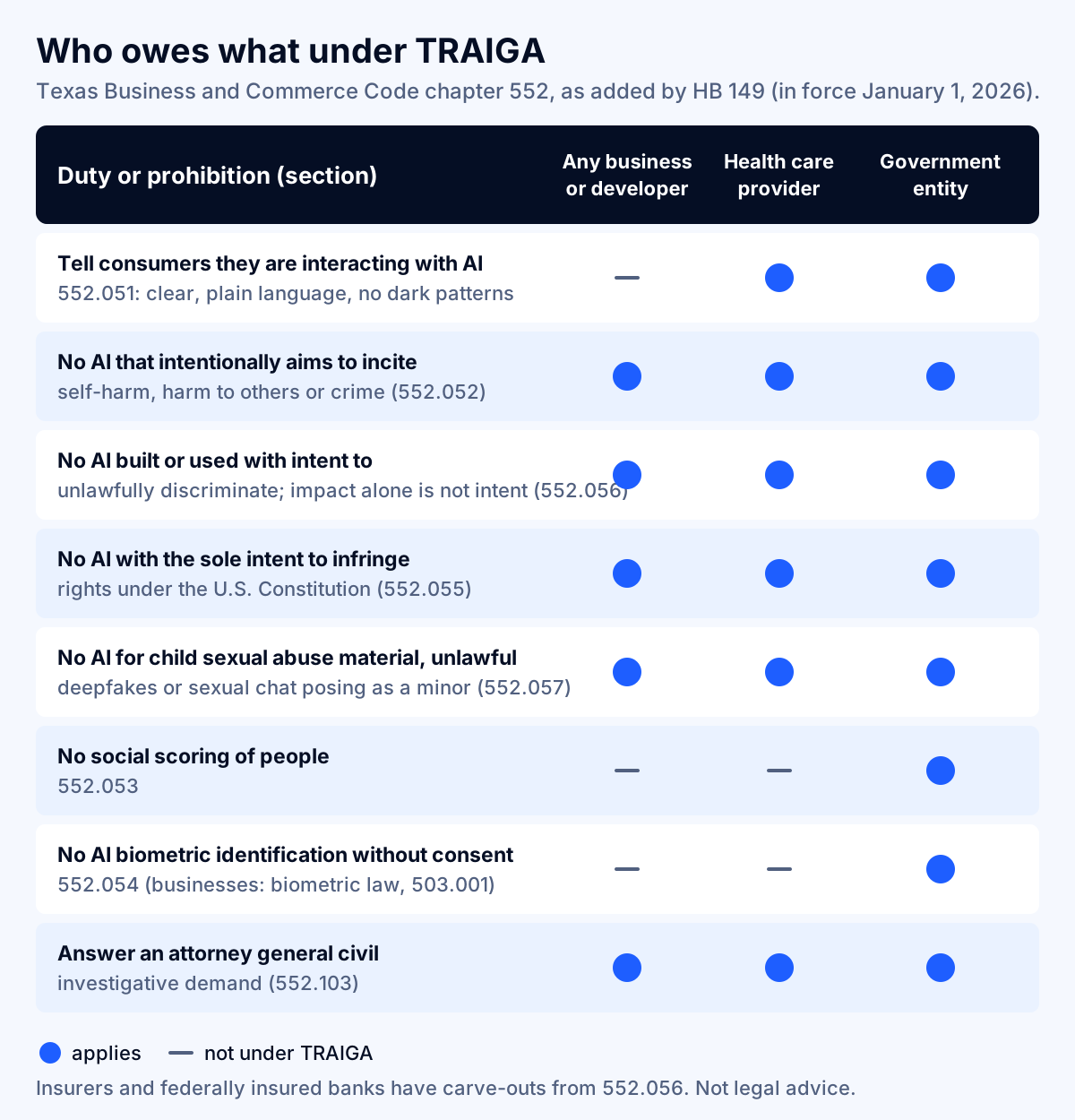
What TRAIGA requires of a business, in one table
TRAIGA's private-sector duties are mostly prohibitions with an intent requirement, plus an obligation to answer the attorney general's questions. The law adds a new Subtitle D, "Artificial Intelligence Protection", to the Texas Business and Commerce Code (chapters 551 to 554). Governor Abbott signed it on June 22, 2025, after the House passed it 146 to 3 and the Senate 31 to 0.
| Provision | Who it binds | What it means in practice |
|---|---|---|
| 551.002 Applicability | Anyone who promotes, advertises or does business in Texas, sells a product or service used by Texans, or develops or deploys AI in Texas | No size or revenue threshold. An out-of-state SaaS company with Texas users is covered. |
| 552.051 Disclosure | Governmental agencies; providers of health care services or treatment | Tell the consumer they are interacting with AI, clearly, in plain language, without dark patterns. |
| 552.052 Manipulation | Any developer or deployer | No AI that intentionally aims to incite self-harm (including suicide), harm to another person or criminal activity. |
| 552.053 Social scoring | Governmental entities | No AI social scores that lead to unjustified or unrelated unfavorable treatment. |
| 552.054 Biometric identification | Governmental entities | No AI identification of individuals from biometric data or scraped images without consent where it would infringe rights. |
| 552.055 Constitutional rights | Any developer or deployer | No AI developed or deployed with the sole intent to infringe constitutional rights. |
| 552.056 Discrimination | Any developer or deployer | No AI developed or deployed with intent to unlawfully discriminate against a protected class. Disparate impact alone is not enough to show intent. |
| 552.057 Sexual content and minors | Any developer or distributor | No AI built to produce child sexual abuse material or unlawful sexual deepfakes, or sexual chat that impersonates a minor. |
| 552.103 Investigations | Anyone reported through the complaint portal | Produce documentation on purpose, data, inputs, outputs, metrics, limits and safeguards when the attorney general issues a civil investigative demand. |
The definition of an AI system is broad: "any machine-based system that, for any explicit or implicit objective, infers from the inputs the system receives how to generate outputs, including content, decisions, predictions, or recommendations, that can influence physical or virtual environments" (section 551.001). A rules-only workflow is probably outside it; a chatbot, a scoring model, an AI agent or a document extractor is inside it.
Key takeaway: For most companies, TRAIGA compliance is about proving intent and diligence: document what each AI system is for, test it for the prohibited outcomes, and keep the records that let you answer the attorney general quickly.
Who must disclose AI use under TRAIGA (and who does not)
Under TRAIGA, the AI-interaction disclosure is owed by governmental agencies and by health care providers, not by businesses in general. Section 552.051(b) reads: "A governmental agency that makes available an artificial intelligence system intended to interact with consumers shall disclose to each consumer, before or at the time of interaction, that the consumer is interacting with an artificial intelligence system." The attorney general's overview describes the requirement the same way.
The disclosure must be clear and conspicuous, written in plain language and free of dark patterns (as defined in the Texas Data Privacy and Security Act), and it is required even when a reasonable person would already know it is AI. A hyperlink to a separate page is allowed.
Health care providers have their own deadline
Subsection (f) is the one private-sector disclosure duty. If AI "is used in relation to health care service or treatment", the provider must give the disclosure to the patient or their personal representative no later than the date the service or treatment is first provided, or as soon as reasonably possible in an emergency. "Health care services" means services from someone licensed, registered or certified to provide them.
Texas providers also have a second, older rule. SB 1188, in force since September 1, 2025, added section 183.005 to the Health and Safety Code: a practitioner may use AI for diagnostic purposes, including diagnosis or treatment recommendations from the medical record, only within the scope of their license, where the use is not otherwise restricted, and after reviewing all AI-created records under Texas Medical Board standards. The practitioner "must disclose the practitioner's use of that technology" to patients. SB 1188 also requires electronic health records to be stored in the United States for records stored on or after January 1, 2026. For the HIPAA side of building these tools, see our HIPAA compliant AI development checklist.
Should other businesses disclose anyway?
Usually yes, for reasons outside TRAIGA. The Texas attorney general's October 23, 2026 lawsuit against OpenAI, was brought under the Texas Deceptive Trade Practices Act, not TRAIGA, and centers on how the product's safety was represented to users. A plain "you're chatting with an AI assistant" line and accurate claims about what the tool can do cost little and protect you under consumer protection law in Texas and elsewhere. If you run an AI phone agent, our guide to the AI receptionist for small business covers disclosure wording.
One drafting wrinkle is worth flagging to counsel: subsection (c) says "a person is required to make the disclosure under Subsection (b)" even when the AI is obvious, while subsection (b) itself names only governmental agencies. The attorney general's page reads the duty as applying to agencies and health care providers, which matches the text of (b) and (f).
What changed from the draft many guides still describe
The enacted TRAIGA is much narrower than the first version, and pages that summarize the early draft give the wrong to-do list. Representative Capriglione's earlier bill, HB 1709, was built around "high-risk artificial intelligence systems", defined as any AI system "that is a substantial factor to a consequential decision". It required developers to share information with deployers and deployers to complete an impact assessment annually and within ninety days of a substantial modification, among other duties.
None of that survived into HB 149.
| Topic | HB 1709 as introduced | HB 149 as enacted (in force January 1, 2026) |
|---|---|---|
| Core concept | High-risk AI systems in consequential decisions | Specific prohibited uses, mostly intent-based |
| Impact assessments | Annual, plus within 90 days of a substantial modification | None |
| Risk management policy | Required | Not required; a recognized framework helps your defense |
| Consumer AI disclosure | Broad | Government agencies and health care providers only |
| Discrimination standard | Algorithmic discrimination duties | Intent to unlawfully discriminate; disparate impact alone is not enough |
| Enforcement | Attorney general | Attorney general only, 60-day cure, no private right of action |
If a vendor or consultant tells you Texas requires an annual AI impact assessment, ask which section. You may still want one, for Colorado, California or customer due diligence, but it is not a TRAIGA duty. Our Colorado AI Act compliance guide covers how Colorado's replacement law, SB 26-189, handles the same question from January 1, 2027.
How TRAIGA treats discrimination, employers and regulated industries
TRAIGA's discrimination rule requires intent, and it carves out insurers and federally insured banks that follow their own regulators' rules. Section 552.056(b) prohibits developing or deploying an AI system "with the intent to unlawfully discriminate against a protected class in violation of state or federal law", and subsection (c) adds that "a disparate impact is not sufficient by itself to demonstrate an intent to discriminate."
Three practical consequences follow.
Employers are partly covered. TRAIGA defines a "consumer" as a Texas resident "acting only in an individual or household context" and says the term "does not include an individual acting in a commercial or employment context." The consumer provisions therefore do not cover employees or job applicants. The discrimination prohibition, though, applies to "a person" who develops or deploys AI, so an AI screening tool built or used with discriminatory intent is within reach. Federal law and other states' hiring rules apply on their own terms regardless of TRAIGA; our AI hiring compliance by state guide maps them.
Insurers answer to the Department of Insurance. Section 552.002 says the chapter does not authorize any agency other than the Texas Department of Insurance to regulate the business of insurance. The discrimination section does not apply to an insurance entity providing insurance services if it is subject to the insurance unfair-discrimination and unfair-practices statutes, and the definition of insurance entity includes the developer of an AI system an insurer uses. Insurers should still track the Texas Department of Insurance's guidance and the NAIC framework covered in our NAIC AI model bulletin checklist.
Banks get a compliance presumption. A federally insured financial institution "is considered to be in compliance with this section if the institution complies with all federal and state banking laws and regulations." That moves the real work to fair lending and model risk management; see our AI governance framework for community banks.
Key takeaway: Intent is a fact question. Your best evidence of no intent is a documented purpose, a bias test run before launch and after changes, and a record of what you did when a test or complaint flagged a problem.
How the attorney general enforces TRAIGA
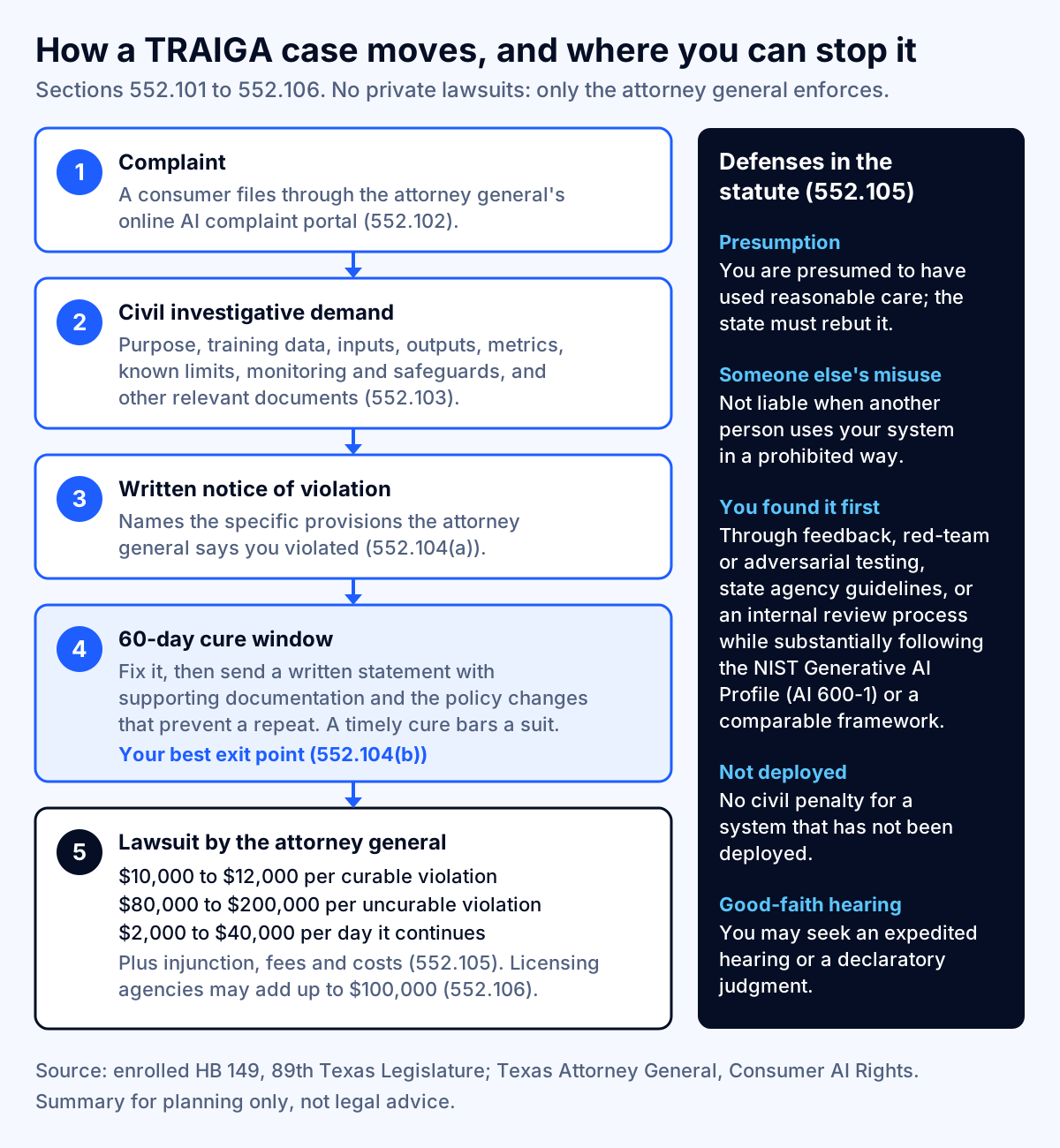
The Texas attorney general is the only enforcer, and every case starts with notice and a 60-day chance to cure. Section 552.101 gives the attorney general "exclusive authority" and says the chapter "does not provide a basis for, and is not subject to, a private right of action." The law required the attorney general to post an online complaint mechanism by September 1, 2026, and the attorney general's Consumer AI Rights page now links to a File An AI Complaint portal.
The civil investigative demand
After a complaint, the attorney general may issue a civil investigative demand under section 552.103 and ask for:
- A high-level description of the system's purpose, intended use, deployment context and benefits.
- The type of data used to program or train it.
- The categories of data it processes as inputs.
- The outputs it produces.
- Any metrics you use to evaluate its performance.
- Its known limitations.
- Post-deployment monitoring and user safeguards, including, for deployers, the oversight, use and learning process you set up to address issues.
- Any other documentation reasonably necessary for the investigation.
That list is the closest thing TRAIGA has to a documentation standard. If you cannot produce items 5 to 7 for a live system, that is the gap to close first.
Notice, cure and penalties
If the attorney general concludes there is a violation, it must send a written notice naming the specific provisions. It cannot sue before the 60th day, and it cannot sue at all if within those 60 days you cure the violation and send a written statement that you cured it, with supporting documentation and the internal policy changes made to prevent a repeat.
If you do not cure, section 552.105 sets civil penalties of:
| Type of violation | Penalty range |
|---|---|
| Curable, or breach of a cure statement you submitted | $10,000 to $12,000 per violation |
| Uncurable (as determined by the court) | $80,000 to $200,000 per violation |
| Continuing violation | $2,000 to $40,000 per day |
The attorney general can also seek an injunction, attorney's fees and investigative costs. Under section 552.106, if a person is found in violation and the attorney general recommends it, a state agency that licenses that person can add sanctions: suspension, probation or revocation of a license, and a monetary penalty of up to $100,000. For a licensed professional or a regulated firm, that second step can matter more than the fine.
As of November 7, 2026, the attorney general's news releases we reviewed announced no lawsuit brought under TRAIGA. The office has been active on AI under older laws, as the OpenAI case shows, so the practical risk today is a complaint that turns into a civil investigative demand.
How the NIST safe harbor works in the Texas AI law
TRAIGA does not require any framework, but it gives you a defense if you find and address a problem through a structured review. Section 552.105(e) says a defendant may not be found liable if another person misused the system in a prohibited way, or if the defendant discovers the violation through feedback from a developer, deployer or other person, through testing "including adversarial testing or red-team testing", by following state agency guidelines, or, if the defendant "substantially complies with the most recent version" of NIST's "Artificial Intelligence Risk Management Framework: Generative Artificial Intelligence Profile" or another recognized framework, through "an internal review process."
The framework named is NIST AI 600-1, published July 26, 2024. It is a companion profile to the NIST AI Risk Management Framework (AI 100-1), organized under the same Govern, Map, Measure and Manage functions. The statute also gives every defendant a rebuttable presumption that it used reasonable care, bars civil penalties for systems that have not been deployed, and lets a defendant who believes in good faith it has not violated the chapter seek an expedited hearing or declaratory judgment.
What "substantially complies" means has not been tested in court. A reasonable reading, and the one that helps you most in a cure letter, is evidence of four things:
- Govern: a named owner for each AI system, an AI acceptable use policy that forbids the prohibited uses, and a review step before launch.
- Map: a written purpose and context for each system, including who it affects and which TRAIGA provisions could be relevant.
- Measure: pre-launch and periodic testing for the prohibited outcomes, including red-team prompts for self-harm and illegal activity, and outcome checks across protected groups where the system scores or ranks people. Our guide to evaluating AI chatbot accuracy covers sample sizes and test sets.
- Manage: a record of each issue found, what you changed and when, which is exactly what a cure statement needs.
Key takeaway: The safe harbor rewards discovery, not paperwork. A dated red-team log showing you found a harmful output and fixed it is worth more than a framework document nobody follows.
Other Texas rules that touch AI systems
TRAIGA also amended two existing Texas laws that matter to AI builders, and Texas privacy law adds its own AI-adjacent duties.
Biometric identifiers (section 503.001). HB 149 amended the Texas biometric identifier law. A person is not considered to have been informed of or consented to the capture of their biometric identifiers for a commercial purpose just because an image or recording of them exists online, unless they made it public themselves. The amendment also exempts training, processing or storing biometric identifiers to develop, train, evaluate or offer AI models, unless the system is used or deployed to uniquely identify a specific individual. If identifiers gathered for AI training are later used for another commercial purpose, the normal possession, destruction and penalty rules apply.
Processor duties (section 541.104). Under the Texas Data Privacy and Security Act, processors must help controllers secure personal data. HB 149 extends that to "the personal data collected, stored, and processed by an artificial intelligence system." Put this in your AI vendor contracts; our AI vendor risk assessment has the questions to ask.
Profiling opt-outs and assessments. The Texas Data Privacy and Security Act, in force since July 1, 2024, already gives Texans the right to opt out of profiling in furtherance of decisions about financial and lending services, housing, insurance, health care, education enrollment, employment, criminal justice or access to basic necessities. Controllers must conduct data protection assessments for profiling that presents certain reasonably foreseeable risks. Small businesses as defined by the SBA are generally exempt, except for consent before selling sensitive data. For many companies, these privacy duties are more demanding than TRAIGA itself.
Local rules are preempted. Section 552.003 says the chapter supersedes any city or county ordinance on the use of AI systems, so there is one Texas standard to track.
The sandbox, the AI council and federal preemption
Three more parts of TRAIGA shape the landscape without adding duties for most companies.
Regulatory sandbox. Chapter 553 directs the Texas Department of Information Resources, with the new AI council, to run a sandbox in which an approved participant can test an AI system for up to 36 months without a license that would otherwise be required. Applicants must describe the system, assess benefits and risks to consumers, privacy and public safety, explain how they will mitigate harm and show compliance with federal AI law, then file quarterly reports. The sandbox cannot waive the chapter 552 prohibitions. It is aimed at regulated activities such as health care or financial services, and the department sets the application form by rule, so check its current status before planning around it.
Texas Artificial Intelligence Council. Chapter 554 creates a seven-member council that studies AI and reports to the legislature. It "may not adopt rules or promulgate guidance that is binding for any entity", so its reports are signals, not obligations.
Federal preemption. Executive Order 14365, signed December 11, 2025, directed the attorney general to create an AI Litigation Task Force within 30 days and the Secretary of Commerce to evaluate state AI laws within 90 days, and called for a legislative proposal for a uniform federal framework. An executive order cannot by itself repeal a state law, and as of November 7, 2026 no court had blocked TRAIGA, so plan as if it applies. If Congress passes a preemptive federal standard, the documentation you build for TRAIGA will carry over, because every framework under discussion asks for the same evidence: purpose, data, testing, monitoring and incident response.
TRAIGA compliance checklist: ten steps
This checklist turns the statute into work items, each with the evidence that proves it. It assumes a private company that builds or uses AI and has customers or users in Texas.
| # | Step | Evidence to keep | Section |
|---|---|---|---|
| 1 | Inventory every AI system that touches Texas users, including vendor tools and agents | System register with owner, purpose, vendor, launch date | 551.001, 551.002 |
| 2 | Classify each as developer, deployer or both | Role noted in the register; contracts | 552.001 |
| 3 | Decide whether a disclosure duty applies (government work, health care) and add one anyway for consumer-facing bots | Screenshot of disclosure; script for voice agents | 552.051 |
| 4 | Write the prohibited uses into policy and product requirements | AI acceptable use policy; product spec sign-off | 552.052 to 552.057 |
| 5 | Red-team consumer-facing systems for self-harm, violence and crime prompts before launch and after major changes | Dated test log, prompts, outputs, fixes | 552.052, 552.105(e) |
| 6 | Test scoring or ranking systems for outcome differences across protected groups and record the business reason for the design | Test results, sample sizes, decision memo | 552.056 |
| 7 | Choose a framework (NIST AI 600-1 or another recognized one) and run an internal review on a schedule | Review minutes, issues found, owners, due dates | 552.105(e) |
| 8 | Build the civil investigative demand file for each live system (eight items listed above) | One folder per system, refreshed quarterly | 552.103 |
| 9 | Monitor live systems and log incidents and fixes | Monitoring dashboards, incident tickets, change log | 552.103(b)(7) |
| 10 | Prepare a cure playbook: who receives a notice, who investigates, who drafts the written statement, within 60 days | Named roles, template statement, counsel contact | 552.104 |
Steps 8 and 9 are where most teams have nothing ready. If your AI system cannot show which version answered a user, what data it used and what was changed after a complaint, start with logging. Our guides to AI audit trail requirements and how to monitor AI agents in production show what to capture and what it costs.
A 60-day cure playbook
If a notice arrives, the clock is short. A workable sequence:
- Days 1 to 5: log the notice, preserve records for the named system, brief counsel, identify the system owner.
- Days 5 to 20: reproduce the alleged behavior, find the root cause, and check whether the same issue exists elsewhere.
- Days 20 to 40: ship the fix, re-run the tests that would have caught it, update the policy or control that failed.
- Days 40 to 55: draft the written statement with counsel: what was cured, the supporting documentation, and the policy changes.
- Before day 60: send the statement, and keep proof of delivery.
Common TRAIGA compliance mistakes
A few errors show up repeatedly in TRAIGA guidance and in company plans.
- Adding Texas-specific impact assessments as a legal requirement. HB 149 has none. Do one if another law or a customer needs it, and say so honestly.
- Assuming no disclosure risk because TRAIGA does not require one. The attorney general's October 2026 OpenAI lawsuit was brought under the Deceptive Trade Practices Act. Misleading claims about an AI product's safety or accuracy are the larger exposure.
- Treating "no intent" as a defense you can assert later. Intent will be judged from your records. If the only documentation is a launch announcement, you have little to show.
- Forgetting health care. Clinics, telehealth companies and practice-management vendors whose AI is used in care need the patient disclosure by the first date of service, plus the SB 1188 diagnostic-use disclosure and record review.
- Ignoring vendor systems. You are a deployer of the chatbot or agent you license. Contract for the documentation you would need to answer a civil investigative demand.
Bottom line
Texas Responsible AI Governance Act compliance comes down to three things for most private companies. Know every AI system you run and what it is for. Test it for the outcomes the law prohibits and keep dated proof of what you found and fixed. Have the eight-part documentation file and a 60-day cure plan ready before a complaint arrives. Health care providers and companies that build AI for Texas government agencies have the added disclosure duty, and insurers and banks should work through their own regulators' rules first.
The same evidence also covers Colorado's SB 26-189, California's ADMT rules, customer security reviews and any federal standard that replaces the state patchwork. If you want help building the system inventory, the red-team and bias testing, or the logging that makes a civil investigative demand routine, our team that builds and operates it does this work for companies in regulated industries, starting with a free discovery call. You can also talk to a specialist about your own systems, or see everything Fleurant AI builds.
If you'd like one clear, practical take on AI, software and cloud decisions each month, subscribe to the Fleurant AI Briefing: one email a month, unsubscribe any time.
Frequently asked questions
Does TRAIGA apply to private businesses or only to government?
Both, but very differently. Any person who does business in Texas, sells a product or service used by Texans, or develops or deploys AI in Texas is covered by the law's prohibitions: AI aimed at inciting self-harm, harm or crime, AI built with intent to unlawfully discriminate, AI meant solely to infringe constitutional rights, and AI for child sexual abuse material or unlawful deepfakes. The duty to tell consumers they are talking to AI applies to government agencies and to health care providers, not to businesses generally.
Do businesses have to disclose AI chatbots under TRAIGA?
Not as a general rule. Section 552.051 puts the 'you are interacting with AI' disclosure on governmental agencies, plus any provider of health care services or treatment that uses AI in that care, who must disclose by the date care is first provided. A retailer's or software company's chatbot has no TRAIGA disclosure duty, although a plain disclosure is still wise because the Texas Deceptive Trade Practices Act and other states' bot laws can apply.
Does TRAIGA apply to AI hiring tools and employees?
Partly. TRAIGA defines a 'consumer' as a Texas resident acting in an individual or household context and expressly excludes the employment context, so its consumer provisions do not cover employees or applicants. Its prohibition on developing or deploying AI with intent to unlawfully discriminate applies to 'a person', so it can reach a hiring tool. Disparate impact alone does not prove intent under TRAIGA, but federal and other state employment laws still apply on their own terms.
What are the penalties for violating TRAIGA?
After a written notice and a 60-day cure period, the attorney general can sue for $10,000 to $12,000 per curable violation (or breach of a cure statement), $80,000 to $200,000 per uncurable violation, and $2,000 to $40,000 per day for a continuing violation, plus an injunction, attorney's fees and costs. A state licensing agency can add sanctions, including up to $100,000, if the attorney general recommends it.
What is the NIST safe harbor in the Texas AI law?
Section 552.105(e) says a defendant may not be found liable if it discovers the violation through feedback, red-team or adversarial testing, state agency guidelines, or an internal review process while substantially complying with the latest NIST 'AI Risk Management Framework: Generative Artificial Intelligence Profile' (NIST AI 600-1) or another recognized AI risk framework. It rewards finding and fixing problems yourself, so keep dated records of testing and reviews.
Can consumers sue a business under TRAIGA?
No. Section 552.101 gives the Texas attorney general exclusive enforcement authority and states that the chapter does not create a private right of action. Consumers can file complaints through the attorney general's online AI complaint portal, which the law required by September 1, 2026, and the attorney general can then issue a civil investigative demand.
Has the federal government preempted TRAIGA?
Not as of November 7, 2026. Executive Order 14365 (December 11, 2025) created a Justice Department AI Litigation Task Force and asked Commerce to identify burdensome state AI laws, but an executive order cannot repeal a state statute and no court has blocked TRAIGA. HB 149 remains in force. Watch for federal legislation and litigation, and confirm the current position with counsel.
Sources
- H.B. No. 149, Texas Responsible Artificial Intelligence Governance Act (enrolled version), Texas Legislature Online
- History of HB 149, 89th Legislature, Regular Session, Texas Legislature Online
- H.B. No. 1709 (introduced version), Texas Legislature Online
- S.B. No. 1188 (enrolled version), electronic health records and artificial intelligence, Texas Legislature Online
- Consumer AI Rights: Texas Responsible Artificial Intelligence Governance Act, Office of the Texas Attorney General
- Texas Data Privacy and Security Act, Office of the Texas Attorney General
- Attorney General Ken Paxton Sues OpenAI and CEO Sam Altman for Lying to Users and Harming Texans (October 23, 2026), Office of the Texas Attorney General
- Artificial Intelligence Risk Management Framework: Generative Artificial Intelligence Profile (NIST AI 600-1), National Institute of Standards and Technology
- AI Risk Management Framework, National Institute of Standards and Technology
- Ensuring a National Policy Framework for Artificial Intelligence (Executive Order 14365), The White House
- Texas Responsible Artificial Intelligence Governance Act (TRAIGA): What Businesses Need to Know, Haynes Boone