AI Compliance
AI Governance Framework for Community Banks and Credit Unions
An AI governance framework for community banks and credit unions built on the new CSBS examiner guide: inventory, risk tiers, controls, vendor AI and a 90-day plan.

In this article
- Why community banks need an AI governance framework now
- Which rules actually apply to AI at a community bank or credit union
- What a right-sized AI governance framework contains
- How to build the AI inventory examiners will ask for
- How to tier AI use cases by risk
- Which controls go with each tier
- Generative AI and AI agents: the questions examiners will add
- Vendor AI: where most community bank AI actually lives
- What changes for credit unions
- Fair lending, adverse action and consumer protection
- Who owns AI governance at a small institution
- A 90-day plan to an exam-ready AI governance file
- What to watch for the rest of 2026
- Where this leaves you
- Frequently asked questions
- Sources
An AI governance framework for community banks does not need a new department, a data science team or a hundred-page policy. It needs five things an examiner can see: an inventory of every place AI is used (including inside software you already license), a risk tier for each use with the reasoning written down, controls that scale with the tier, a named owner and an approval record, and regular reporting to the board. Credit unions need the same five.
The reason to build it now is that state examiners just got a playbook. On September 16, 2026, the Conference of State Bank Supervisors released its AI Supervisory Framework, including a Core Examiner Guide, a document request list and an optional risk-tiering worksheet. State regulators supervise about 79 percent of U.S. banks, according to CSBS. Meanwhile the federal model risk guidance, SR 26-2, points itself at banks above $30 billion and leaves generative and agentic AI out of scope entirely.
This guide turns those documents into a program sized for a community institution: what applies to you, how to inventory and tier AI use, which controls go with which tier, what changes for credit unions, and a 90-day plan that ends with an exam-ready file. It is a practitioner's guide, not legal advice; confirm specifics with your compliance team and counsel.
Why community banks need an AI governance framework now
For most of the past two years, a community bank asking "what do regulators expect from us on AI?" got an unsatisfying answer: existing guidance applies, nothing AI-specific exists, use judgment. That answer is still technically true. What changed in 2026 is that the people who will exercise that judgment published how they intend to look.
Four developments matter for a community institution:
- The federal model risk guidance moved away from you. SR 26-2, issued April 17, 2026 by the Federal Reserve, OCC and FDIC, says it is "expected to be most relevant to banking organizations with over $30 billion in total assets," and a footnote excludes generative AI and agentic AI from its scope. We cover the details in our SR 26-2 model risk management guide. The practical effect: the most detailed federal governance document no longer covers either your size or the AI you are most likely to deploy.
- State examiners got a specific toolkit. The CSBS Core Examiner Guide, approved August 13, 2026, gives examiners eight scoping questions, a document request list and procedures for governance, inventory and generative AI. CSBS calls it "a discretionary tool" and says "each state agency will determine the extent to which this framework is incorporated into their supervisory programs." Discretionary or not, it tells you exactly what a prepared bank looks like.
- Third-party risk guidance is being rewritten. On September 15, 2026, the OCC, Federal Reserve, FDIC and, for the first time, the NCUA proposed replacement third-party risk guidance. Comments close November 16, 2026. Most community bank AI arrives through vendors, so this matters more to you than any model risk document.
- The promised federal AI guidance has not arrived. When SR 26-2 was issued, the agencies said they "plan to issue in the near future" a request for information covering banks' use of generative AI, agentic AI and AI-based models. As of October 17, 2026, a search of the Federal Register for documents from the OCC, Federal Reserve, FDIC and NCUA mentioning artificial intelligence since April 17 returns no such request.
The internationally coordinated view landed on October 15, 2026, when the Financial Stability Board finalized its Sound Practices for Responsible Adoption of AI: twelve practices in two groups, organization-wide governance and lifecycle risk management, offered as "a practical toolkit that financial institutions can tailor to their specific context and risk profile." The FSB writes for the global system, not for a $700 million bank in Iowa, but its list lines up closely with the CSBS framework. When international, federal and state bodies converge on the same handful of controls, those controls are the ones to build.
Demand is real, too. Federal Reserve Governor Michael Barr noted in October 2025 that AI for customer support was an important focus for 31 percent of respondents to the CSBS community bank survey in 2024, a share that "jumped to 47 percent" in 2025. Customer-facing AI is exactly the category that draws the most examiner attention.
Key takeaway: "We are below $30 billion" answers whether SR 26-2 applies. It does not answer whether your AI is governed. State examiners now have a written method for asking the second question.
Which rules actually apply to AI at a community bank or credit union
There is no single AI rule for community institutions. There is a stack of existing obligations, each of which reaches some AI uses. The table below is the map we would put at the front of an AI policy.
| Source | Who it reaches | Status (October 2026) | What it means for AI |
|---|---|---|---|
| SR 26-2 / OCC Bulletin 2026-13 / FDIC FIL-15-2026 | Banks; "most relevant" above $30B | Final, April 17, 2026 | Principles apply to statistical models and non-generative, non-agentic AI; generative and agentic AI excluded |
| OCC Bulletin 2025-26 | OCC-supervised community banks up to $30B | In effect; cited in Bulletin 2026-13 | Tailor model risk practices; no requirement for annual validation |
| SR 23-4 third-party guidance (2023) | All banking organizations, no asset threshold | In effect; replacement proposed | Vendor AI is a third-party relationship; the bank stays responsible |
| Proposed interagency TPRM guidance | Banks and, newly, credit unions | Proposed; comments close Nov 16, 2026 | Risk-based oversight; "no generally applicable expected contract terms" |
| CSBS AI Supervisory Framework | State-chartered banks and state-licensed nonbanks | Released Sept 16, 2026; discretionary | Inventory, tiering, governance, generative AI review |
| NCUA AI resources | Federally insured credit unions | No AI-specific rules | AI supervised within the existing framework |
| ECOA / Regulation B | Any creditor | In effect | Adverse action reasons must be specific, whatever the model |
| UDAP/UDAAP, privacy, fair lending, BSA | All institutions | In effect | Apply to AI-driven outputs exactly as to human ones |
| NIST AI RMF | Voluntary | AI RMF 1.0, January 2023 | Common vocabulary: govern, map, measure, manage |
Two observations from that table drive the design of everything below.
First, the documents that reach community banks are about relationships and outcomes, not models. Vendor oversight, consumer protection and fair lending apply regardless of asset size or AI type. A framework built only around model validation would cover the smallest slice of your actual exposure.
Second, the CSBS framework is the most specific published examiner tool for AI, and it is explicitly scaled to institution size. Even a nationally chartered bank or a credit union can use it as a self-assessment, because CSBS says institutions can also use it to assess their own AI programs, set up governance and prepare for exams. That makes it the natural spine for a community bank program.
What a right-sized AI governance framework contains
Strip away the vocabulary and every serious framework, NIST, FSB, CSBS, asks for the same components. Here they are in the order a community institution should build them, with the scale that is realistic for a bank or credit union with a few hundred employees.
- A policy that fits on a few pages. Scope (what counts as AI for your purposes), roles, the approval process, the tiering method, prohibited uses, data rules and reporting. Staff-facing rules for tools like chatbots and copilots belong in an acceptable use policy; our AI acceptable use policy template includes a banking variant.
- An inventory. One row per AI use case, including vendor-embedded AI. This is the foundation every examiner procedure builds on.
- A tiering method. A consistent way to decide which use cases need light-touch oversight and which need testing, monitoring and board visibility.
- Controls that scale with tier. A short baseline for everything, more for anything customer-facing or decision-influencing, and the full set for anything that directly determines a customer outcome.
- Vendor oversight for AI. Questions and contract terms that a standard security review misses, applied in proportion to the tier.
- Named accountability. A business owner per use case, a coordinator for the program, a committee that approves higher tiers and a board that receives reporting.
- Monitoring and change triggers. A rule for when a use case gets re-tiered: new data, new decision authority, a vendor model change, or a problem.
None of these require new technology. A spreadsheet inventory, a Word policy and a recurring committee agenda item are enough to start, and for most community institutions they are enough to finish.
How to build the AI inventory examiners will ask for
The CSBS document request list asks for an "inventory or list of AI systems, tools, models, or use cases," documentation of "business purposes, ownership, and use," and a "list of vendor products or services with known or potential embedded AI capabilities." The examiner work program is blunt about why: AI use "may be missed if it is embedded in software or treated as a feature rather than as a distinct system or use case."
That is the central problem for a community bank. You probably built very little AI. You almost certainly bought some.
Where to look
Run a structured data call rather than asking "do we use AI?" in a meeting. Ask each department head, and your core and major software vendors, the same questions:
- Fraud and BSA: Does any monitoring, screening or alert-scoring tool use machine learning, behavioral analytics or anomaly detection?
- Lending: Do any origination, decisioning, document processing or pricing tools use models, scorecards or AI-based document extraction?
- Customer service: Do your chatbot, contact center, call summarization or online banking platforms use generative AI or natural language processing?
- Marketing: Do any targeting, segmentation or content tools use AI?
- Productivity: Which generative AI tools (copilots, chat assistants, meeting transcription, email drafting) are licensed or in use, approved or not?
- IT and security: Does endpoint, email or network security tooling rely on machine learning detection?
Then confirm the answers against your vendor inventory, software inventory, approved tools list and recent product release notes. The CSBS guide tells examiners to do exactly this cross-check when an institution's answer is negative or unclear, so you should do it first.
What each inventory row should capture
| Field | Why examiners care |
|---|---|
| Use case name and description | IS-1 and AI-2: what the AI does |
| Business line and business owner | AI-2: named accountability |
| System or vendor, and in-house or third party | IS-4 and IS-5: vendor dependence and embedded AI |
| AI type (predictive, generative, NLP, computer vision, agentic, other) | Determines whether generative AI procedures apply |
| Role: internal, customer-facing, decision-support or decision-making | AI-3 asks for exactly this classification |
| Data used, including whether nonpublic personal information is involved | IS-8: sensitive data flowing through AI |
| Output, and who or what relies on it | Distinguishes drafting help from decision input |
| Risk tier and date assigned | AI-4: evidence of risk-based tiering |
| Approval date and approver | GO-3: evaluation and approval of use cases |
| Linked controls (testing, monitoring, vendor review) | Links inventory items to lifecycle controls |
| Last review date and next trigger | Shows the inventory is kept current |
Do not wait for the inventory to be perfect. An honest list with gaps marked "vendor has not confirmed" is more useful, and more credible in an exam, than a polished list that misses half your embedded AI.
How to tier AI use cases by risk
Tiering is what keeps a small institution's program proportionate. Without it, you either over-govern a meeting-notes tool or under-govern a credit decision engine.
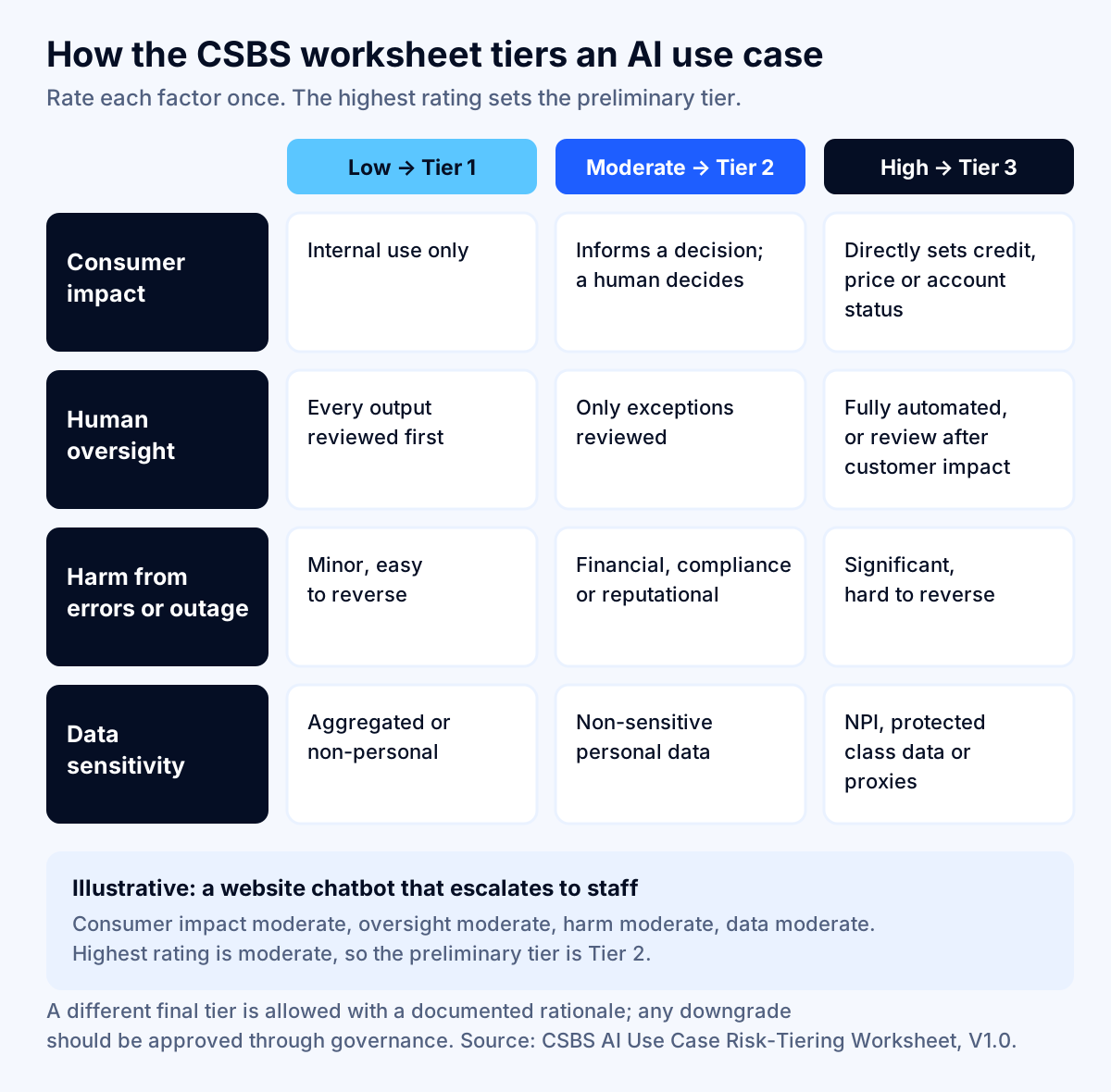
CSBS published an optional AI Use Case Risk-Tiering Worksheet alongside the examiner guide, available from the framework page. It scores each use case on four factors, each rated low, moderate or high:
- Consumer impact: internal use only; informs decisions affecting consumers with a human making the final call; or directly determines outcomes such as access to credit, pricing or account status with no human review.
- Human oversight: every output reviewed before action; only exceptions reviewed; or fully automated, including cases where human review happens only after the customer is affected.
- Harm potential from errors or outage: minor and easily reversed; financial, compliance or reputational harm; or significant, hard-to-reverse harm such as wrongful denial of credit or unlawful discrimination.
- Data sensitivity: aggregated or non-personal data; non-sensitive personal data such as contact details or transaction history; or sensitive data including nonpublic personal information, protected class data, biometrics or likely proxies for protected characteristics.
The rule that makes it work: "The highest-rated risk factor should generally establish the preliminary tier assignment." A final tier can differ "when supported by documented rationale," and any downward adjustment "should be reviewed and approved consistent with the institution's governance process."
Worked examples for a typical community bank
The table below applies the worksheet to use cases common at community institutions. These are our illustrative assessments, not CSBS determinations; your facts, especially data flows and how much humans actually review, will change the answers.
| Use case | Highest-rated factor | Preliminary tier |
|---|---|---|
| Staff copilot drafting internal emails, no customer data allowed | None above low, if the data rule holds | Tier 1 |
| Meeting transcription and summaries for internal meetings | Data sensitivity can rise to moderate if customer matters are discussed | Tier 1 or 2 |
| Generative AI summarizing loan files for an underwriter who decides | Data sensitivity (nonpublic personal information) | Tier 3 preliminary; a documented rationale may support Tier 2 |
| Website chatbot answering product questions, escalates to staff | Consumer impact (customer-facing), exceptions-only oversight | Tier 2 |
| Vendor fraud model that auto-blocks card transactions | Human oversight (automated action before review) | Tier 3 |
| Automated credit decisioning on small consumer loans | Consumer impact (directly determines outcomes) | Tier 3 |
The loan-summary row shows why the documented rationale matters. Strictly applied, sensitive data alone makes it Tier 3. Many institutions will reasonably argue that an underwriter reviewing every summary against the source file, inside a private deployment with no retention by the vendor, justifies Tier 2. The worksheet permits that, as long as the reasoning is written down and the downgrade is approved through governance. What it does not permit is skipping the analysis.
Which controls go with each tier
The CSBS worksheet lists suggested controls by tier, and they are cumulative: "Tier 3 use cases are expected to have Tier 1 and Tier 2 controls as well." Condensed, with the work involved at a community institution:
| Tier | Suggested controls (CSBS worksheet, condensed) | Realistic effort at a community bank |
|---|---|---|
| All tiers | Inventory entry with owner and purpose; written policy on acceptable use; vendor contract addresses AI risks and includes audit rights; staff trained on limitations; data quality understood; periodic management reporting; documented risk level | Hours per use case once the policy exists |
| Tier 2 and 3 | Model risk or similar review process; pre-deployment testing for accuracy, performance and fairness; explainability for consumer-facing outputs; tested adverse action process where relevant; escalation path for bad outputs; scheduled performance review; vendor model oversight; complaint process that captures AI issues | Days to weeks per use case, mostly testing and documentation |
| Tier 3 | Ongoing monitoring of accuracy, fairness and consumer outcomes; independent validation by a qualified party; senior management review of the full inventory; AI-specific incident response procedures; consumer disclosures on automated decisions where applicable; documented pre-deployment fair lending review; board or committee reporting on the use case | Weeks per use case, often with outside validation support |
Two practical notes.
Testing is the control most institutions underestimate. "Pre-deployment testing addresses accuracy" means a set of real cases with known correct answers, run before launch and re-run after every vendor model change. For chatbots and document tools, our guide on how to evaluate AI chatbot accuracy explains how many test cases you need before an accuracy number means anything.
Logging is the control that is hardest to add later. Incident response, complaint investigation and fair lending review all depend on being able to reconstruct what the AI saw and produced. Decide what to log when you approve a use case, not after the first complaint. Our AI audit trail requirements guide has a field-by-field list.
Key takeaway: Most community banks will find that the bulk of their AI sits in Tier 1, with a few Tier 2 uses and perhaps one or two Tier 3. Spend most of the effort there. Proportionality is the point of tiering, and it is what examiners are told to expect.
Generative AI and AI agents: the questions examiners will add
The CSBS guide has a separate section for generative AI, large language models and agentic tools, triggered whenever scoping finds them. Its eight procedures boil down to five questions your file should answer for each generative use case:
- What kind of deployment is it? Public, private, internally deployed or vendor-provided. A consumer chatbot app that staff use with personal accounts is a very different risk from an enterprise tenant with no training on your data.
- What data may go in? The work program says public or lightly controlled tools "may warrant closer attention because of data, access, and output-control risks." Your answer is a written data rule plus technical enforcement where you can get it.
- Who reviews the output, and how? "Human in the loop" is only a control if you can say who reviews what, against which source, before which action.
- Have you identified the specific risks? The guide names "inaccuracy, hallucination, prompt injection, and data exposure." Document how each is addressed or accepted for each use case.
- Can you restrict or stop it? For systems that take actions, procedure GE-8 asks how the institution "defines the actions the system is permitted to take, human checkpoints, logging, reversibility, and the ability to restrict or halt the system."
That last question is the one community banks are least prepared for, and it will matter more as vendors add agent features to core, digital banking and contact center platforms. The FSB's final sound practices include human oversight and explainability with compensating controls among its twelve items. If a vendor proposes an agent that can move money, change account settings or send customer communications, ask for the permission list, the approval step and the off switch in writing before the pilot, not after. Our guide to building AI agents describes the permission and checkpoint design we would expect to see.
Vendor AI: where most community bank AI actually lives
For a community institution, AI governance is mostly third-party risk management with a few new questions. The 2023 interagency guidance, issued by the Fed as SR 23-4, states that using a third party does not diminish a banking organization's responsibility to operate safely and soundly and in compliance with law. The CSBS work program quotes that principle directly in its scoping questions on vendor and embedded AI.
The proposed replacement guidance, published September 15, 2026, keeps that responsibility but changes the tone. The agencies say the 2023 guidance "frequently has been interpreted in an overly broad manner and with an insufficient focus on tailoring," and propose a risk-based approach in which oversight scales with significance. It also states that "there are no generally applicable expected contract terms for third-party relationships--even for higher-risk relationships." Until it is finalized, the 2023 guidance remains the operative document for banks.
For AI specifically, the CSBS document request list is a useful guide to what you will be asked for: "contract terms, service terms, or vendor documentation addressing the use, retention, sharing, or training of AI systems on customer, consumer, confidential, or institutional data." In plain terms, every AI vendor file should answer:
- Does the vendor or its model provider train on our data, and where is that prohibited in writing?
- How long are prompts, documents and outputs retained, and where?
- Which underlying models and subprocessors are used, and will we be told when they change?
- What testing evidence can the vendor share, and can we run our own?
- What happens to our data and the service if we leave?
Our AI vendor risk assessment questionnaire has the full question set with evidence to request and red flags. Use the tier from the worksheet to decide how much of it to send; a Tier 1 productivity tool does not need the same review as a Tier 3 decisioning model.
What changes for credit unions
Credit unions should build the same framework, with three differences in emphasis.
The supervisor's stance is technology-neutral. NCUA's AI resources page says the agency has issued no AI-specific rules, supervises AI "within the existing supervisory framework," and that "our supervisory focus is on risk management, not the tool itself." Examiners look at safety and soundness, compliance, internal controls over AI tools, ongoing risk monitoring and third-party due diligence. The same page points to NCUA Letters to Credit Unions 07-CU-13, Evaluating Third Party Relationships, and 01-CU-20, Due Diligence Over Third Party Service Providers, as the vendor reference points.
Model risk guidance is thinner. The Government Accountability Office reported in GAO-25-107197, published May 19, 2025, that NCUA's model risk management guidance is limited in scope and detail and does not give staff or credit unions sufficient detail on managing model risks, including AI models. GAO recommended an update. As of GAO's latest status note, the recommendation remains open; NCUA pointed to its AI resources page, and GAO responded that the page does not provide detailed model risk guidance covering a broad variety of models. A credit union that adopts a CSBS-style tiering method is filling that gap itself, which is a defensible position in an exam.
Vendor oversight carries more weight. The same GAO report notes that NCUA lacks authority to examine technology service providers, despite credit unions' growing reliance on them for AI-driven services, and reiterates GAO's 2015 recommendation that Congress consider granting it. Banks benefit indirectly when federal banking agencies examine major service providers; credit unions cannot rely on that. Your own due diligence is the main line of defense.
State-chartered credit unions may also meet state examiners, and the CSBS framework covers state-licensed nonbanks; whether a given state applies it to credit unions is a question for that state's regulator. The NCUA also joined the September 2026 third-party risk proposal, so its outcome matters to credit unions for the first time.
Fair lending, adverse action and consumer protection
The fastest way for an AI system to create a real violation at a community institution is in lending and customer communications, not in model documentation.
Regulation B requires that the statement of reasons for adverse action "must be specific and indicate the principal reason(s) for the adverse action," and says statements that the decision was based on internal standards or policies are insufficient. The official commentary adds that reasons "must relate to and accurately describe the factors actually considered or scored by a creditor." The CSBS work program draws the AI conclusion directly: using AI or other complex tools "does not eliminate the need to identify the principal reasons for adverse action where such notices are required."
So for any AI that touches credit decisions, including vendor scorecards and underwriting assistants, your file needs to show:
- Reason codes that map to real factors. If you cannot get them from the vendor, the use case is not ready.
- A fairness review before launch and periodically after. The CSBS Tier 3 controls call for a documented pre-deployment review of fairness and fair lending risk, plus ongoing monitoring.
- Proxy awareness. The worksheet's high data-sensitivity rating explicitly includes "data elements that could serve as proxies for protected characteristics." Ask what inputs the model uses, not only whether it uses protected class data.
- Complaint capture. Tier 2 controls include a complaint process that captures AI-related issues. Tag them so you can find them.
For customer-facing generative AI, the CSBS document request list includes "samples of recent AI-generated or AI-assisted consumer-facing outputs," such as chatbot transcripts and generated communications. Expect examiners to read what your chatbot actually said. Review a sample yourself every month, against your product terms and disclosures, before they do.
Who owns AI governance at a small institution
Large banks build AI offices. Community institutions should not. A structure that works at most banks and credit unions with a few hundred staff:
| Role | Who it usually is | Responsibilities |
|---|---|---|
| Board or board risk committee | Existing board structure | Approves the AI policy; receives reporting on AI use, risk tiers, incidents and material changes, at least annually and more often while adoption is growing |
| Executive sponsor | CEO, COO or chief risk officer | Owns the program; breaks ties between business demand and risk appetite |
| Program coordinator | Compliance, risk or information security officer | Maintains the inventory and tiering records; runs the intake process; prepares reporting |
| Approving committee | Existing risk, technology or management committee | Approves Tier 2 and Tier 3 use cases and any downward tier adjustments; records decisions |
| Use case owner | Business line manager | Accountable for one use case: data, outputs, testing, monitoring, complaints |
| Independent review | Internal audit or an outside firm | Periodically tests whether the program works; validates Tier 3 use cases where required |
The CSBS governance procedures ask whether governance is aligned "to the size, complexity, risk profile, and scope of the institution's AI use." A coordinator, a standing agenda item and a named owner per use case meet that test at a community bank. A committee charter that nobody follows does not.
A 90-day plan to an exam-ready AI governance file
This is the sequence we would run at a community bank or credit union starting from little or nothing. Durations assume a handful of AI use cases and no Tier 3 system that needs outside validation; adjust if you have more.
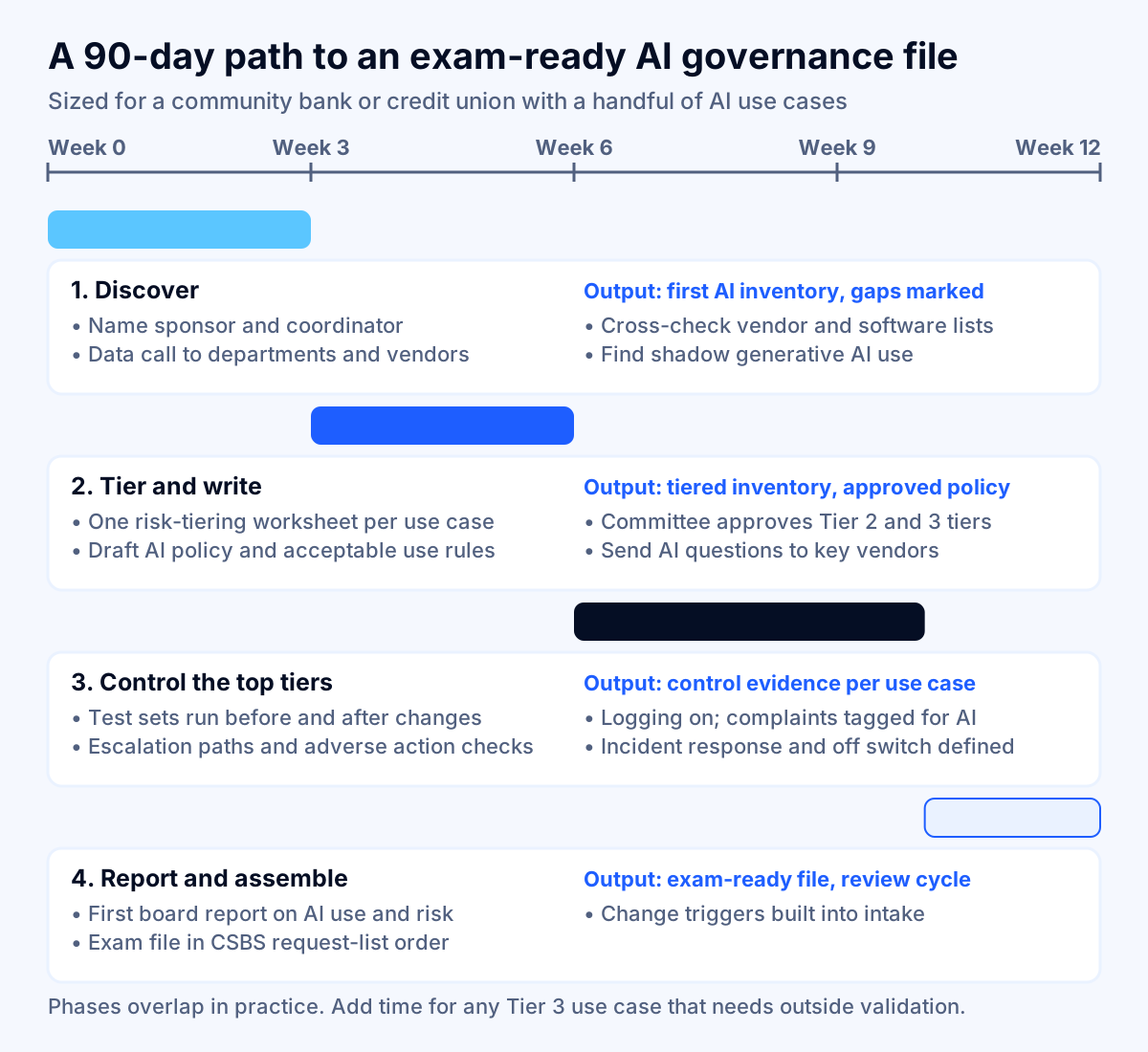
Weeks 1 to 3: discover. Name the executive sponsor and coordinator. Run the data call across departments and vendors. Cross-check against vendor and software inventories. Find shadow use of generative AI tools by asking, and by checking network and expense records with IT. Produce a first inventory with gaps marked.
Weeks 3 to 6: tier and write. Complete a risk-tiering worksheet for each use case. Draft the AI policy and the staff acceptable use rules. Get committee approval for the tiering of anything at Tier 2 or above, and record any downward adjustments with their rationale. Send AI-specific questions to vendors behind Tier 2 and Tier 3 use cases.
Weeks 6 to 10: control the top tiers. For Tier 2 and Tier 3 use cases, build or obtain test sets and run them, confirm escalation paths, check adverse action processes where credit is involved, turn on logging and add AI tags to the complaint system. Write the AI incident response procedure, including who can switch a tool off and how fast.
Weeks 10 to 12: report and assemble. Deliver the first board report: inventory by tier, open issues, vendor gaps, incidents and the plan for the next two quarters. Assemble the exam file in the order of the CSBS document request list: policies, committee materials, board reporting, the inventory, tiering worksheets, generative AI rules and approved tools, vendor materials, testing results, consumer-facing samples and any independent review.
Then keep it current. The worksheet says to update the tier when "the business purpose for a use case expands, more decision-making authority is granted, or issues arise from a vendor." Make those events triggers in your intake process so the inventory never drifts more than a quarter out of date.
What to watch for the rest of 2026
Three things could change the picture before year end, and none of them change the core of the framework above.
- The federal AI request for information. The agencies said in April they would issue one "in the near future." It had not appeared as of October 17. When it does, it is the clearest signal of where federal expectations for generative and agentic AI are heading, and community bankers' comment letters will matter.
- The final third-party risk guidance. Comments on the September proposal close November 16. If finalized broadly as proposed, it would give community banks more room to tailor vendor oversight, including for AI vendors, and would bring credit unions under the same interagency text.
- State adoption of the CSBS framework. Each state decides how far to use it. Ask your state regulator directly whether it will be used in your next exam and in what form.
Where this leaves you
An AI governance framework for community banks and credit unions is no longer a guess about what regulators might want. The CSBS examiner guide spells out the questions, its worksheet spells out the tiering, and the FSB, NIST and federal agencies point the same way. What none of them do is require a large program. They ask for an honest inventory, proportionate controls, named owners and a board that knows what is running.
Start with the inventory this month, because every other control depends on it, and expect to find more embedded vendor AI than you thought. Tier each use case with the reasoning written down. Put real testing, logging and an off switch on the few that touch customers or decisions. Then report it.
Fleurant AI builds AI for regulated industries, including the evaluation harnesses, logging and control documentation that make an AI system defensible in an exam, alongside custom AI development for institutions that want to build rather than buy. If you are working out how a specific AI use case should be tiered and controlled, talk to a specialist. For questions of legal interpretation, your counsel and compliance team make the call. You can also see everything we do on the Fleurant AI home page.
Frequently asked questions
Do community banks need an AI governance framework if SR 26-2 does not apply to them?
Yes. SR 26-2 is expected to be most relevant above $30 billion in assets and excludes generative and agentic AI, but that only tells you which document does not apply. Third-party risk guidance, consumer protection law, fair lending rules and safety-and-soundness expectations still reach every AI system you run. State examiners now also have the CSBS AI Supervisory Framework, which asks for an AI inventory, risk tiering and governance records.
What is the CSBS AI Supervisory Framework?
It is a set of examiner tools released by the Conference of State Bank Supervisors on September 16, 2026: a Core Examiner Guide, an Examiner Work Program, a nonbank supplement, an optional AI use case risk-tiering worksheet and a source list. CSBS describes it as a discretionary tool that creates no new legal obligations, and each state agency decides how much of it to use. It is built on the NIST AI RMF, the Cyber Risk Institute's financial services AI framework and Treasury's AI Lexicon.
What should an AI inventory for a community bank include?
At minimum: the use case name, business owner, vendor or in-house, AI type, business purpose, what the output is and who relies on it, whether it is internal, customer-facing, decision-support or decision-making, the data it touches, the risk tier, deployment date and the date of the last review. Include AI embedded in software you already license and generative AI tools staff use, not only formal models.
How do credit unions approach AI governance differently?
The building blocks are the same, but the supervisor differs. NCUA has issued no AI-specific rules and says it supervises AI within its existing framework, focusing on risk management rather than the tool. NCUA also cannot examine technology service providers directly, a gap GAO highlighted in May 2025, so a credit union's own vendor due diligence carries more of the load. Its third-party letters 07-CU-13 and 01-CU-20 remain the reference points.
Is the NIST AI Risk Management Framework too big for a small bank?
Used as a checklist, it can be. Used as a vocabulary, it fits well. Its four functions, govern, map, measure and manage, translate directly into a policy, an inventory, testing and monitoring. The CSBS risk-tiering worksheet is effectively a compact NIST-aligned tool sized for a community institution, so many banks can start there and reach for the full framework only for their highest-risk use cases.
How long does it take a community bank to stand up AI governance?
For most institutions with a handful of AI uses, a workable program takes about a quarter: a few weeks to find and inventory AI use, a few weeks to tier it and write the policy, and the remainder to put controls on the highest tiers and deliver the first board report. Institutions with customer-facing or credit-decision AI should expect the testing and fair lending work to take longer.
Who should own AI governance at a small bank or credit union?
Usually an existing committee with a named executive sponsor, not a new department. Many community institutions route AI through the risk or technology committee, with the chief risk or compliance officer as coordinator and a business owner accountable for each use case. What matters to examiners is that accountability is specific, approvals are recorded and the board receives reporting on AI use and risk.
Sources
- Artificial Intelligence Supervisory Framework: Core Examiner Guide, Version 1.0, Conference of State Bank Supervisors
- CSBS Artificial Intelligence Supervisory Framework (framework page, work program and risk-tiering worksheet), Conference of State Bank Supervisors
- CSBS Announces AI Supervisory Framework, Conference of State Bank Supervisors
- SR 26-2: Revised Guidance on Model Risk Management, Board of Governors of the Federal Reserve System
- OCC Bulletin 2026-13: Model Risk Management: Revised Guidance, Office of the Comptroller of the Currency
- OCC Bulletin 2025-26: Model Risk Management: Clarification for Community Banks, Office of the Comptroller of the Currency
- Proposed Third-Party Risk Management Guidance (91 FR 58536, September 15, 2026), OCC, Federal Reserve, FDIC and NCUA via the Federal Register
- SR 23-4: Interagency Guidance on Third-Party Relationships: Risk Management, Board of Governors of the Federal Reserve System
- Artificial Intelligence (AI) Resources, National Credit Union Administration
- Artificial Intelligence: Use and Oversight in Financial Services (GAO-25-107197), U.S. Government Accountability Office
- AI Risk Management Framework, National Institute of Standards and Technology
- FSB Finalises Sound Practices for the Responsible Adoption of Artificial Intelligence (AI), Financial Stability Board
- Regulation B, 12 CFR 1002.9: Notifications, Consumer Financial Protection Bureau
- Community Banking: The Cornerstone of Building Communities (speech by Governor Michael S. Barr), Board of Governors of the Federal Reserve System


