AI Compliance
Colorado AI Act Compliance: What SB 26-189 Requires in 2027
Colorado AI Act compliance now means SB 26-189: who is covered, the 30-day adverse-outcome notice, human review, 3-year records and a plan for January 1, 2027.

In this article
- What changed: the Colorado AI Act you prepared for no longer exists
- Who has to comply with SB 26-189?
- Is your AI tool "covered ADMT"? A four-question test
- What deployers must do under SB 26-189
- What developers and AI vendors must do
- Sector carve-outs: credit, insurance, health care and education
- How to prove Colorado AI Act compliance: the three-year evidence file
- Enforcement, penalties and the xAI lawsuit: when does this really start?
- A nine-week plan to January 1, 2027
- Bottom line
- Frequently asked questions
- Sources
Colorado AI Act compliance now means complying with SB 26-189, not the 2024 law most guides still describe. Governor Polis signed it on May 14, 2026, and it repealed and reenacted the Colorado Artificial Intelligence Act (SB 24-205) before that law ever took effect. From January 1, 2027, any business that uses "automated decision-making technology" to materially influence a consequential decision about a Colorado consumer (hiring, lending, housing, insurance, health care, education or government benefits) must give notice before use, explain adverse outcomes within 30 days, offer data correction and meaningful human review, and keep compliance records for at least three years. Companies that build or sell those tools owe their customers documentation.
The risk management programs, impact assessments and algorithmic-discrimination duty of care that companies spent 2025 preparing for are gone. What replaced them is narrower, but more operational: it touches your application flows, your rejection letters, your vendor contracts and your logs.
This guide gives you a four-question test for whether a tool is covered, a side-by-side of old and new duties, a disclosure checklist with sample wording, the records to keep, the sector carve-outs, where enforcement stands after the xAI lawsuit, and a nine-week plan to January 1. It summarizes the enacted text and the Attorney General's draft rules as of October 30, 2026. It is not legal advice; confirm specifics with your counsel.
What changed: the Colorado AI Act you prepared for no longer exists
SB 26-189 replaced a risk-management law with a transparency-and-rights law. The 2024 act told developers and deployers of "high-risk AI systems" to use reasonable care against algorithmic discrimination, backed by programs, assessments and reports. The 2026 act tells them what to disclose, to whom, and when, and what consumers can ask for afterward.
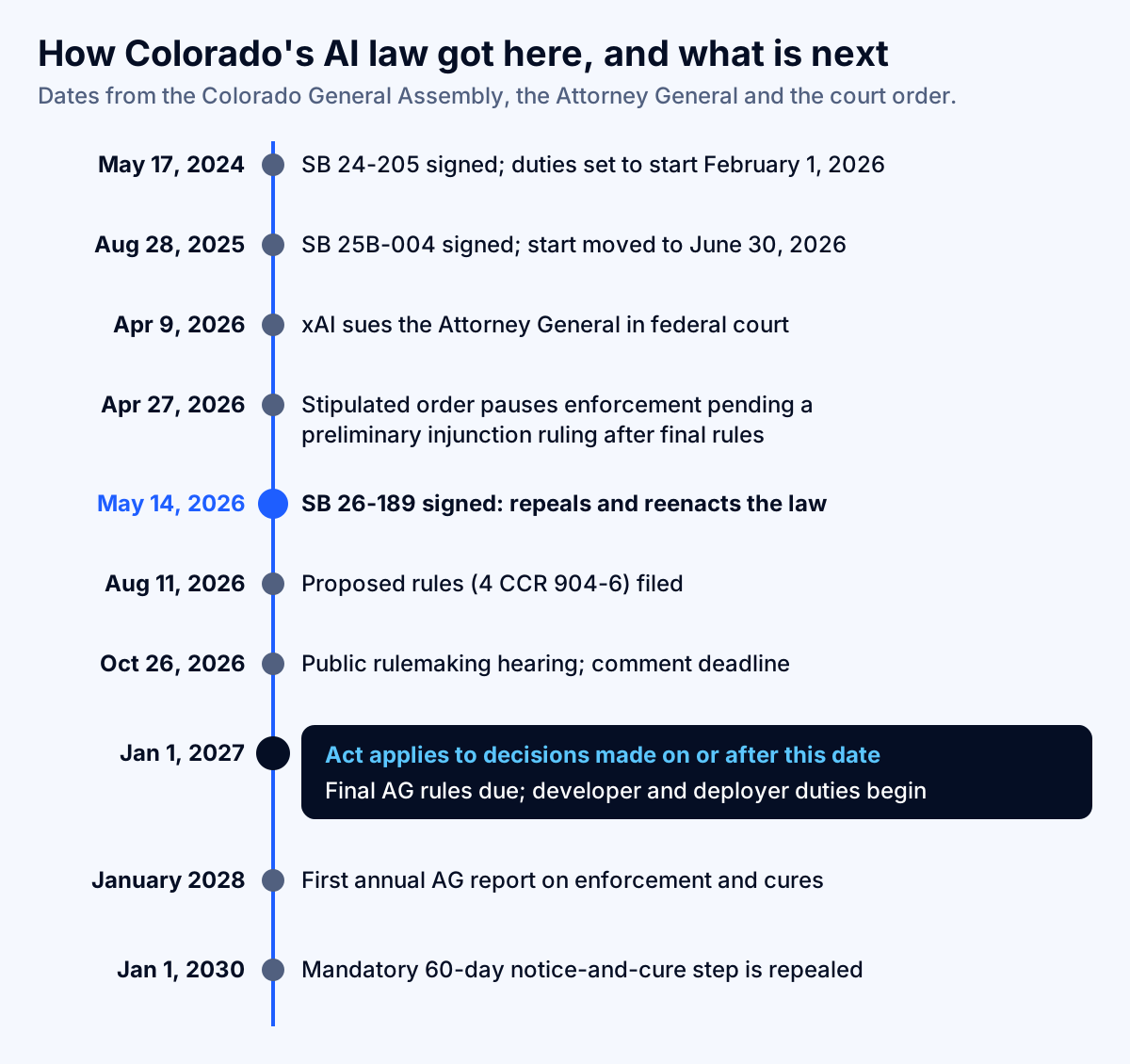
The history matters because so much published guidance is stale. SB 24-205 was signed May 17, 2024, with duties starting February 1, 2026. SB 25B-004, signed August 28, 2025 in a special session, pushed that to June 30, 2026. Then SB 26-189 passed the Senate 34 to 1 and the House 57 to 6 and was signed before the June date arrived.
| SB 24-205 (2024, never took effect) | SB 26-189 (applies from January 1, 2027) | |
|---|---|---|
| What is regulated | "High-risk AI systems" | "Covered ADMT": automated decision-making technology that materially influences a consequential decision |
| Core duty | Reasonable care to protect consumers from algorithmic discrimination | Notice, adverse-outcome disclosure, consumer rights, records |
| Deployer program | Risk management policy and program, impact assessment, annual review | None required |
| Reporting to the Attorney General | Disclose discovered algorithmic discrimination within 90 days | None |
| Consumer notice | Notice when a system makes or substantially factors into a decision | Clear and conspicuous notice before use, plus a written disclosure within 30 days of an adverse outcome |
| Consumer rights | Correct data, appeal with human review if technically feasible | Request personal data, correct it, and get meaningful human review and reconsideration if commercially reasonable |
| Records | Tied to assessments and program documents | At least 3 years for developers and deployers |
| Framework safe harbor | Affirmative defense for following a recognized AI risk framework | No framework defense in the text |
| Enforcement | Attorney General, deceptive trade practice | Attorney General only, deceptive trade practice, 60-day cure until January 1, 2030 |
Key takeaway: If your Colorado plan is built around impact assessments and an algorithmic discrimination program, it was built for a law that no longer exists. Keep what helps, but re-scope the project around notices, disclosures, human review and records.
Who has to comply with SB 26-189?
Any developer or deployer "doing business in Colorado" is covered, and there is no size threshold. A deployer is a person doing business in Colorado that deploys covered ADMT. A developer is one that develops, sells, licenses or otherwise makes covered ADMT commercially available, builds a component designed or contracted to be part of it, or intentionally and substantially modifies an ordinary tool so that it becomes covered.
Three details widen the net:
- Employees and applicants are consumers. Section 6-1-1701(4)(b) says "consumer" includes an employee, a Colorado-resident job applicant and anyone whose access to or opportunity in Colorado is evaluated by a person doing business in Colorado. That pulls in HR software, even though Colorado's general privacy law leaves out people acting in an employment context.
- Size does not matter. The Attorney General's October 21, 2026 regulatory analysis says the act and rules apply to entities that use covered ADMT in covered domains "regardless of size or where they are located."
- You can be both. A lender that builds its own underwriting model is a developer and a deployer. The draft rules let a developer-deployer meet its documentation duty by keeping the information in one internal documentation system.
Some builders are carved out of "developer": research-only systems not used in real decisions, systems built and used only internally (including by affiliates) and not made available to others, an original developer whose tool an unaffiliated party modifies beyond its intended use, and a component maker whose part was integrated without its actual knowledge.
Is your AI tool "covered ADMT"? A four-question test
A tool is covered when all four answers below are yes. Work through them for every tool that touches a decision about a person, write down the answer and the reason, and keep that analysis. It is the first thing you will want if the Attorney General asks why a tool was or was not treated as covered.
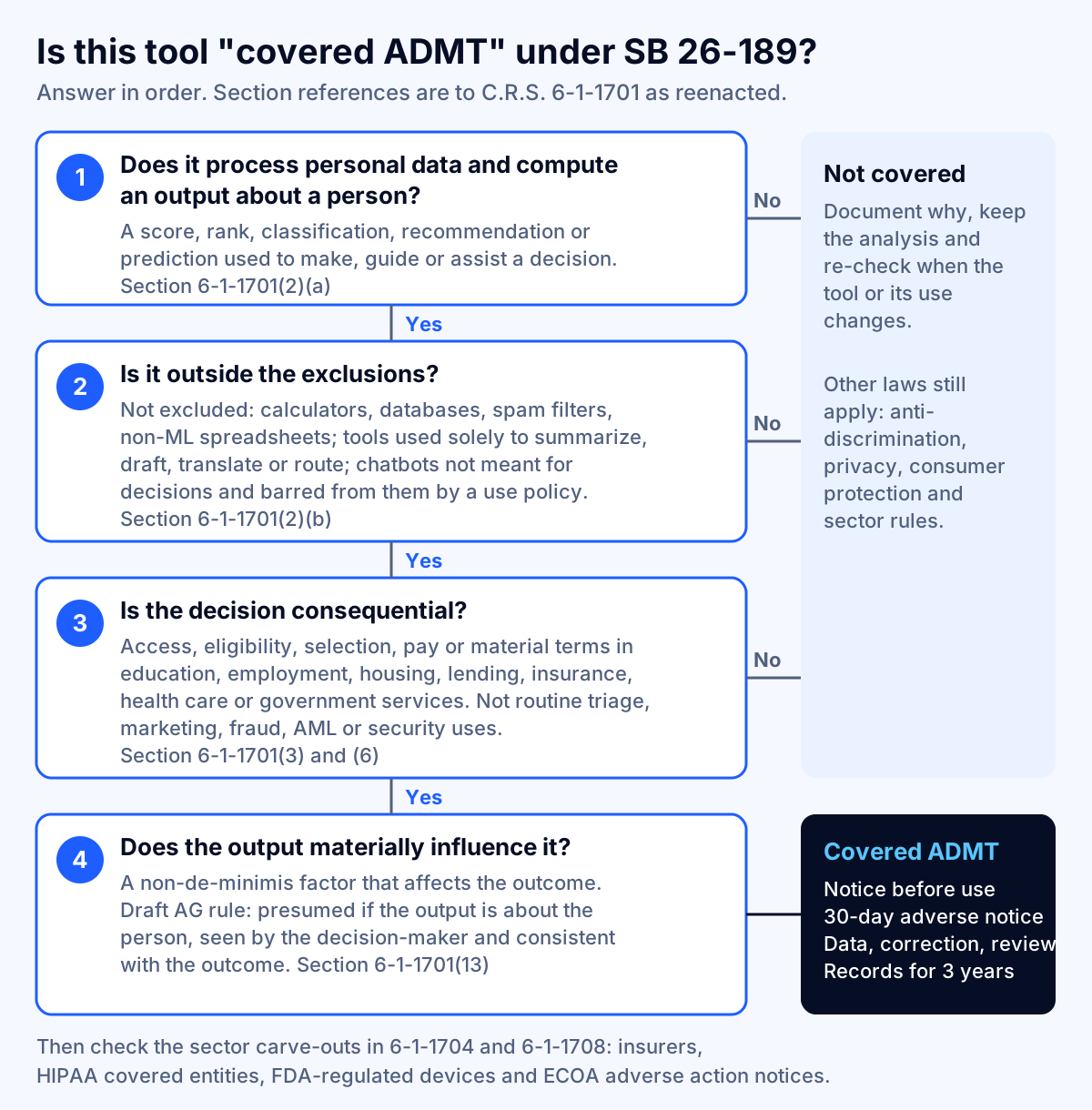
1. Does it process personal data and compute an output about a person? The definition covers technology that "processes personal data and uses computation to generate output," including predictions, recommendations, classifications, rankings and scores used to make, guide or assist a decision about an individual. That is broad on purpose: it is not limited to machine learning.
2. Is it outside the exclusions? The act lists technologies that are never ADMT, including anti-malware, anti-virus, calculators, databases, data storage, firewalls, networking, spam and robocall filtering, spell-checking, web hosting and spreadsheets that require human analysis and do not use machine learning, foundation models or large language models. Two more exclusions matter for AI teams, covered in the next subsection.
3. Is the decision a consequential decision? It must relate to access to, eligibility for, selection for or compensation for one of seven covered domains: education, employment, the lease or purchase of residential real estate in Colorado, financial or lending services, insurance, health-care services, and essential government services and public benefits. Price and terms count too, when a less favorable price or term is reasonably likely to limit, delay or effectively deny access. The act excludes routine scheduling, administrative routing, customer service triage, communicating decisions, workflow management, advertising and marketing, product recommendations, search, content moderation, cybersecurity, anti-money laundering, sanctions screening and fraud prevention, including identity verification.
4. Does the output materially influence the decision? "Materially influence" means the output is a non-de-minimis factor in the decision and affects its outcome, including by constraining, ranking, scoring, recommending or classifying. Incidental, trivial and clerical uses do not count.
When generative AI tools and chatbots are covered
Most workplace generative AI is outside the law, by design. A tool "used by an individual solely to summarize, organize, translate, draft, route, or present information for human review" is not ADMT. Neither is a chatbot that answers questions, makes referrals or generates content, as long as two conditions are met: it is not contracted, marketed, configured or intended for consequential decisions, and it is subject to an acceptable use policy that prohibits using its content in one.
That second condition is a cheap control with real legal value. If your company licenses a general-purpose assistant, your AI acceptable use policy should say plainly that its output may not be used to decide on hiring, credit, tenancy, insurance or benefits.
The exclusion ends where judgment begins. The Attorney General's interim draft includes a property-management example: a tool that sorts tenant applicants' data into "positive" and "negative" categories is covered, because it opines rather than objectively summarizes. The same tool producing a spreadsheet sorted by unit size and application date is not. An AI recruiting agent that summarizes resumes is likely excluded; one that ranks "strongest" to "weakest" candidates is likely covered.
The draft "material influence" presumption
The Attorney General's interim draft rules, released October 6, 2026, propose a presumption that does most of the work. An output is presumed to materially influence a decision if it constrains an option set, sets a threshold or produces a rank, score, classification, recommendation, prediction or other inference that pertains to the person, is reviewed by the decision-maker (or used to screen what the decision-maker sees) before or during the decision, and is consistent with the outcome.
You can rebut the presumption with evidence that the output was a de minimis factor. The draft lists examples: the decision-maker did not consult the output; the decision rested on a consistently applied hard cutoff; a qualified person with authority did an independent review of substantial other information; the decision went against the output; or other contemporaneous evidence of independent judgment.
Read the draft's hiring example carefully. A manager who sees a candidate score, interviews everyone and picks the top scorer is presumed to have been materially influenced, even though the interviews happened. To rebut that, the employer needs evidence such as interview notes showing an independent basis for the choice. "A human was in the loop" is not, by itself, a defense.
Key takeaway: If a person sees an AI score or ranking before deciding, plan to treat the tool as covered unless you can produce contemporaneous evidence that the decision rested on something else. Design your workflow so that evidence is captured automatically.
What deployers must do under SB 26-189
Deployers carry most of the operational load: a notice before use, a written disclosure after any adverse outcome, three consumer rights, and three years of records. Each duty has a specific trigger, so map them to the steps in your process rather than to the tool.
| Duty | Trigger | Deadline | Section |
|---|---|---|---|
| Point-of-interaction notice | Before covered ADMT is used to materially influence a consequential decision | Before use | 6-1-1704(1)-(2) |
| Adverse-outcome disclosure | A covered decision results in an adverse outcome | Within 30 days after the decision | 6-1-1704(3) |
| Personal data and correction instructions | Consumer request after an adverse outcome | Draft rules: response within 45 days for data and correction requests | 6-1-1705(1)(a)(I) |
| Meaningful human review and reconsideration | Consumer request after an adverse outcome | To the extent commercially reasonable | 6-1-1705(1)(a)(II) |
| Records | Every consequential decision | Keep at least 3 years after the decision | 6-1-1703 |
An adverse outcome is a decision that denies, terminates, revokes or materially reduces access to an opportunity or service, or one that imposes a materially less favorable price, cost or other material term than similarly situated consumers get, in a way likely to limit or effectively deny access. Rejected applications, declined loans, non-renewed leases and higher premiums can all qualify.
The notice before use
Tell consumers, clearly and conspicuously, that you use or will use covered ADMT in a decision affecting them, and how to get more information. The act lets you satisfy this with a prominent public notice that is reasonably accessible at the point of interaction, including a link or posting near the transaction. For hiring, Epstein Becker Green suggests job postings or the careers page. Notices must be accessible to people with disabilities and people with limited English proficiency, and the draft rules point to WCAG 2.2 for online content.
The 30-day adverse-outcome disclosure
Within 30 days after an adverse decision, the deployer must give the consumer:
- A plain-language description of the decision and the role the covered ADMT played in it.
- Instructions and a simple process to request more information, including the ADMT's name, its version number if applicable, the developer, and the types, categories and sources of personal data used, to the extent the developer supplied that information.
- An explanation of the consumer's rights and how to exercise them.
The interim draft rules add form requirements: deliver it in writing through the channels you normally use with that consumer, in an easy-to-read font (at least 12-point if mailed), and name data sources specifically, such as particular data brokers, courts or prior employers, when you know them. They also propose short response deadlines when a consumer asks for the additional information. Those details may change in the final rules, so build templates you can edit.
A starting draft for counsel to adapt, for a lending example:
Your application for a personal loan was not approved on November 3, 2027. We used an automated scoring tool, [Tool name, version 4.2, from Vendor], to help evaluate your application. It produced a risk score based on your credit report, your stated income and your account history with us. Your score was below the level we use to approve loans of this size, and that was a main reason for the decision. To see the personal data we used and where it came from, correct information you believe is wrong, or ask a trained person to review and reconsider this decision, visit [link] or call [number].
Lenders have a shortcut, covered in the sector section below: a compliant ECOA adverse action notice can satisfy this duty if it also meets the act's requirements.
Consumer rights: data, correction and human review
After an adverse outcome, a consumer may request instructions for getting and correcting the personal data used, and an opportunity for meaningful human review and reconsideration, to the extent commercially reasonable. Corrections cover facts, not "opinions, predictions, scores, or protected evaluations," so a consumer can fix a wrong eviction record but cannot demand a different risk score.
The statute defines meaningful human review tightly. The reviewer must be designated by the deployer, have authority to approve, modify or override the decision, consider relevant primary evidence, be trained, not default to the system output, and have enough information to understand the output's intended use, limitations, input categories and principal factors, without needing source code or model weights.
Designing human review that holds up
The draft rules go further on human review, and this is where most companies will need new process:
- Independence and protection. The reviewer can be internal or a contracted external reviewer, but must not be subject to steering by upper management and must be shielded from retaliation. External reviewers need contract terms insulating individual decisions from the deployer's influence.
- No ADMT in the review. The draft says covered ADMT may not assist in the review. Summarization and organization tools, which are not ADMT, may.
- Fit the review to the complaint. If the system lacked relevant facts, review the primary evidence. If it malfunctioned, fix it and re-run the decision, or review the evidence directly.
- Commercial reasonableness is weighed, and you carry the burden. Factors include the magnitude and reversibility of harm, the value of the review, the deployer's size and capacity, cost, feasibility and reviewer availability. A severe, irreversible denial of a basic need such as housing or medical care is presumed to warrant review.
If you already run a credit appeals desk or an HR grievance process, extend it. Train reviewers on the tool's limitations, give them the inputs and principal factors, and log what they looked at and why they decided. That log is your evidence that the review was meaningful.
What developers and AI vendors must do
Developers owe deployers documentation and update notices, plus three years of records. From January 1, 2027, a developer must make available to each deployer, in an understandable form that protects trade secrets:
- a statement of intended uses and known harmful or inappropriate uses;
- the categories of data, including personal data, used to train the system, to the extent known;
- known limitations, risks, and circumstances in which it should not be used;
- instructions for appropriate use, monitoring and meaningful human review;
- information reasonably necessary for the deployer's disclosures, with notice to the deployer if anything is withheld.
Developers must also send notice of material updates, intentional and substantial modifications, and changes to intended use, limitations or risk mitigation within a reasonable time. Public release notes count if each deployer gets direct notice that they were published. A "material update" includes changes to model parameters and default settings that are likely to materially affect outputs. Records must include version identifiers, changelogs and the notices sent.
These duties apply only where the tool was marketed, configured, contracted, sold or licensed for use in consequential decisions, or where the developer learns it is being used that way consistent with its intended uses. The interim draft adds a midstream developer rule: a company that builds a covered product on top of another developer's covered ADMT must pass the upstream documentation down and write its own. A company that builds a covered application on a third-party AI product that is not itself ADMT, such as a general-purpose model, writes documentation for its own product, and the maker of that underlying product has no developer duties.
Vendor contracts after SB 26-189
Liability rules in section 6-1-1707 make contract language matter more than usual:
- Developers and deployers can be liable under the Colorado Anti-Discrimination Act for decisions materially influenced by covered ADMT, with fault allocated by relative fault, not joint and several liability.
- A developer is liable only to the extent the deployer used the tool as intended, documented, marketed, configured or contracted for. Your stated intended use becomes a liability boundary.
- Any clause that indemnifies a developer or deployer against liability under the section for its own acts or omissions that violate Colorado anti-discrimination law is void as against public policy. Claims on applicable liability insurance are unaffected.
When you buy, ask for the 6-1-1702 documentation package before signing, a defined "intended use" that matches how you will actually use the tool, direct notice of material updates with version numbers, help producing adverse-outcome disclosures and data-source lists, and cooperation with human review and record requests. When you sell, write the intended use precisely and keep your changelog clean. Our AI vendor risk assessment guide has a fuller question set.
Sector carve-outs: credit, insurance, health care and education
SB 26-189 defers to several existing regimes, but each carve-out is narrower than it first looks. Read the section that applies to you with counsel.
Credit. A creditor that gives an adverse action notice under the Equal Credit Opportunity Act and Regulation B, and the Fair Credit Reporting Act where applicable, complies with the act's notice and disclosure duties for the same decision if that notice also satisfies the act's requirements. The notice may add a brief statement that covered ADMT was used and how to get more information or exercise rights. Banks and credit unions should fold this into their model governance; our community bank AI governance framework covers the inventory side.
Insurance. Insurers and affiliates subject to C.R.S. 10-3-1104.9, Colorado's insurance-specific AI statute, are deemed in compliance in the practice of insurance. That does not cover their employment decisions, and insurers not deemed compliant must give adverse-outcome disclosures. The Commissioner may also adopt new notice rules. See our NAIC AI model bulletin checklist for Colorado's Regulation 10-1-1.
Health care. HIPAA covered entities, and their business associates for services to them, are exempt from the core sections except for employment decisions. They must still give patients a general notice about the use of advanced technologies, and an entity that uses covered ADMT to decide eligibility for financial assistance or discounted care owes patients specific disclosures. FDA-regulated medical devices and FDA-overseen research are excluded entirely.
Education. Schools subject to FERPA can meet the notice, disclosure, correction and review duties through their existing FERPA processes.
Fraud, AML and security. These activities are excluded from "consequential decision," and the act does not require disclosures that would compromise them or violate federal law, including GLBA. Facial recognition in sanctions compliance is excluded only when used solely to confirm identity.
How to prove Colorado AI Act compliance: the three-year evidence file
Compliance under SB 26-189 is proven with records, so design them first. Deployers must keep records "reasonably necessary to demonstrate compliance" for at least three years after each consequential decision, and developers for three years after each record is created, or longer where another law requires.
| Record | Who | What it proves |
|---|---|---|
| Tool inventory with the four-question analysis | Deployer, developer | Which tools are covered and why the others are not |
| Developer documentation package and update notices received | Deployer | You had the information your disclosures depend on |
| Version identifiers and changelogs of the ADMT used | Both | Which version made each decision |
| Copy of the point-of-interaction notice and where it appeared, by date | Deployer | Notice was given before use |
| Per-decision record: inputs, data sources, output, version, decision-maker, outcome, timestamp | Deployer | The role the tool played, and what to disclose |
| Adverse-outcome disclosures sent, with delivery date and channel | Deployer | The 30-day deadline was met |
| Consumer requests, responses and dates | Deployer | Rights were honored on time |
| Human review files: reviewer, training, evidence considered, result | Deployer | Review was meaningful, not a rubber stamp |
| Evidence of independent judgment, when you claim no material influence | Deployer | The presumption is rebutted |
The per-decision record is the hard one. You cannot write a plain-language description of the role a tool played in a specific decision, name the data sources, or reconstruct the decision for a reviewer, unless you captured them when the decision was made. For LLM-based tools that means logging the model and prompt version, the retrieved documents, tool calls and the final output, tied to the case ID. Our AI audit trail requirements guide has a field-by-field logging spec you can reuse.
Key takeaway: Every Colorado duty after a decision (the 30-day disclosure, data requests and human review) depends on a per-decision record captured at the time. If your system does not log it today, that is your critical path to January 1.
Enforcement, penalties and the xAI lawsuit: when does this really start?
The act applies to consequential decisions made on or after January 1, 2027, but the first enforcement action is likely to come later. Three things set the timing.
The rules. The Attorney General must adopt rules on adverse-outcome disclosures and consumer rights by January 1, 2027. According to the Attorney General's rulemaking page, the Department of Law filed proposed rules (4 CCR 904-6, which also implement the Chatbot Safety Act, HB 26-1263) on August 11, 2026, released an interim draft on October 6, published a regulatory analysis on October 21 and held the public hearing on October 26, 2026, with written comments accepted through that day. Final rules had not been posted when this article was written.
The lawsuit. xAI sued the Attorney General in federal court on April 9, 2026, and the Justice Department joined the challenge later that month. On April 27, 2026, a stipulated order paused enforcement. The legislature's final fiscal note describes it as an order not to initiate enforcement of SB 24-205 or legislation amending it until the Attorney General completes rulemaking and the court rules in X.AI LLC v. Weiser. McDermott's summary explains the sequence: xAI files its preliminary injunction motion after final rules, and enforcement waits until 14 days after the court rules on it. Commentators expect xAI and the Justice Department to challenge SB 26-189 too.
The cure period. Until January 1, 2030, the Attorney General must issue a notice of violation and allow 60 days to cure where a cure is possible, unless the violation was knowing or repeated. The fiscal note says a cured violation will not draw civil penalties, though injunctive relief remains possible. Penalties under the Colorado Consumer Protection Act can reach $20,000 per violation, according to the same fiscal note. Only the Attorney General can enforce the disclosure and rights provisions; there is no new private right of action, but existing anti-discrimination claims remain.
None of this is a reason to wait. The act will apply to decisions from January 1, records created from that day are the ones an investigator will ask for, and a court could leave the law in place. Treat the litigation as a reason to keep your process editable, not a reason to postpone it.
A nine-week plan to January 1, 2027
Nine weeks is enough to be credibly ready if you focus on covered tools and the post-decision workflow. The steps below assume a mid-sized company with a handful of AI-assisted decision flows.
| Week | Work | Output |
|---|---|---|
| 1 | Inventory every tool that touches hiring, promotion, lending, tenancy, insurance, health or benefits decisions about Colorado consumers | Tool list with owner, vendor, version and decision supported |
| 2 | Run the four-question test on each; flag "score or ranking seen by a decision-maker" cases as covered by default | Scoping memo per tool, reviewed by counsel |
| 3 | Request 6-1-1702 documentation from vendors; add the generative AI prohibition to your acceptable use policy | Documentation requests sent; policy update |
| 4 | Draft the point-of-interaction notice and publish it where decisions start: careers page, application forms, portals | Live notice, with an archived dated copy |
| 5 | Build adverse-outcome templates per decision type, with data-source lists; map ECOA, FERPA and insurance overlaps | Templates approved by counsel |
| 6 | Instrument per-decision logging and retention for three years; test that one decision can be reconstructed | Working evidence record |
| 7 | Stand up request intake (web form plus a second channel), routing and response tracking | Request workflow with deadline alerts |
| 8 | Designate and train human reviewers; write the review procedure and the commercial-reasonableness assessment | Reviewer roster, training record, procedure |
| 9 | Dry run: push three test cases through decision, disclosure, data request and review; fix gaps | Test evidence; launch sign-off |
When the final Attorney General rules publish, compare them line by line with your templates and response deadlines, and adjust. Expect that to take a week.
Common mistakes to avoid
- Scoping by vendor marketing. A tool sold as "AI-assisted summaries" is covered if your team uses its rankings to decide. Scope by how you use it.
- Treating "a human makes the final call" as an exemption. Under the draft presumption, a human who sees the score is presumed influenced by it.
- Forgetting employees. HR tools are in scope even though employee data is outside Colorado's general privacy law.
- Relying on indemnities. Clauses that shift liability for a party's own discriminatory acts under the section are void.
- Building disclosures you cannot populate. If you do not know the data sources or the version used, you cannot send a compliant notice. Fix logging and vendor documentation first.
Bottom line
Colorado AI Act compliance in 2027 is a narrower job than the 2024 law promised, but a more concrete one. Find the tools that score, rank or recommend in decisions about Colorado consumers. Put a notice in front of them. Be ready to explain any adverse outcome in plain language within 30 days. Give people a real path to correct their data and get a trained human to look again. And keep three years of records that prove each of those things happened.
The companies that will find this easiest are the ones whose AI systems already log what they did and why. If yours do not, start there. The same records answer California's ADMT rules, customer due diligence and your own model risk reviews.
If you want help mapping your AI decision flows against SB 26-189, building the logging and disclosure workflow, or designing human review that holds up, our AI compliance team does this work for companies in regulated industries, and the first conversation is a free discovery call. You can also talk to a specialist about your specific tools. For a broader view of what Fleurant AI builds, start at the home page.
Frequently asked questions
Is the Colorado AI Act still in effect?
Not in its 2024 form. SB 24-205 never took effect: its start date was pushed to June 30, 2026, and on May 14, 2026 Governor Polis signed SB 26-189, which repeals and reenacts it as a law on automated decision-making technology. People still call it the Colorado AI Act, but the duties are different: notice, adverse-outcome explanations, data correction, human review and records, applying to decisions made on or after January 1, 2027.
Does SB 26-189 apply to small businesses or companies outside Colorado?
The act has no employee or revenue threshold. It applies to any developer or deployer 'doing business in Colorado' that uses covered technology in a consequential decision about a Colorado consumer, and consumers include employees and Colorado-resident job applicants. The Attorney General's October 2026 regulatory analysis says the rules apply regardless of an entity's size or where it is located. A small employer screening Colorado applicants with a scoring tool can be a deployer.
Do we still need an AI impact assessment for Colorado?
SB 26-189 dropped the 2024 law's impact assessments, risk management program and duty to report algorithmic discrimination to the Attorney General. You may still want a short internal assessment, because it is how you show a tool is not covered, document the role it plays and prepare for California's ADMT rules or customer due diligence. Anti-discrimination liability also remains, and the new law allocates it between developers and deployers.
Does using ChatGPT or Microsoft Copilot at work trigger the Colorado law?
Usually not. Tools used solely to summarize, organize, translate, draft or route information for human review are excluded, and general chatbots are excluded when they are not intended for consequential decisions and an acceptable use policy prohibits that use. The risk comes when staff use a general model to score, rank or recommend candidates, borrowers or tenants. Write the prohibition into your AI acceptable use policy and enforce it.
What are the penalties for violating SB 26-189?
A violation is a deceptive trade practice under the Colorado Consumer Protection Act, enforced only by the Attorney General. The legislature's fiscal note says penalties can reach $20,000 per violation. Until January 1, 2030, the Attorney General must first send a notice of violation and allow 60 days to cure where a cure is possible, unless the violation was knowing or repeated. There is no new private right of action.
Can our AI vendor handle Colorado compliance for us?
Partly. Developers must give you documentation, notice of material updates and enough information to write your disclosures, and you can contract with a vendor that runs the tool to help with notices and reviews. But the draft Attorney General rules say the business that makes the decision remains the deployer and is responsible for deployer duties. Contract terms that indemnify a party for its own discrimination violations are void under the act.
When will enforcement actually start?
The act applies to consequential decisions made on or after January 1, 2027, and the Attorney General's rules are due by the same date. Enforcement timing is less certain. Under an April 27, 2026 federal court order in xAI's lawsuit, the Attorney General agreed not to begin enforcement until after final rulemaking and a ruling on a preliminary injunction motion. Records created from January 2027 can still be examined later, so build the process now.
Sources
- SB26-189: Automated Decision-Making Technology, Colorado General Assembly
- Senate Bill 26-189, signed act (enrolled text), Colorado General Assembly
- SB 26-189 Final Fiscal Note (September 8, 2026), Colorado Legislative Council Staff
- SB24-205: Consumer Protections for Artificial Intelligence, Colorado General Assembly
- SB25B-004: Increase Transparency for Algorithmic Systems, Colorado General Assembly
- Colorado Automated Decision-Making Technology & Chatbot Safety Rulemaking, Colorado Attorney General
- ADMT and Chatbot Safety Rules, 4 CCR 904-6, interim draft (October 6, 2026), Colorado Department of Law
- Regulatory Analysis for Rules Governing the ADMT and Chatbot Safety Acts (October 21, 2026), Colorado Department of Law
- Colorado AI law in flux: Comprehensive replacement bill signed after federal court blocks predecessor's enforcement, McDermott Will & Schulte
- Colorado AI Act Repealed and Replaced by Narrower Statute Focused on Transparency Requirements and Enhanced Consumer Rights, Davis Wright Tremaine
- Inside Colorado's Senate Bill 26-189: Impacts and Implications for Employers, Epstein Becker Green, Workforce Bulletin


