AI Compliance
HIPAA-Compliant AI Chatbot Development Cost, Line by Line
HIPAA compliant AI chatbot development cost, priced line by line: the compliance work in engineer-days, run costs from list prices, and the BAA limits that move it.

In this article
- Why most HIPAA chatbot quotes are hard to compare
- What makes a chatbot "HIPAA-compliant" in practice
- What does HIPAA compliant AI chatbot development cost to build?
- The HIPAA layer, priced line by line
- BAA limits that change what you can build
- What a HIPAA-compliant chatbot costs to run each month
- What a mistake costs: penalties, settlements and breaches
- Build, buy or configure: the cheaper paths
- Seven questions that explain a quote
- When not to build a HIPAA chatbot yet
- A budget template you can adapt
- Where this leaves you
- Frequently asked questions
- Sources
Most published estimates of HIPAA compliant AI chatbot development cost give a range, add a percentage for HIPAA, and stop. None of them shows what the compliance work actually is, how long each piece takes, or which vendor terms quietly change the design. That is the part buyers need, because it is where budgets break.
The short answer, using a $750 engineer-day derived from Bureau of Labor Statistics wage data: a staff assistant designed to keep protected health information (PHI) out costs roughly $28,500 to $64,000 to build. A staff assistant that reads PHI from your EHR is roughly $91,000 to $215,000. An authenticated patient-facing assistant that can book appointments or request refills is roughly $116,000 to $255,000. The HIPAA layer inside those numbers is 41 to 96 engineer-days for any build that touches PHI. Running costs are small; the recurring expense is people.
This article prices each piece of that compliance layer, shows monthly run costs built from published list prices as of October 2026, explains the business associate agreement (BAA) limits at OpenAI, Anthropic, Microsoft and AWS that change what you can build, and ends with a budget template. It is a planning guide, not legal advice; confirm scope decisions with your privacy officer and counsel.
Why most HIPAA chatbot quotes are hard to compare
Search for this topic today and the results are almost entirely development agencies' own price guides. They are useful for one thing, which is showing how wide the market is: tiered ranges from the low tens of thousands to well past a quarter of a million dollars, with EHR integration and "compliance" listed as the main drivers.
What they rarely show is the unit behind the number. A $60,000 quote from a firm billing $60 an hour and a $60,000 quote from a firm billing $200 an hour describe completely different amounts of work. A quote that says "HIPAA compliance included" might mean a signed BAA with the model vendor and nothing else, or it might mean audit logging, access reviews, adversarial testing and an updated risk analysis. Those differ by tens of engineer-days.
So this article prices work in engineer-days and converts with one rate you can replace with your own:
- The BLS reports a median annual wage of $135,980 for software developers and $129,180 for information security analysts, both as of May 2025.
- The BLS Employer Costs for Employee Compensation release puts wages and salaries at 70.0 percent of total compensation for private industry workers in June 2026, with benefits making up the rest.
- That yields a fully loaded cost of about $194,000 a year for a median developer, or about $750 per engineer-day across 260 working days. The same math gives about $710 a day for a median information security analyst, close enough that one rate works for both.
A US agency bills more than that, because its rate carries recruiting, management, bench time and margin. An offshore team bills less and usually needs more days. Swap in whatever rate matches how you will actually staff the work. The day counts are what you should compare between quotes.
Key takeaway: Ask every vendor for a quote in days by work package, not a lump sum. If a vendor cannot tell you how many days go to audit logging or the risk analysis, the work is probably not in the quote.
What makes a chatbot "HIPAA-compliant" in practice
There is no HIPAA certification for software. HIPAA regulates how covered entities and their business associates use, disclose and protect PHI, and a chatbot is simply one more system in which that happens. Our HIPAA-compliant AI development checklist covers the full regulatory map; for budgeting, five obligations do most of the work:
- A BAA with every vendor PHI touches. The model provider, but also the vector database host, the tracing or observability tool, the error tracker and the hosting platform.
- Technical safeguards from 45 CFR 164.312. Unique user identification, access controls, audit controls that "record and examine activity" in systems containing electronic PHI, integrity protection, authentication and transmission security.
- A risk analysis under 45 CFR 164.308(a)(1) that actually includes the chatbot: what PHI it can reach, where that PHI goes, and who sees the output.
- Documentation kept for six years. 45 CFR 164.316(b)(2) requires retaining required documentation for six years from creation or from the date it was last in effect, whichever is later.
- Minimum necessary. The assistant should retrieve and reveal only what the person asking needs, which in an AI system means filtering at retrieval time, not just at the database.
The Security Rule overhaul HHS proposed in January 2025 is still a proposal. The Unified Agenda entry lists it as a long-term action, with a projected final action date of July 2027. Budget against today's rule, and treat the proposal as a preview of how HHS reads that rule when AI is involved.
What does HIPAA compliant AI chatbot development cost to build?
The single biggest cost decision is made before anyone writes code: does the chatbot need PHI at all? That one choice moves the budget more than model choice, cloud choice and user interface combined. The three archetypes below cover most of what healthcare organizations and health tech companies actually build.
| Archetype | What it does | Base build | HIPAA layer | EHR integration | Total days | At $750/day |
|---|---|---|---|---|---|---|
| A. Staff assistant, PHI kept out | Answers staff questions from policies, payer rules, procedures; refuses or strips PHI | 30–70 | 8–15 | None | 38–85 | $28,500–$63,750 |
| B. Staff assistant with PHI | Summarizes or answers questions over patient records for authorized staff, read-only | 65–150 | 41–96 | 15–40 (read) | 121–286 | $90,750–$214,500 |
| C. Patient-facing assistant | Authenticated portal or app assistant that answers account questions and books, reschedules or requests refills | 80–170 | 50–110 | 25–60 (read and write) | 155–340 | $116,250–$255,000 |
These are our planning ranges, built from work-package estimates rather than survey data, and they assume a US-based team at the BLS-derived rate. They exclude EHR vendor program fees, which vary by vendor and contract and which you should ask about directly.
What sits in each column
Base build is the work any production retrieval-augmented chatbot needs: connectors to source content, chunking and retrieval tuning, answer generation with citations, an evaluation harness, monitoring, a user interface and deployment. Our RAG chatbot development cost guide breaks those work packages down; the ranges here follow it, with archetype C adding authentication, accessibility and conversation flows for patients.
HIPAA layer is the compliance work covered line by line in the next section. Archetype A still needs some of it, because staff will paste patient details into any text box you give them. Archetype C needs more than B, because patients authenticate differently from staff, consent and disclosure flows exist, and a mistake reaches a patient instead of a colleague.
EHR integration is usually the most uncertain line. A read-only integration over a FHIR API with backend service authorization is a well-trodden path. Writing back, such as booking into real schedule slots or creating a refill request, means handling the EHR's business rules, error states and reconciliation, which is why archetype C's range is wider.
Why archetype A is so much cheaper
An assistant that answers "what is our prior authorization process for this payer?" or "how do I document a late cancellation?" can be extremely useful without touching a single patient record. It skips EHR integration entirely, its audit logs are simpler, its retrieval permissions follow document access rather than patient relationships, and the consequences of a retrieval mistake are small.
Most organizations should build this first. It proves the retrieval quality, the evaluation process and the support model on low-risk content, and it gives the compliance team something concrete to review before PHI is in play.
The HIPAA layer, priced line by line
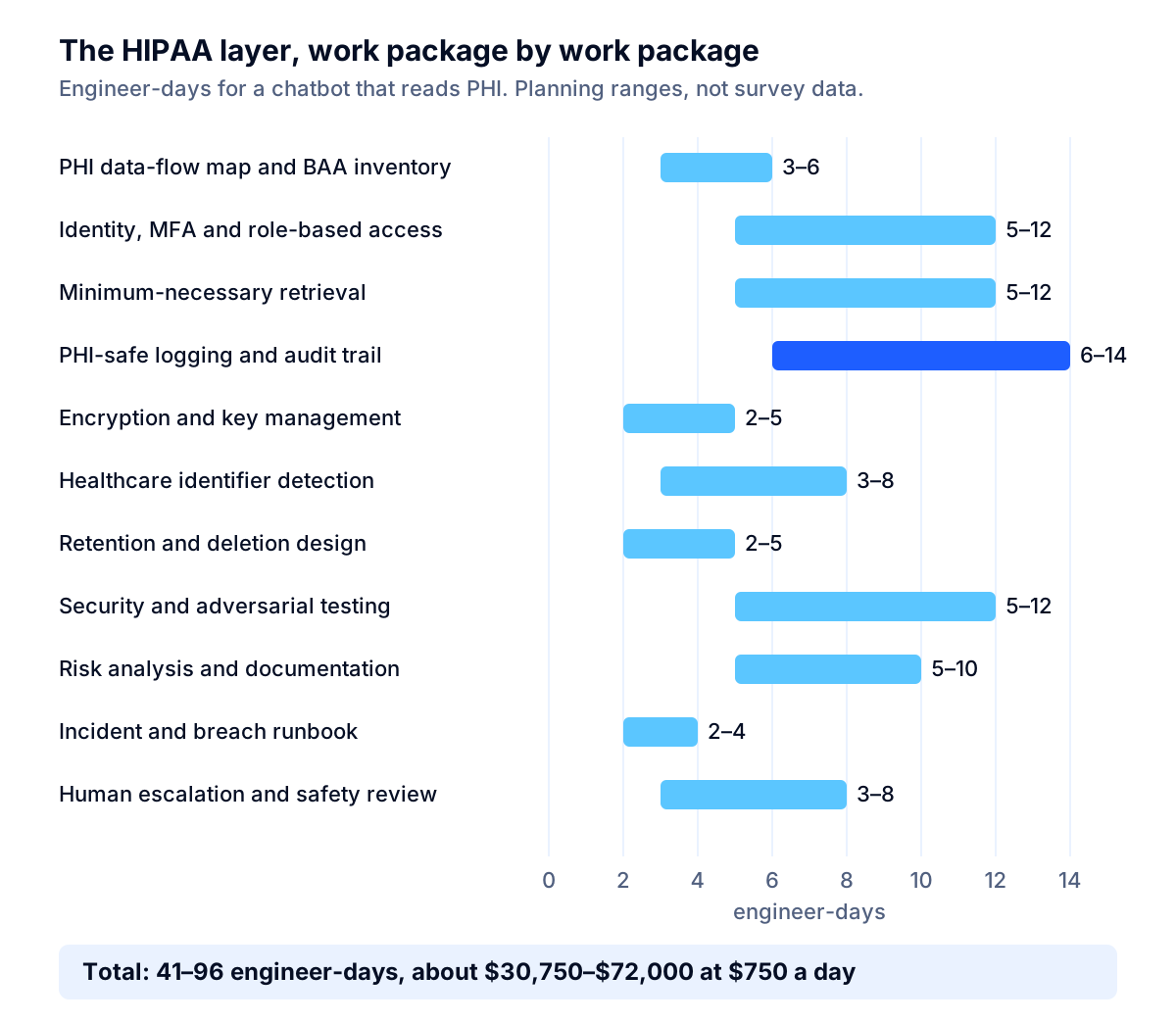
This is the part competing guides leave as a percentage. Here is what the work actually is, for archetype B, with the reason each item exists.
| Work package | Engineer-days | Why it exists |
|---|---|---|
| PHI data-flow map and BAA inventory | 3–6 | Every system PHI reaches is a business associate; you cannot sign BAAs for hops you have not found |
| Identity, unique user IDs, MFA, session timeout, role-based access | 5–12 | 164.312 requires unique user identification and access control; shared logins break audit trails |
| Minimum-necessary retrieval and tool scopes | 5–12 | The assistant must only retrieve records the asker is entitled to see, enforced as search filters |
| PHI-safe logging and the audit trail store | 6–14 | Audit controls are required, and application logs and traces are where PHI leaks first |
| Encryption and key management | 2–5 | Customer-managed keys, TLS everywhere, encrypted backups and vector stores |
| Identifier detection beyond the built-ins | 3–8 | Off-the-shelf PII filters miss healthcare identifiers such as medical record numbers |
| Retention and deletion design | 2–5 | Conversation retention, vendor retention windows and six-year documentation all need a decision |
| Security and adversarial testing | 5–12 | Prompt injection, cross-patient leakage and jailbreak tests specific to the assistant |
| Risk analysis update, policies, documentation | 5–10 | The chatbot must appear in the risk analysis and risk management plan, in writing |
| Incident and breach runbook for AI | 2–4 | Who investigates a suspected PHI disclosure in a chat transcript, and how fast |
| Human escalation and clinical safety review | 3–8 | Routing to a person, clinical review of answer boundaries, and what the bot must never say |
| Total | 41–96 | About $30,750–$72,000 at $750/day |
Four of these deserve more detail, because they are the ones most often skipped or underestimated.
The data-flow map finds the BAAs you forgot
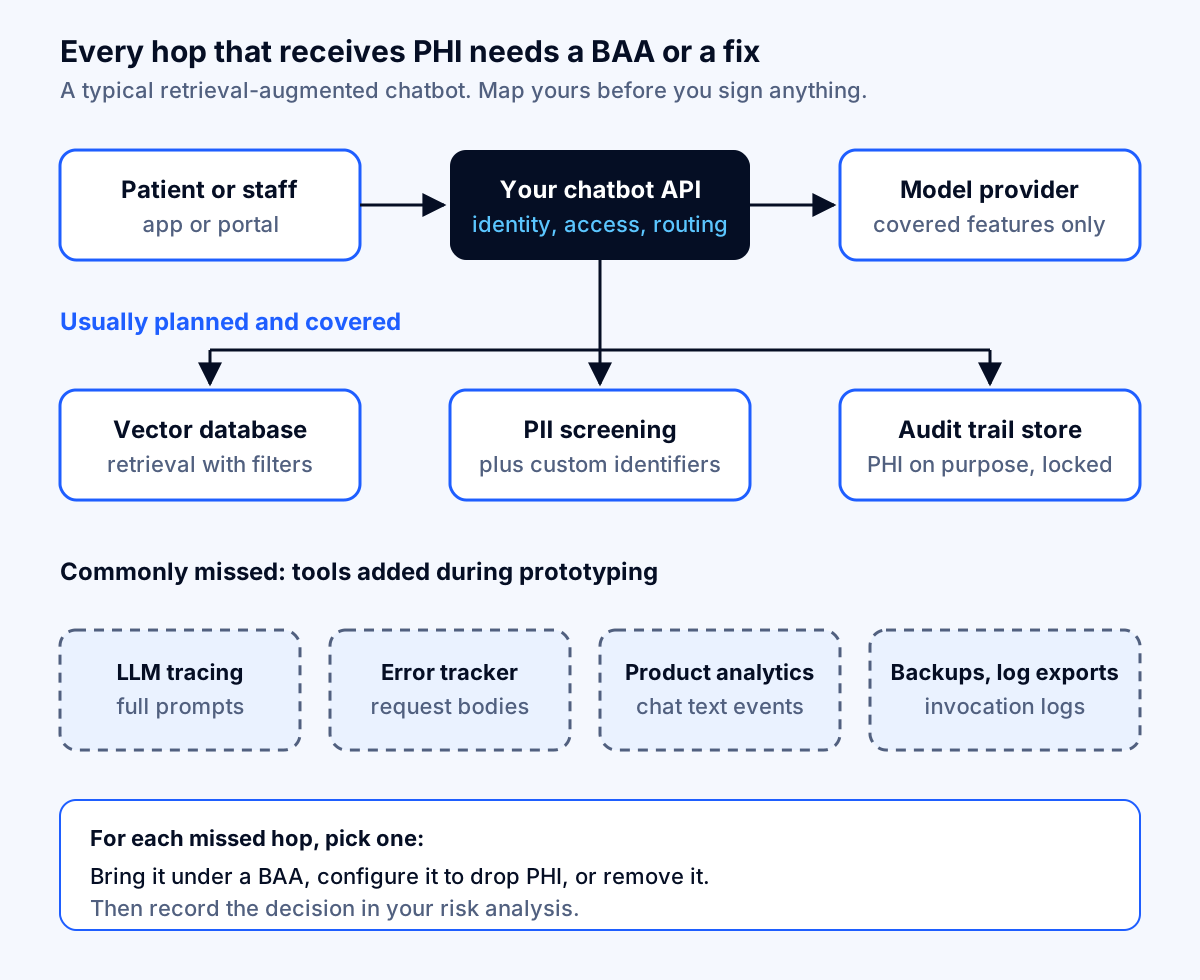
Draw every hop a prompt takes: the browser or app, your API, the retrieval service, the vector database, the model provider, any guardrail or moderation service, the logging pipeline, the tracing tool, the error tracker, analytics, and the backup system. Then mark which ones receive PHI.
In most first drafts, the model provider has a BAA and two or three other hops do not. The usual culprits are the LLM tracing tool someone added during prototyping, an error tracker that captures request bodies, and product analytics that record chat text. Each one is either removed, configured to drop PHI, or brought under a BAA. That decision process is the three to six days.
Logging is cheap to store and expensive to design
The audit trail has to answer a specific question months later: who asked what, which records were retrieved on their behalf, which model and prompt version produced the answer, and what the user saw. Our article on AI audit trail requirements describes the fields in detail.
The storage is trivial, as the run-cost section shows. The engineering is not, because you need two different logs. The audit trail holds PHI deliberately, in a locked-down store with its own access controls and retention. Everything else, including application logs, traces and error reports, must hold no PHI at all. Getting PHI out of the second category takes deliberate work on every logging call and every third-party SDK.
There is a specific trap on AWS. Amazon Bedrock's documentation states that Guardrails PII masking applies to what is sent to and returned from the model, not to model invocation logs: if you enable invocation logging, the input field in CloudWatch Logs "always contains the original, unmodified request regardless of guardrail intervention." AWS points to CloudWatch log data protection for masking there. Teams that turn on invocation logging for debugging and assume the guardrail protected it are storing raw PHI in a second place.
Off-the-shelf PII filters do not know healthcare identifiers
HIPAA's Safe Harbor de-identification standard at 45 CFR 164.514(b)(2) lists 18 identifier categories, including medical record numbers, health plan beneficiary numbers and account numbers. Generic PII detectors were not built around that list.
Amazon Bedrock Guardrails is a good example because its documentation is explicit. The built-in sensitive information types include names, addresses, ages, phone numbers, email addresses, US Social Security numbers, driver's license numbers and several financial identifiers, plus Canadian and UK health numbers. There is no built-in type for a US medical record number or health plan member ID. You add them with custom regular expressions, which Guardrails supports, and you test them against your own identifier formats. AWS also notes that the filter does not evaluate tool call arguments, tool results or tool definitions, so PHI moving through function calls is neither blocked nor masked.
None of this is a criticism of one product. Every general-purpose PII service needs this tuning for healthcare, and the three to eight days cover building and testing it.
The risk analysis is where enforcement actually lands
A finding that keeps appearing in OCR settlements is not a missing encryption setting. It is a missing or inadequate risk analysis. In September 2026, OCR announced a settlement with Ambry Genetics: $700,000 and a corrective action plan monitored for two years, after OCR found potential violations including "failing to conduct an accurate and thorough risk analysis," failing to terminate access when it was no longer appropriate, and failing to assign unique user identification.
For a chatbot, the risk analysis update means documenting what PHI the assistant can reach, which vendors receive it and under what terms, what could go wrong (wrong-patient retrieval, prompt injection through a document, transcript exposure) and what controls address each risk. Smaller practices can start from the free HHS Security Risk Assessment Tool, now at version 3.7, which is aimed at small and medium providers; its own disclaimer notes that using it neither is required nor guarantees compliance.
BAA limits that change what you can build
The BAA itself is rarely the expensive part. What costs money is designing around what the BAA does not cover, and those limits are increasingly feature by feature. Here is what each vendor documents as of October 2026.
OpenAI
OpenAI lists its HIPAA-eligible products as ChatGPT for Healthcare, ChatGPT for Enterprise with Regulated Workspace, ChatGPT FedRAMP, ChatGPT for Clinicians, API with Modified Retention and API FedRAMP with Modified Retention. For the API, its help center says eligibility "requires an executed OpenAI BAA" and that the organization "must also be provisioned with Modified Retention, unless OpenAI specifies otherwise," then lists the eligible endpoints, including chat completions and responses.
On the ChatGPT side, OpenAI states that features not listed "are not automatically covered under the BAA" and lists exclusions such as improved memory and event-triggered scheduled tasks. For budgeting, that means one design review every time you adopt a new feature.
Anthropic
Anthropic's BAA page says the agreement covers only the organization that accepted it, and that only features marked as covered may process PHI. For the first-party API, covered features include the Messages API with prompt caching, structured outputs, memory and web search, plus token counting and several administrative APIs.
Two details have direct cost consequences:
- The Batch API, Files API, Skills API, Code Execution and Web Fetch are not available for HIPAA-ready API organizations. Batch processing is how teams normally cut the cost of large evaluation runs and re-processing jobs by roughly half. With PHI in the test set, you pay standard rates or build evaluation sets from de-identified data, which is better practice anyway.
- Connectors and MCP servers are available but not covered, and "third-party data flows are not covered." An agent design that reaches the EHR through an MCP server needs its own BAA chain for that path. Our guide to MCP server security best practices covers the controls such a path needs.
Anthropic also states that covered models "require 30-day data retention" and are not available with zero data retention unless Anthropic has expressly authorized it. Your risk analysis should record that window.
Microsoft Azure
Microsoft's HIPAA BAA is included through its standard data protection terms. The design question is abuse monitoring. Microsoft's abuse monitoring documentation explains that flagged prompts and completions may be reviewed by automated systems and, when automated review is not confident enough, by authorized Microsoft employees. Customers who do not want that can apply for modified abuse monitoring, but only if they meet additional Limited Access eligibility criteria. Budget calendar time for the application, and record the default behavior in your risk analysis until approval arrives.
Amazon Web Services
AWS publishes a HIPAA Eligible Services Reference, last updated October 15, 2026, that lists Amazon Bedrock and Bedrock AgentCore along with the supporting services a chatbot needs: OpenSearch Service, CloudWatch, CloudTrail, KMS, S3, WAF, Cognito, Lambda and others. Amazon RDS is eligible only for its named database engines, and only Amazon Q Business is listed among the Amazon Q offerings.
Bedrock now has explicit retention modes. Its data retention documentation describes a zero-retention mode, a default mode and an aws_review mode. Claude Fable 5 and Claude Fable 5.1 require aws_review: prompts and completions "are retained within the AWS boundary for up to 30 days and may be reviewed by AWS," and are not shared with the model provider. Other models, the documentation notes, permit zero retention. So the model you choose on Bedrock decides whether a 30-day review window exists, which is a risk analysis entry and, for some organizations, a policy decision. AWS also shows how to enforce a zero-retention policy across an organization with a service control policy.
Key takeaway: The BAA is the start of the vendor work, not the end. Budget a day or two per vendor to read the covered-features list, pick the configuration, and write down the retention behavior, and repeat that review whenever you adopt a new feature.
What a HIPAA-compliant chatbot costs to run each month
Take a reference workload for archetype B or C: 5,000 conversations a month, four turns each, so 20,000 model calls. Each call sends about 4,000 input tokens (retrieved records or passages, the system prompt and recent history) and returns about 300 output tokens.
Model tokens
At Anthropic's published list prices as of October 2026:
| Model | Input / output per 1M tokens | Cost per turn | 20,000 turns |
|---|---|---|---|
| Claude Haiku 5.5 | $0.10 / $0.50 | $0.00055 | $11 |
| Claude Sonnet 5.5 | $2.00 / $10.00 | $0.011 | $220 |
| Claude Opus 5.5 | $4.00 / $20.00 | $0.022 | $440 |
| Claude Fable 5.1 | $10.00 / $50.00 | $0.055 | $1,100 |
Haiku 5.5 carries a higher rate, $0.50 / $2.50, for prompts above 100,000 tokens, which a chatbot turn of this size stays well below. Prices through Bedrock and Azure are listed on their own pricing pages and can differ; check them for the region you will run in. HIPAA itself adds nothing to token prices. What it can change is which features you may use to lower them, as the Batch API example shows. For the levers that remain, see our guide to LLM API cost optimization.
PHI screening
If you screen prompts and answers with Amazon Bedrock Guardrails, Bedrock pricing lists sensitive information filters at $0.10 per 1,000 text units (custom regular expressions are free) and text content filters at $0.15 per 1,000 text units. AWS defines a text unit as 1,000 characters.
Screening the full prompt and answer, about 17,200 characters or 18 text units per turn, comes to 360,000 text units a month: about $36 for the PII filter and $54 for content filters, $90 in total. Screening only the user's message and the answer, which is often enough because the retrieved records came from your own systems, cuts that to roughly $15.
Audit logs, keys and API activity
Here is the arithmetic that should end any argument about logging less to save money. Assume each turn writes a rich audit record of 20 KB: the question, retrieved record identifiers and excerpts, model and prompt version, and the answer.
- Ingestion: 20,000 × 20 KB is about 0.4 GB a month. CloudWatch Logs charges $0.50 per GB ingested in the Standard class, so about $0.20 a month, and the first 5 GB a month fall in the free tier.
- Storage for six years: the log grows by 0.4 GB a month, reaching about 29 GB after 72 months. At $0.03 per GB-month, the total storage bill over the full six years is about $32.
- Even at ten times the record size, 200 KB per turn with full retrieved passages, six years of storage is about $315.
- Keys: AWS KMS charges $1.00 per customer-managed key per month and $0.03 per 10,000 requests, with 20,000 requests a month free. A handful of keys costs a few dollars.
- API activity: CloudTrail data events, which record object-level access such as reads of S3 objects, are priced at $0.10 per 100,000 events in US East.
Compliance infrastructure for this workload is, in total, a few dollars to about a hundred dollars a month. Retrieval infrastructure and hosting add the same $0 to $350 range our RAG cost guide documents for a comparable workload.
The line that is actually large
The recurring cost that matters is people. A chatbot handling PHI needs regular access reviews, evaluation runs after every prompt or model change, sampled transcript review for wrong-patient or out-of-bounds answers, log review, vendor feature-list re-checks and an annual update to the risk analysis. Two to four engineer-days a month is a realistic floor for one assistant: $1,500 to $3,000 a month, which is more than every infrastructure line above combined.
Our article on how to evaluate AI chatbot accuracy covers the evaluation half of that workload, including how to build a test set that does not itself become a PHI liability.
Key takeaway: HIPAA does not make a chatbot expensive to run. It makes it expensive to run carelessly. The infrastructure for strong compliance costs less than a single engineer-hour a month; the people who use it are the real budget line.
What a mistake costs: penalties, settlements and breaches
A budget needs a downside to compare against. Three public reference points:
Civil money penalties. HHS adjusted HIPAA penalty amounts for inflation in a final rule published January 28, 2026, effective on publication:
| Culpability tier | Per violation | Calendar-year cap for identical violations |
|---|---|---|
| Did not know | $145 – $73,011 | $2,190,294 |
| Reasonable cause | $1,461 – $73,011 | $2,190,294 |
| Willful neglect, corrected within 30 days | $14,602 – $73,011 | $2,190,294 |
| Willful neglect, not corrected | $73,011 – $2,190,294 | $2,190,294 |
Settlements and corrective action plans. The Ambry Genetics settlement described above combined a $700,000 payment with two years of OCR monitoring. The monitoring often costs more than the payment, because it means a funded compliance program under outside scrutiny.
Breach costs. The HIPAA Journal's coverage of IBM's 2026 Cost of a Data Breach study reports an average healthcare breach cost of $6.64 million, still the highest of any industry, and a US average of $11.5 million across industries.
None of these numbers means a chatbot will cause a breach. They mean that spending $31,000 to $72,000 on the compliance layer of a PHI-handling assistant is a small fraction of what one serious failure costs, and that regulators look first at whether you did the risk analysis.
Build, buy or configure: the cheaper paths
Not every healthcare AI use case needs a custom build.
For internal staff productivity, a HIPAA-ready enterprise plan may be enough. Anthropic's pricing page lists a HIPAA-ready offering on Enterprise plans, not on Free, Pro, Max or Team, with self-serve Enterprise at $20 per seat per month billed annually and a 20-seat minimum, or about $4,800 a year at the minimum. OpenAI offers ChatGPT for Healthcare and ChatGPT for Enterprise with Regulated Workspace under its BAA. Neither replaces a custom assistant that is grounded in your own systems and permissions, but for drafting, summarizing documents a user already has open, and policy questions, configuration plus training plus a written policy is far cheaper than a build. You still owe the risk analysis, feature-by-feature BAA review and an acceptable use policy.
For patient-facing scheduling and FAQs, check your EHR and phone vendors first. Many already offer patient messaging or voice automation under your existing BAA. Our guide to the AI receptionist for small business covers the phone side, including recording-consent rules.
Build custom when the assistant must combine data from several systems, enforce your own permission model, act inside your workflows, or deliver an experience that is part of your product. That is where the archetype B and C budgets apply, and where the compliance layer is unavoidable rather than optional. Whichever path you choose, vet the vendor the same way; our AI vendor risk assessment questionnaire is a starting point.
Seven questions that explain a quote
When two quotes for the same assistant differ by a factor of two or three, these questions usually explain why:
- How many engineer-days go to each item in the HIPAA layer? A vendor that cannot answer has not planned the work.
- Which systems will receive PHI, and which of them have a BAA today? The answer should name tracing, logging and error tools, not just the model.
- How is minimum necessary enforced at retrieval time? Look for per-user or per-patient-relationship filters, not "the model is instructed not to share."
- What is in the audit record, where is it stored, and who can read it?
- Which model and vendor features are you using, and are they on the covered-features list? Ask the vendor to show you the list.
- How will you test for cross-patient leakage and prompt injection before launch?
- What does ongoing operation cost after launch, in days per month? A quote with no operating line is incomplete.
A good partner answers these in writing during discovery. Fleurant AI's AI compliance practice works this way: a free discovery call, then a written scope that prices the compliance layer explicitly.
When not to build a HIPAA chatbot yet
Some honest reasons to wait or choose a smaller scope:
- You do not have a current risk analysis. Adding an AI system to a risk program that does not exist repeats the gap OCR cited in the Ambry settlement. Fix the foundation first.
- Nobody owns the content. A chatbot that answers from outdated policies or stale payer rules is worse than no chatbot. Name an owner for every source before you index it.
- The use case requires clinical judgment. If the answer could change a diagnosis or treatment decision, you are in clinical decision support territory, where the FDA's clinical decision support guidance applies on top of HIPAA. Scope it with regulatory counsel first.
- You cannot fund operations. If the two to four days a month for reviews and evaluation are not in next year's budget, the assistant will drift out of compliance within months.
- Volume is low. If staff ask a few dozen questions a week, a well-organized policy library and a search box may deliver most of the value for a fraction of the cost.
A budget template you can adapt
For a first PHI-handling assistant (archetype B), a defensible budget at $750 per engineer-day looks like this:
| Line | Low | High |
|---|---|---|
| Discovery, data-tier decision and data-flow map | Included in HIPAA layer | Included in HIPAA layer |
| Base build (65–150 days) | $48,750 | $112,500 |
| HIPAA layer (41–96 days) | $30,750 | $72,000 |
| EHR read integration (15–40 days) | $11,250 | $30,000 |
| EHR vendor program fees | Ask your EHR vendor | Ask your EHR vendor |
| One-time total | $90,750 | $214,500 |
| Model tokens, 20,000 turns a month | $11 | $440 |
| PHI screening, retrieval, hosting, logs, keys | About $20 | About $450 |
| Operations: 2–4 engineer-days a month | $1,500 | $3,000 |
| Monthly total | About $1,530 | About $3,890 |
Two adjustments to make before you take this to a budget meeting. First, replace the $750 day rate with your real one; if you hire an agency, its rate is likely higher. Second, add a contingency on the EHR line, because it carries the most uncertainty in every project.
Where this leaves you
The cost of a HIPAA-compliant AI chatbot is driven by three decisions, in order: whether the assistant needs PHI at all, how deeply it integrates with the EHR, and how seriously the compliance layer is staffed. The infrastructure that makes strong compliance possible, such as audit logs, encryption keys and PHI screening, costs almost nothing. The work of designing it, testing it and keeping it current is where the money goes, and it is the part most quotes leave vague.
Start with a staff assistant that keeps PHI out, use it to prove retrieval quality and your review process, and then extend to PHI with the compliance layer priced line by line. If you want a second opinion on a scope or a quote, talk to a specialist; a free discovery call is a good place to pressure-test the numbers before you commit. You can also see how we approach custom AI development more broadly, or start from the Fleurant AI home page.
Frequently asked questions
How much does a HIPAA-compliant AI chatbot cost to build?
Using a $750 engineer-day derived from BLS wage data, our planning ranges are about $28,500 to $64,000 for a staff assistant designed to keep PHI out, $91,000 to $215,000 for a staff assistant that reads PHI from the EHR, and $116,000 to $255,000 for an authenticated patient-facing assistant that can act on appointments or refills. Your own day rate and EHR integration scope move these numbers more than anything else.
How much does HIPAA compliance add to an AI chatbot budget?
For a chatbot that handles PHI, the compliance layer in our model is 41 to 96 engineer-days, or about $31,000 to $72,000 at $750 a day. That covers the PHI data-flow map and BAA inventory, identity and access controls, minimum-necessary retrieval, PHI-safe logging, identifier detection, security testing, the risk analysis update and human escalation. The infrastructure part of compliance is cheap; nearly all of the cost is labor.
Can I build a HIPAA chatbot on the OpenAI or Claude API?
Yes, but only on the products and features each vendor names under its BAA. OpenAI requires an executed BAA and Modified Retention for API use with PHI, and lists the eligible endpoints. Anthropic's BAA covers its first-party Messages API and named features, while the Batch API, Files API, Skills API, Code Execution and Web Fetch are not available to HIPAA-ready API organizations. Check the current lists before you design, because they change.
What does a HIPAA-compliant chatbot cost to run each month?
For 5,000 conversations a month at four turns each, model tokens run from about $11 on Claude Haiku 5.5 to about $220 on Claude Sonnet 5.5 at Anthropic list prices, as of October 2026. PII screening with Amazon Bedrock Guardrails adds roughly $15 to $90, and full audit logs cost under a dollar a month to store. The larger recurring cost is two to four engineer-days a month of access reviews, evaluation runs and log review, about $1,500 to $3,000.
Is it cheaper to keep PHI out of the chatbot entirely?
Usually, by a wide margin. A staff assistant that answers questions from policies, payer rules or scheduling procedures, and is built to refuse or strip PHI, avoids EHR integration and most of the compliance layer. It still needs a BAA as a safety net, because users will paste patient details into it anyway. Our HIPAA-compliant AI development checklist explains how to decide which data tier a feature needs.
What are the HIPAA penalties if a chatbot exposes PHI?
As adjusted by HHS on January 28, 2026, civil money penalties run from $145 per violation where the entity did not know, up to $73,011 per violation, with a calendar-year cap of $2,190,294 for identical violations. Settlements often include multi-year corrective action plans. In September 2026, Ambry Genetics paid $700,000 and accepted two years of OCR monitoring after OCR found, among other things, no accurate and thorough risk analysis.
Sources
- Annual Civil Monetary Penalties Inflation Adjustment (2025 adjustment, published January 28, 2026), Federal Register via GovInfo
- HHS' Office for Civil Rights Settles HIPAA Investigation of Ambry Genetics Phishing Attack Affecting 225,000 Individuals, U.S. Department of Health and Human Services
- 45 CFR 164.308: Administrative safeguards, eCFR
- 45 CFR 164.312: Technical safeguards, eCFR
- 45 CFR 164.316: Policies and procedures and documentation requirements, eCFR
- 45 CFR 164.514: Other requirements relating to uses and disclosures of protected health information, eCFR
- Clinical Decision Support Software: Guidance for Industry and FDA Staff, U.S. Food and Drug Administration
- HIPAA Security Rule rulemaking, RIN 0945-AA22 (Unified Agenda), Office of Information and Regulatory Affairs
- Security Risk Assessment Tool, Assistant Secretary for Technology Policy (HealthIT.gov)
- Business Associate Agreements (BAA) for Commercial Customers, Anthropic Privacy Center
- Claude pricing, Anthropic
- HIPAA eligible products and functionality, OpenAI Help Center
- Foundry Models sold by Azure abuse monitoring, Microsoft Learn
- HIPAA Eligible Services Reference, Amazon Web Services
- Data retention (Amazon Bedrock User Guide), Amazon Web Services
- Remove PII from conversations by using sensitive information filters, Amazon Web Services
- Amazon Bedrock pricing, Amazon Web Services
- Best practices for applying Amazon Bedrock Guardrails to code generation workflows, AWS Machine Learning Blog
- Amazon CloudWatch pricing, Amazon Web Services
- AWS Key Management Service pricing, Amazon Web Services
- Occupational Outlook Handbook: Software Developers, U.S. Bureau of Labor Statistics
- Occupational Outlook Handbook: Information Security Analysts, U.S. Bureau of Labor Statistics
- Employer Costs for Employee Compensation, U.S. Bureau of Labor Statistics
- IBM 2026 Cost of a Data Breach study coverage, The HIPAA Journal


