Software Costs
ServiceTitan Pricing in 2026: What It Costs per Technician
ServiceTitan pricing is quote-only. Here is what is verified, what is estimated, and a cost-per-technician model for 10, 25 and 50 techs.

In this article
- What does ServiceTitan pricing look like in 2026?
- What does ServiceTitan say about how it charges?
- How much does ServiceTitan cost per technician? What the estimates say
- ServiceTitan cost per technician at 10, 25 and 50 techs
- What does ServiceTitan cost besides the subscription?
- What do Jobber and Housecall Pro publish, for comparison?
- Is ServiceTitan worth the price for a shop your size?
- What should you ask for in writing before signing?
- What does it cost to leave or switch?
- What are the alternatives to paying per technician?
- How do you decide whether a quote is worth accepting?
- How a Stack Audit answers the ServiceTitan question
- Conclusion: the number to get, and the date to remember
- Frequently asked questions
- Sources
Short answer: ServiceTitan pricing is not published. The company sells by quote, so the only way to learn your real number is a written quote for your technician count. What is verified: ServiceTitan's annual report says its subscription price is "partially based on the number of technicians" you employ, and that new customers typically sign 12 to 36 month contracts that renew automatically. What is estimated: third-party guides put the subscription at roughly $245 to $500 per technician per month and onboarding at $5,000 to $50,000, and almost every one of those guides is written by a competitor.
This article separates the two. You will get:
- what ServiceTitan itself says about its packages, contracts and fees, read from its own pricing page and its filing with the SEC on the dates given;
- a cost-per-technician model for 10, 25 and 50 technicians, with every assumption stated so you can replace ours with yours;
- the cost lines a per-technician quote does not show, and a checklist of what to ask for in writing;
- what Jobber and Housecall Pro publish, as a reference point for what a smaller shop pays;
- the arithmetic for deciding whether a quote is worth accepting, replacing, or connecting to what you already have.
We do not have a ServiceTitan quote to show you, and we do not have a customer. Every ServiceTitan number below that did not come from ServiceTitan is labeled as an estimate and linked to where it came from.
What does ServiceTitan pricing look like in 2026?
ServiceTitan publishes package names and no prices. As of November 24, 2026, its pricing page lists four packages: Core, Demand AI, Field AI and MAX. The only calls to action are "Get Pricing" and "Get Demo." The page states that its pricing is "built to drive ROI for your individual business," which is a way of saying the quote depends on the conversation.
What each package includes, according to that page:
| Package | What the page says it adds |
|---|---|
| Core | The platform: scheduling, dispatching, call booking, invoicing, pricebook, reporting, mobile estimates, configurable payroll, commission tracking and customizable memberships |
| Demand AI | Core plus marketing and booking automation (campaign automation, online scheduling, voice and SMS agents, smart dispatching) |
| Field AI | Core plus field-side automation (AI sales coaching, equipment intelligence, AI estimates and presentations, job assistance and job prep) |
| MAX | Everything above plus office automation (AI payments collection, accounts payable approvals, owner analytics) |
Two details matter for anyone reading older advice. First, many ranking pages still describe three packages called Starter, Essentials and The Works. Those are the previous names, and the per-technician figures attached to them describe the previous structure. Second, the page notes that all packages are available for in-home residential customers and that MAX is in pilot for other business types, so a commercial-heavy contractor should ask which package they are actually being quoted.
Beyond the packages, the page links to a list of Pro products sold on top: AI Virtual Agent, Marketing Pro, Contact Center Pro, Pricebook Pro, Fleet Pro, Scheduling Pro, Dispatch Pro and Field Pro. It also lists a "Pay and Get Paid" group (payments, integrated financing, accounts payable and expense management). None of these shows a price.
Key takeaway: ServiceTitan's quote has at least three moving parts that a "per technician" figure hides: the package, the Pro products you add, and the payments and financing you route through it. Ask for all three itemized.
What does ServiceTitan say about how it charges?
ServiceTitan's own words come from its annual report. In the Form 10-K for the fiscal year ended January 31, 2026, filed with the SEC, the company says four things that a contractor can use.
Pricing is partly per technician. The filing says the pricing of its subscription platform "is partially based on the number of technicians employed by each of our customers." The word "partially" matters: the filing does not give a per-technician rate, and it does not say what the rest of the price is based on. The pricing page says the package's features drive the price, so a reasonable reading is technician count multiplied by a package rate, plus add-ons. Confirm that reading with your rep.
Contracts are 12 to 36 months and renew on their own. The filing says that for new customers the company "primarily" enters annual or multi-year subscription agreements with terms "typically ranging from 12 to 36 months," that certain Pro product and legacy customers are month-to-month, and that in nearly all cases contracts renew automatically unless cancelled in advance. It also says customers are generally billed monthly in advance. The length you are offered is a negotiating point, and so is the notice period.
Professional services are billed separately. The filing says fees for professional services are generally invoiced separately at the start of the contract or as ordered. It describes implementation work as data and accounting migrations, telecom setup and custom reporting. It does not state an onboarding price.
The model can change. The filing includes the sentence "In the future, we may implement changes to our pricing model." That is a standard risk-factor line, not an announcement. It is still a reason to put the renewal price in writing.
The filing also gives scale. ServiceTitan reports about 10,800 "Active Customers," defined as customers with more than $10,000 of annualized billings, who account for over 97% of annualized billings. It reports net dollar retention above 110% in each of the last three fiscal years, which means existing customers as a group spent more over time, through more technicians, more modules and more transactions. That is useful context for a renewal conversation: a vendor whose existing customers expand every year has a reason to build the quote around expansion.
How much does ServiceTitan cost per technician? What the estimates say
Third-party estimates cluster between roughly $245 and $500 per technician per month, and they come from companies that compete with ServiceTitan. The most-cited one, from Projul, a competing construction software vendor, gives these figures as estimates for the older package names:
| Older package name | Estimated per technician per month |
|---|---|
| Starter | $245 to $300 |
| Essentials | $300 to $400 |
| The Works | $400 to $500 |
The same page estimates implementation at $5,000 to $50,000, a 12-month minimum contract, and a 2-to-12-month implementation period. The page attributes its per-technician figures to two other third-party sources rather than to ServiceTitan. We read the page on November 24, 2026, and we could not confirm any of these numbers on a ServiceTitan page or in its filing. We are repeating them because they are the numbers owners keep finding, and the right way to use them is as a range to test a real quote against, not as a price.
We also looked for contractor-reported figures. The forum threads where owners compare what they pay could not be fetched by our tools, so we are not quoting any. If you want first-hand numbers, the owner communities for your trade are the place, and a forum post is still not a vendor quote. Ask the poster how many technicians they have, which package they are on, what year they signed and whether the figure includes Pro products and payments.
ServiceTitan cost per technician at 10, 25 and 50 techs
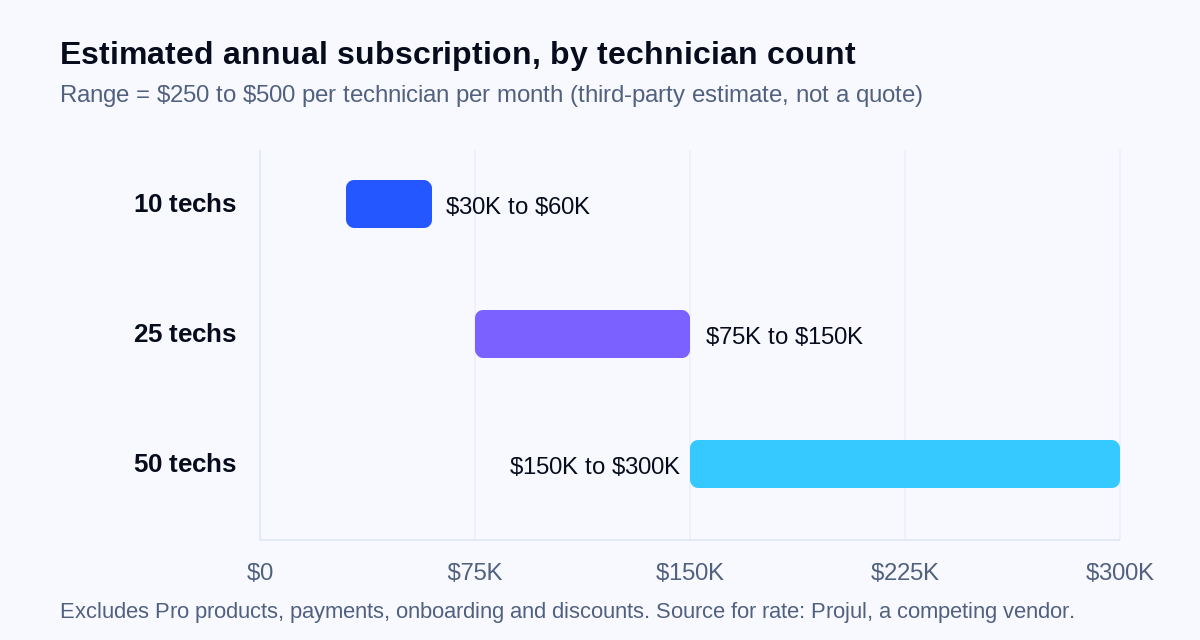
The model below applies the $250 to $500 per technician per month estimate to three shop sizes. It uses the low end of Projul's Starter range, rounded to $250, and the top of The Works, $500. It is an illustration of how the estimate scales, not a quote.
| Technicians | Monthly at $250 | Monthly at $500 | Annual range | Three-year range (subscription only) |
|---|---|---|---|---|
| 10 | $2,500 | $5,000 | $30,000 to $60,000 | $90,000 to $180,000 |
| 25 | $6,250 | $12,500 | $75,000 to $150,000 | $225,000 to $450,000 |
| 50 | $12,500 | $25,000 | $150,000 to $300,000 | $450,000 to $900,000 |
The assumptions, so you can change them:
- Technician count means licensed technicians. We have not verified whether office staff, dispatchers or managers are counted. The filing says the price is partially based on technicians, so ask what else is counted.
- No Pro products and no payments revenue share. Every Pro product raises the monthly line, and the filing describes Pro and FinTech as the add-on layers.
- No implementation fee. Add $5,000 to $50,000 to year one if you accept the third-party estimate.
- No discount. Multi-year terms and negotiation move the real number, and nothing public says by how much.
- No renewal increase. The filing does not state renewal pricing. Ask.
The shape of the table is the useful part. The monthly bill scales with technicians, so every truck you add adds a line to it. That is the per-seat pattern, and it is the reason the cost of a growing shop's software tracks its payroll rather than its needs. We wrote about the same pattern in what a custom CRM costs: the subscription is the part of the cost that never stops.
What does ServiceTitan cost besides the subscription?
The subscription is the number everyone asks about, and it is rarely the whole bill. These are the other lines, who bills them, and what is known publicly.
| Cost line | Who bills it | What is verified | What is not |
|---|---|---|---|
| Subscription | ServiceTitan | Partly per technician; billed monthly in advance; 12 to 36 month terms (10-K) | The rate |
| Pro products | ServiceTitan | Sold as add-ons; named on the pricing page (Marketing Pro, Dispatch Pro, Pricebook Pro and others) | Every price |
| Onboarding and professional services | ServiceTitan | Billed separately at contract start (10-K) | The amount; third-party estimates are $5,000 to $50,000 |
| Payments and financing | ServiceTitan and its partners | Listed as "Pay and Get Paid" on the pricing page | Processing rates |
| Phone, call center and marketing services | ServiceTitan or third parties | Live voice and chat services and ancillary hardware are described in the 10-K | Prices |
| Your own time | You | Nothing public | The hours your office spends in onboarding and re-keying |
| Exit | You | Auto-renewal unless cancelled in advance (10-K) | Early termination terms; get them in writing |
The line owners underestimate is the last two. Implementation is rarely a weekend. Projul estimates two to twelve months, and anyone who has migrated a pricebook, a customer list and open jobs knows the office keeps running two systems in the meantime. If your dispatcher spends five hours a week reconciling, that is time you pay for twice.
What do Jobber and Housecall Pro publish, for comparison?
For a side-by-side at 10, 25 and 50 people, with the tier each one forces, see Jobber vs Housecall Pro vs ServiceTitan.
Jobber and Housecall Pro publish prices, and at the size where they apply they cost a few hundred dollars a month. That gives a floor for the question "is ServiceTitan worth its premium for us?" These are list prices read from each vendor's pricing page on November 24, 2026, and promotional rates change often, so follow the links for current numbers.
| Vendor and plan | Users included | Price shown | Extra users |
|---|---|---|---|
| Jobber Connect, 10 users | 10 | $161 a month for the first 12 months on annual billing, then $229 | $29 a month each |
| Jobber Plus, 15 users | 15 | $371 a month for the first 12 months on annual billing, then $529 | $29 a month each |
| Housecall Pro Essentials | 5 | $149 a month billed annually | Not shown |
| Housecall Pro Max | 8 | $299 a month billed annually | $35 a month each |
Compare those with the estimate table above, with two cautions. These are different products: Jobber and Housecall Pro are built for smaller shops, and ServiceTitan's page describes customers from four trucks to thousands, with deeper pricebook, call booking, reporting and marketing tooling. A 25-technician commercial and residential contractor may need features the cheaper tools lack. And per-user pricing still scales with headcount: Jobber's extra users are $29 a month each, Housecall Pro's Max plan $35.
The comparison is still useful, because it shows what the premium has to buy. If a quote for your shop comes in at $9,000 a month, the question is which problems are solved by the extra $8,000 a month, and which of them a tool that costs a tenth of that would solve too.
Is ServiceTitan worth the price for a shop your size?
It is worth it when the price buys specific, named things you will use in the first year, and when you can say which of them. It is not worth it when the buying reason is "everyone in the trade uses it." A five-question test:
- Do you run more than one department or location that dispatch from one board? Multi-department dispatch is where per-technician platforms earn their keep.
- Do you sell service agreements at volume? Memberships and recurring visits are a core feature of the Core package.
- Do you use a pricebook and good-better-best estimates in the field? If techs quote from a standard price list, that is a built-in strength of the platform.
- Will you use at least two Pro products? Paying for the platform and using only scheduling and invoicing means paying for the part you do not use.
- Can you name the person responsible for onboarding? A migration without an owner on your side is the most common reason it runs long.
If you answer yes to most of them, a quote is worth requesting and the model above shows what to expect. If you answer no to most, the money is probably better spent on a smaller tool, or on connecting the tools you already pay for. We make no promise about which is right for you: that depends on your numbers, not on ours.
What should you ask for in writing before signing?
Ask for every item below in the quote itself, not in an email afterward. This is the checklist we would want before any software contract of this size.
- The package name and the exact feature list in that package, as listed on ServiceTitan's pricing page on the day you sign.
- The number of technician licenses, and whether dispatchers, office staff and managers count toward the price.
- The price per technician per month, the billing frequency, and the total for the first 12 months.
- Every Pro product included, with its monthly price, and the price of any you might add later.
- The onboarding and professional services fee, the number of hours it covers, and what happens if the migration runs past the estimate.
- Payments and financing terms: processing rates, who owns the merchant account, and what happens to it if you leave.
- The contract length, the renewal date, the notice period to cancel, and how the notice is delivered.
- The renewal price, or the cap on the renewal increase. Net dollar retention above 110% in the filing says existing customers spend more each year, so make the increase explicit.
- What your data export looks like when you leave: the format, how long it takes, and the cost, if any.
- The price you are quoted if you add technicians in the middle of the term.
The last item is the per-seat test. A seasonal hire in June should not change a mid-term invoice you did not expect. This is the same distinction that matters in any contract with a platform you depend on, and we describe the alternative below.
Key takeaway: The contract date matters more than the sticker price. A 36-month term that renews automatically means the real decision is made on the day you do or do not send the cancellation notice, not on the day you sign.
What does it cost to leave or switch?
Leaving a field service platform costs more in disruption than in fees, and the disruption is concentrated in two places. The first is the field app, because technicians are the people most resistant to change and the most expensive to disrupt, and a bad cutover shows up as missed jobs. The second is history: customer records, equipment, service agreements and photos need to come out in a usable format.
Do not plan a switch in peak season. If your busy period runs from June through September, schedule the change for the quiet months and run the old and new systems in parallel for two weeks before you cancel anything. We cover the sequencing in what to replace first and what to leave alone, but the short version is: office modules first, the truck last, and never cancel a subscription before the replacement has survived a full billing cycle.
Never replace the things that carry regulatory or banking risk. Accounting, payroll and payment processing stay with the tools built for them, and any replacement plan should connect to them rather than rebuild them.
What are the alternatives to paying per technician?
There are three, in order of how much they change. Which one fits depends on how much of the platform you actually use.
1. Keep it and negotiate. If ServiceTitan fits, the leverage is in the contract: multi-year terms for a lower rate, a capped renewal increase, a written onboarding scope, and the right to remove technician licenses you stop using. The 10-K's own language, that customers add technicians and transactions over time, is the thing your quote should hold flat.
2. Move to a smaller tool. Jobber and Housecall Pro publish prices and suit shops that do not need ServiceTitan's depth. The risk is outgrowing them: the shop that doubles in two years needs to know what the switch back would cost.
3. Make the tools you have work together, or replace the subscriptions with software built for your shop. Fleurant AI sells this in two ways. The Connector keeps your current tools and makes them work as one system, at $7,500 to build and $750 a month. The Operations Stack replaces a named set of subscriptions with software built for the business, at $18,000 for three modules or $32,000 for five or more, plus a monthly fee set by company size rather than by seats: $2,000 up to 30 employees, $2,750 for 31 to 60 and $3,500 for 61 to 100. The band is reviewed once a year at renewal, never mid-term, so hiring a technician in March never changes the April invoice.
That last sentence is the whole point of the difference, and it comes with a trade-off we state plainly: you own your data and your software instance, and you rent the agent fleet that operates it. Data export in standard formats is free, any time. On cancellation you get 60 days of read-only access plus a full export. Source code escrow is available on request.
We do not claim the Operations Stack does everything ServiceTitan does. It does not, and for a shop that uses the full platform it may not be the right answer. The honest test is the arithmetic below.
How do you decide whether a quote is worth accepting?
Run the numbers on your total software bill, not on one product. The question is not "what does ServiceTitan cost" but "what do we pay in total for the software that runs the business, and what would it cost to run it differently?"
The break-even formula for replacing subscriptions with a built stack is simple:
Months to pay back = build fee ÷ (your monthly software spend you would cancel − the monthly fee)
The table below uses hypothetical monthly spends, not client results, because Fleurant AI has no client yet. It applies the published three-module build fee of $18,000 and the standard-band monthly fee of $2,000 to show how the payback period changes with the bill. Your own spend is the input that matters.
| Subscriptions you would cancel, per month | Monthly fee (up to 30 employees) | Monthly difference | Months to pay back $18,000 |
|---|---|---|---|
| $2,500 | $2,000 | $500 | 36 |
| $3,400 | $2,000 | $1,400 | About 13 |
| $5,000 | $2,000 | $3,000 | 6 |
| $8,000 | $2,000 | $6,000 | 3 |
Read the table carefully. At $2,500 a month of cancellable subscriptions, payback takes three years and the case is thin. That is why the Stack Audit has a floor: below about $1,500 a month in software spend, replacing it does not pay back in a sensible time, and we say so. Above it, the arithmetic can work, but only if the subscriptions you cancel are really cancelled. Most shops will keep accounting, payroll and payments, and many will keep a field app until last, so the number that goes in the left column is smaller than the total software bill.
Be sceptical of the labor-savings argument in any vendor's model, including ours. The case worth approving is the subscription arithmetic, because it is a number on your own invoices. The hours your office saves are real but hard to prove, and a build should not depend on them.
If you are weighing the decision, the related questions are in build versus buy, and the cost of keeping software working over the years is in what an AI agent costs to build and run. For a portal your customers use, the cheaper answer is usually the one already in your platform, which we explain in the customer portal guide.
How a Stack Audit answers the ServiceTitan question
A Stack Audit is $2,500, takes one to two weeks and is credited in full against a build started within 90 days. It produces four things: every subscription you pay for (tool, seats, monthly and annual cost, contract end date and who actually uses it), a map of where your office re-types data, a list of overlaps you pay for twice, and a costed plan with payback in months.
For a ServiceTitan decision the audit does something a quote cannot: it puts your current bill, your contract dates and your quote on one page. You see whether the new quote is a replacement for what you pay or an addition to it. If the answer is that the quote is good value, that is a useful result too, and you keep the document either way.
Before you spend anything, you can do a rough version yourself with a spreadsheet and a few questions:
- List every tool you pay for with its monthly cost and its contract end date.
- Write the cancellation notice date next to each one.
- Mark each as keep, connect or replace, and write down the reason in one sentence.
- Add up the "replace" column and compare it with the quote you are considering.
If the quote is larger than the column, ask what it buys that the old tools did not.
Conclusion: the number to get, and the date to remember
ServiceTitan pricing is a quote, not a list price. The verified facts are small and useful: the price is partly per technician, contracts typically run 12 to 36 months and renew automatically, professional services are billed separately, and the company's own filing says it may change its pricing model. Everything else, from $245 to $500 per technician and from $5,000 to $50,000 for implementation, is a third-party estimate to test a quote against.
What to do next:
- Ask for a written quote using the ten-item checklist above.
- Put the renewal and cancellation notice dates in your calendar when you sign.
- Compare the quote against everything you pay for today, not against one product.
- If you want your own numbers before committing, book a Stack Audit or talk to a specialist.
For the rest of the stack, we modeled what each hire adds to a per-seat software bill, from 9 to 25 employees.
If you'd like one clear, practical take on the software that runs your business each month, subscribe to the Fleurant AI Briefing: one email a month, unsubscribe any time.
Frequently asked questions
How much is ServiceTitan per technician per month?
ServiceTitan does not publish a price. Third-party estimates, mostly from competing vendors, run from about $245 to $500 per technician per month depending on package, and none of them is a ServiceTitan quote. ServiceTitan's own annual report confirms that pricing is partly based on the number of technicians, so a written quote for your headcount is the only real number.
Does ServiceTitan have an implementation fee?
Yes, in the sense that professional services are billed separately. ServiceTitan's 10-K says fees for these services are generally invoiced separately at the start of the contract, but it does not state an amount. Third-party estimates run from about $5,000 to $50,000, and you should get the figure in writing before signing.
How long is a ServiceTitan contract?
ServiceTitan's annual report says new customers primarily sign annual or multi-year agreements, typically 12 to 36 months, and that nearly all contracts renew automatically unless cancelled in advance. Put the cancellation notice date in your calendar the day you sign, because that is the date that decides whether you renew.
What are ServiceTitan's packages in 2026?
As of November 24, 2026, ServiceTitan's pricing page lists four packages: Core, Demand AI, Field AI and MAX. Many articles still describe Starter, Essentials and The Works, which are the older names. Treat any per-technician figure tied to the old names as a rough guide to the old structure, not a quote for today's packages.
Is ServiceTitan too expensive for a small contractor?
It depends on the size of the shop and the number of problems it solves. ServiceTitan's own page describes customers from four trucks upward. Jobber and Housecall Pro publish prices, and at 5 to 15 users they cost a few hundred dollars a month, so a shop that does not need ServiceTitan's depth can often stay far below its estimated range.
How do I find out what my own ServiceTitan bill is going to be?
Ask for a written quote that lists the package, the number of technician licenses, every Pro product and payments setting, the onboarding fee, the contract length, the renewal notice period and the renewal price. A Stack Audit does this for the software you already pay for, so you can compare a quote against your real numbers before you sign.
Sources
- ServiceTitan packages, ServiceTitan
- ServiceTitan, Inc. Form 10-K for the fiscal year ended January 31, 2026, U.S. Securities and Exchange Commission
- ServiceTitan pricing analysis 2026, Projul (a competing vendor)
- Jobber pricing, Jobber
- Housecall Pro pricing, Housecall Pro