Web & Software Development
Custom CRM Development Cost: Hours, Prices and Break-Even Seats
Custom CRM development cost: 440 to 2,640 engineering hours, about $33,000 to $198,000 at $75/hour, and the seat count at which it beats HubSpot or Salesforce.

In this article
- Custom CRM development cost at a glance
- What you are actually paying for in a custom CRM
- How the hours break down: a work-package estimate
- What does a CRM subscription cost? November 2026 list prices
- Custom CRM vs HubSpot or Salesforce: a three-year cost model
- Buy, extend or build: four questions to decide
- The hidden costs in a custom CRM project
- How long does it take to build a custom CRM?
- How to get an accurate custom CRM quote
- Putting it together
- Frequently asked questions
- Sources
The short answer on custom CRM development cost: a basic pipeline CRM takes 438 to 920 engineering hours, a mid-sized CRM with two-way email sync and two integrations takes 780 to 1,840 hours, and an advanced CRM with sequences, quoting and four integrations takes 1,140 to 2,640 hours. At a $75-an-hour team rate, that is roughly $33,000 to $69,000, $59,000 to $138,000 and $86,000 to $198,000, before you pay to run it.
Whether that is a good deal depends on one number: how many people will use it. In our three-year model, a mid-sized custom CRM becomes cheaper than HubSpot Sales Hub Professional somewhere around 31 to 75 sales users, and cheaper than Salesforce Sales Cloud Core around 14 to 35 users, at November 2026 list prices.
This guide shows its work. You get a work-package hour model with written assumptions, rates derived from federal wage data, current list prices for HubSpot, Salesforce and Dynamics 365 (including the onboarding fees most price guides leave out), a break-even chart by seat count, the hidden costs that turn up in email sync and data migration, and a four-question test for deciding whether to buy, extend or build.
Custom CRM development cost at a glance
A custom CRM costs between about $18,000 and $264,000 to build, depending on scope and who builds it, plus $1,600 to $3,400 a month to run at a $75 rate. Here is the whole answer in one table. Every number is explained in the sections below.
| Basic pipeline CRM | Mid-sized CRM | Advanced CRM | |
|---|---|---|---|
| What it does | Contacts, companies, deals, tasks, basic reports | Adds two-way email and calendar sync, two integrations, dashboards | Adds sequences, quoting, territories, four integrations |
| Engineering hours | 438–920 | 780–1,840 | 1,140–2,640 |
| At $40/hour | $17,520–$36,800 | $31,200–$73,600 | $45,600–$105,600 |
| At $75/hour | $32,850–$69,000 | $58,500–$138,000 | $85,500–$198,000 |
| At $100/hour | $43,800–$92,000 | $78,000–$184,000 | $114,000–$264,000 |
| Calendar time, two engineers | 2–4 months | 3–8 months | 5–11 months |
| Usually worth it when | Rarely; buy instead | 30–75+ daily users, or seat prices above $150 | Selling process is unusual and central to how you win |
Key takeaway: The build is only part of the bill. At $75 an hour, three years of maintenance and hosting for a mid-sized CRM add $57,600 to $122,400, which can equal the original build. Compare three-year totals, never build cost against one year of licenses.
What you are actually paying for in a custom CRM
You are paying for a database of customers and deals, the screens and permissions around it, and the plumbing that keeps it in sync with email, calendars and your other systems. The first part is cheap; the plumbing and the permissions are where budgets go.
A customer relationship management (CRM) system at its core has five records: leads, contacts, companies, deals (opportunities) and activities (calls, emails, meetings, tasks). Sales teams live in two views: the pipeline board, where deals move through stages, and the activity timeline, which shows every interaction with a customer in one place.
The ranking price guides for this keyword mostly list features with dollar figures attached and no method behind them. We think hours are a better unit, because you can check them against any quote you receive and multiply them by any rate. The estimates below are Fleurant AI planning ranges for a senior-led team building one responsive web application (no native mobile apps) on managed cloud services, for an internal sales team of roughly 10 to 100 users.
How the hours break down: a work-package estimate
A mid-sized custom CRM breaks into eleven work packages totaling 780 to 1,840 engineering hours, and three of them (email sync, integrations and permissions) carry most of the uncertainty. Here is the mid-sized tier in detail.
| Work package | Hours (low–high) | What drives the range |
|---|---|---|
| Discovery, data model and interface design | 60–120 | Number of record types, custom fields and user roles |
| Login through company sign-on, roles, record-level permissions | 60–140 | Whether reps see only their own deals, team deals or everything |
| Contacts and companies: custom fields, duplicate detection, import tool | 80–160 | Quality of existing data, matching rules |
| Deals pipeline, tasks and activity timeline | 100–200 | Number of pipelines, stage rules, required fields per stage |
| Two-way email and calendar sync (Gmail or Microsoft 365) | 120–280 | Threading, attachments, shared inboxes, sync conflicts |
| Reports and dashboards | 60–160 | Fixed reports vs a user-built report tool |
| Two integrations (for example accounting and website forms) | 80–240 | API quality, test data, who owns the other system |
| Data migration from spreadsheets or the old CRM | 40–120 | Number of sources, history to keep, deduplication |
| Search, audit log and admin settings | 40–100 | Field-change history, export controls |
| QA, security and access-control tests, accessibility | 80–180 | Automated test coverage, external penetration test |
| Project management, deployment pipeline, hosting setup | 60–140 | Environments, approvals, documentation |
| Total | 780–1,840 |
The basic tier drops email sync and integrations and trims the rest: discovery 40–80, sign-on and roles 40–80, contacts 80–160, pipeline 100–200, reports 40–80, migration 24–60, search and admin 24–60, QA 50–110 and project management 40–90, for 438 to 920 hours.
The advanced tier adds four packages to the mid-sized build: email sequences and workflow automation (120–240 hours), quoting with price books and approvals (100–220), two more integrations (80–200) and teams, territories and field-level permissions (60–140). That is 1,140 to 2,640 hours.
Where the rates come from
The three rates in the tables reflect three kinds of team, and each is anchored to published data:
- $40 an hour reflects marketplace freelancers and offshore firms. Clutch's software development pricing guide reports that most companies listed on its platform charge under $50 an hour.
- $75 an hour is our planning assumption for a US small development firm or a nearshore team with US leadership.
- $100 an hour reflects a US agency, and it is still below the cost of building with your own staff. The BLS Occupational Outlook Handbook puts the median annual wage for software developers at $135,980 in May 2025. Wages and salaries were 70.0 percent of private-industry employer compensation costs in June 2026, according to the BLS Employer Costs for Employee Compensation release. Gross that wage up to about $194,000 and divide by roughly 1,414 productive hours a year, and a median in-house software developer costs about $137 per productive hour.
The 1,414 productive hours (2,080 paid hours minus time off, meetings and administration) are worked through in our guide on how to hire a web app developer.
What does a CRM subscription cost? November 2026 list prices
A mainstream CRM subscription costs $65 to $550 per user per month at list price for the editions mid-sized sales teams buy, and HubSpot adds a required one-time onboarding fee on its Professional and Enterprise plans. These are the prices that matter for the build-versus-buy math, as listed on each vendor's pricing page on November 12, 2026.
| Product and edition | List price | Billing | One-time fee |
|---|---|---|---|
| HubSpot Sales Hub Starter | $7 to $20 per seat per month (shown with a new-customer discount) | Monthly or annual | None listed |
| HubSpot Sales Hub Professional | $90 per seat per month (annual commitment); $100 month to month | Annual or monthly | $1,500 required onboarding |
| HubSpot Sales Hub Enterprise | $150 per seat per month | Through sales | $3,500 required onboarding |
| Salesforce Starter Suite | $25 per user per month | Monthly or annual | None listed |
| Salesforce Pro Suite | $100 per user per month | Billed annually | None listed |
| Salesforce Sales Cloud Core | $195 per user per month | Billed annually | None listed |
| Salesforce Advanced / Max | $395 / $550 per user per month | Billed annually | None listed |
| Dynamics 365 Sales Professional | $65 per user per month | Paid yearly | None listed |
| Dynamics 365 Sales Enterprise | $105 per user per month | Paid yearly | None listed |
| Dynamics 365 Sales Premium | $150 per user per month | Paid yearly | None listed |
Two things are worth knowing before you compare these with a custom build.
Salesforce renamed its upper editions. The pricing page now lists Core, Advanced and Max, while many price guides still quote Enterprise and Unlimited editions. If a guide quotes those names, it predates the current page; check the page yourself before you budget.
AI is metered separately. HubSpot plans include a monthly allowance of HubSpot Credits (3,000 on Sales Hub Professional) that its AI agents consume, and Salesforce sells Agentforce for Sales as an add-on listed from $125 per user per month. A custom CRM pays its AI model provider directly instead. Either way, AI features are a usage cost to model separately, not something the seat price covers.
Custom CRM vs HubSpot or Salesforce: a three-year cost model
Over three years, a mid-sized custom CRM at $75 an hour costs about $116,000 to $260,000 in total (midpoint $188,000), which is cheaper than a 40-seat HubSpot Professional subscription only at the low end of the build estimate, and cheaper than 40 seats of Salesforce Core at every point in the range. The model, with every assumption stated:
Custom CRM, mid-sized tier, three years at $75 an hour:
| Line | Assumption | Three-year cost |
|---|---|---|
| Build | 780–1,840 hours | $58,500–$138,000 |
| Maintenance and small changes | 20–40 hours a month | $54,000–$108,000 |
| Hosting, backups, monitoring, email sending | $100–$400 a month (planning assumption) | $3,600–$14,400 |
| Total | $116,100–$260,400 (midpoint $188,250) |
Subscription, three years: list price per seat times 36 months, plus HubSpot's onboarding fee where it applies, plus configuration and data migration by a consultant or your own admin. We assume 100 to 300 hours of setup at $75 ($7,500 to $22,500) and use the $15,000 midpoint. Your own CRM administrator's time is a cost in both options, so it is left out of both.
At 40 sales users, that gives:
| Option | Three-year cost, 40 users |
|---|---|
| HubSpot Sales Hub Professional ($90 + $1,500 onboarding) | $146,100 |
| Salesforce Pro Suite ($100) | $159,000 |
| Dynamics 365 Sales Enterprise ($105) | $166,200 |
| Custom CRM, mid-sized (range) | $116,100–$260,400 |
| Salesforce Sales Cloud Core ($195) | $295,800 |
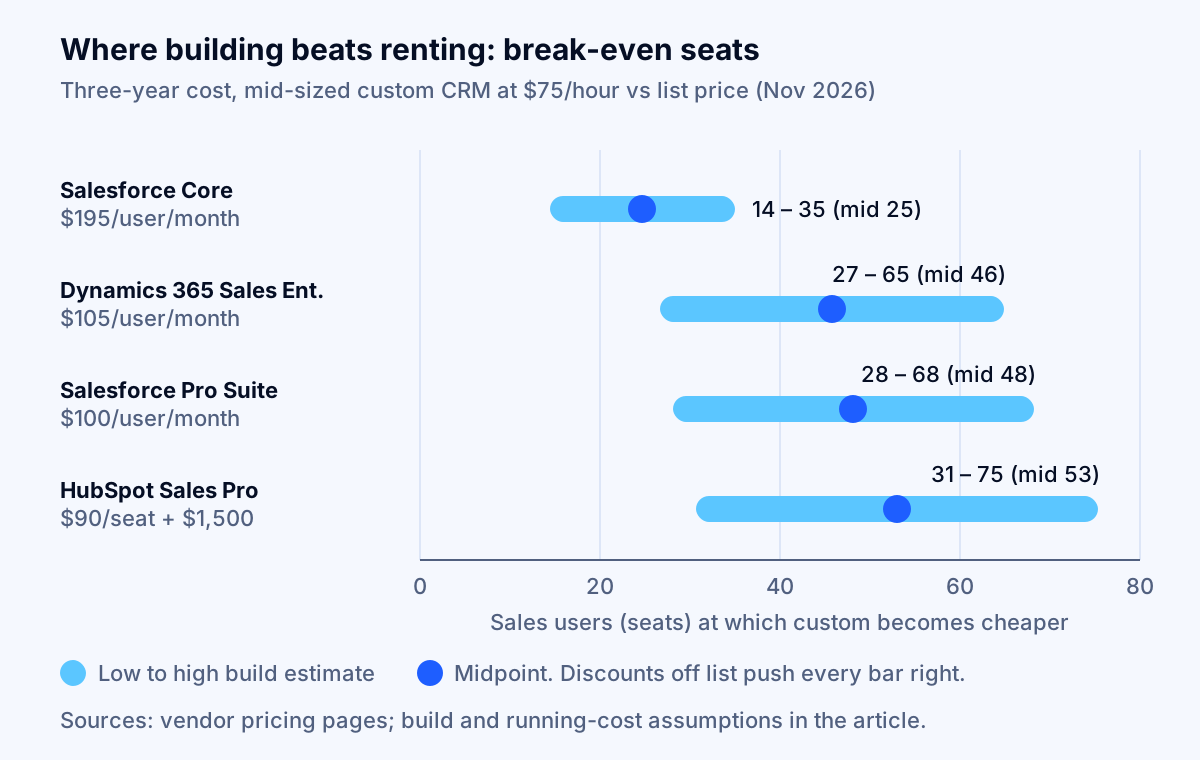
The break-even seat count
Divide the difference in fixed costs by the per-seat cost over three years, and you get the number of users above which building is cheaper:
| Compared with | Break-even seats (low build–high build) | Midpoint |
|---|---|---|
| Salesforce Sales Cloud Core, $195 | 14–35 | 25 |
| Dynamics 365 Sales Enterprise, $105 | 27–65 | 46 |
| Salesforce Pro Suite, $100 | 28–68 | 48 |
| HubSpot Sales Hub Professional, $90 | 31–75 | 53 |
Three things move these numbers:
- Discounts move them up. List prices are the ceiling. A 20 percent negotiated discount on HubSpot Professional raises the midpoint break-even from about 53 seats to about 66.
- A longer horizon moves them down. Over five years, maintenance and hosting for the custom CRM grow to $150,000 at the midpoint, but licenses grow faster: the midpoint break-even against HubSpot Professional falls to about 43 seats, and against Salesforce Core to about 20.
- Edition creep moves them down. Teams rarely stay on the edition they started with. If you need a feature only the next edition has, every seat pays the difference, which is the most common way a subscription outgrows a custom build.
Key takeaway: Below about 30 daily users, building a CRM to save on licenses almost never pays. Above about 50 users on a $90 to $105 edition, or about 25 users on a $195 edition, it often does, provided you will run it for three years or more and can fund maintenance.
The same break-even method, applied to customer-facing software, is in our guide to customer portal development cost, and to internal tools in Retool vs custom internal tools.
Buy, extend or build: four questions to decide
Most companies should buy a CRM, a meaningful minority should extend the one they have, and only a few should build from scratch. These four questions, answered in order, sort you into the right group.
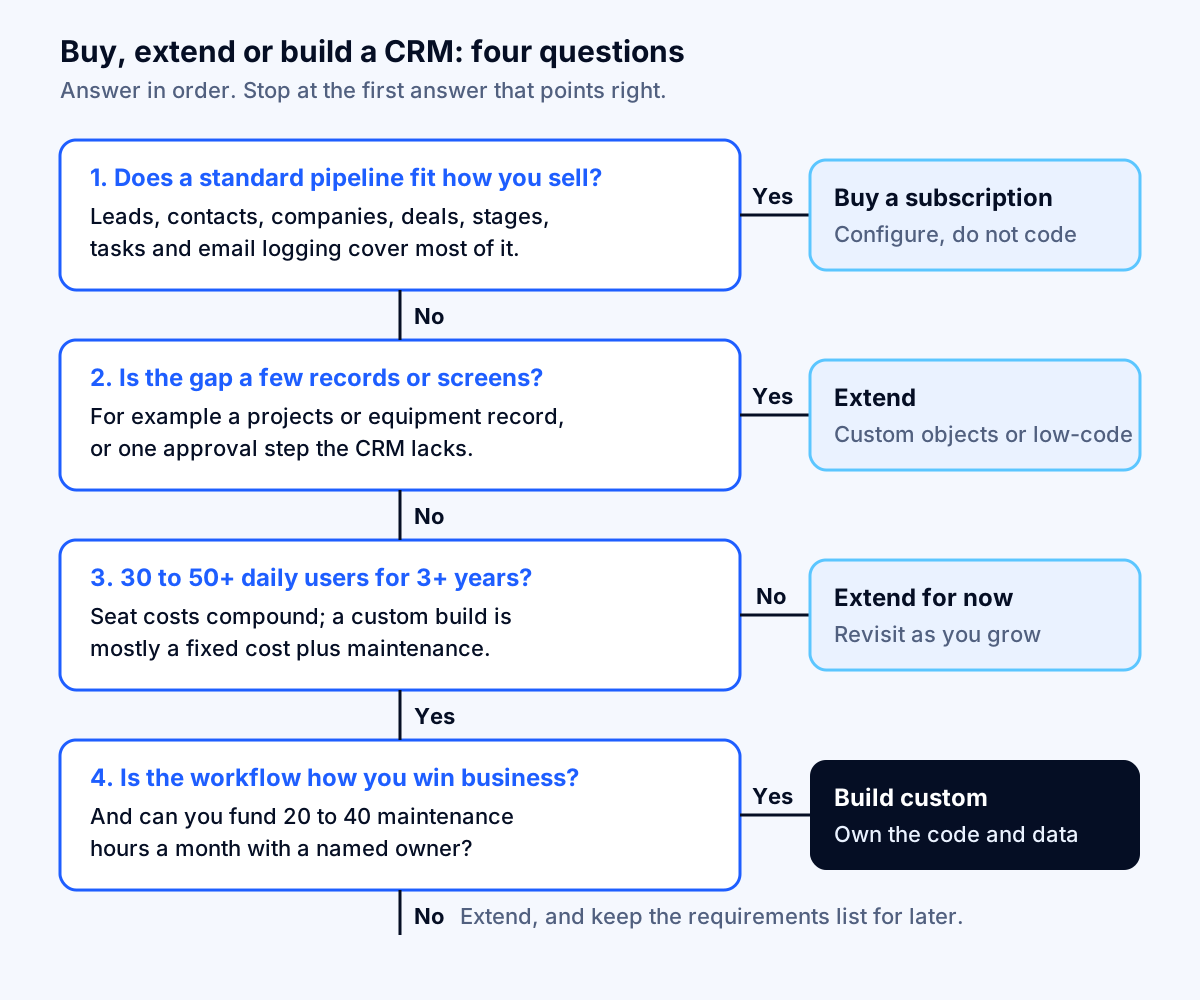
- Does a standard pipeline fit how you sell? If leads, contacts, companies, deals, stages, tasks and email logging cover most of your process, buy. Configuration is cheaper than code, and the vendor carries security patches, uptime and mobile apps.
- Is the gap a few records or screens? If what is missing is one or two record types (projects, equipment, properties, policies) or an approval step, extend. Check which edition unlocks custom records first: HubSpot's custom objects require an Enterprise subscription. Microsoft's Power Apps Premium is listed at $20 per user per month for building custom apps on Microsoft Dataverse.
- Will 30 to 50 or more people use it daily for three years or more? Below that, the break-even table says a custom build rarely pays for itself on cost alone. Extend for now and revisit.
- Is the workflow part of how you win business, and can you fund maintenance? Build when the CRM encodes something competitors cannot buy (a pricing engine, a dispatch rule, a regulated intake process) and you can commit 20 to 40 maintenance hours a month with a named internal owner. If not, extend.
The extension trap
Extending is usually the cheapest first move, but check the edition math. Unlocking HubSpot custom objects means moving every seat from Professional ($90) to Enterprise ($150): for 40 users that is $86,400 more over three years, plus the $3,500 Enterprise onboarding fee, before anyone builds anything. At that point a focused custom application next to the CRM, or a small custom CRM, can cost less. Run the numbers for the edition you would actually need.
The hidden costs in a custom CRM project
The costs that sink CRM budgets are rarely the screens. They are email sync, data migration, permissions and the maintenance nobody budgeted, and each can be planned for.
Email sync and Google's security assessment
Two-way email sync is the most-requested CRM feature and the riskiest line in the estimate, partly because of platform rules most guides skip. Google classifies full Gmail access (including the https://mail.google.com/ scope and the read, modify and compose scopes) as restricted scopes. According to Google's verification requirements, apps requesting restricted scopes must submit to "an annual security assessment from a Google empanelled group of security assessors," and Google's OAuth verification help center says they must re-verify annually.
The exemption that matters: Google lists internal-use apps as not needing verification when the app is used only by people in your own Google Workspace or Cloud Identity organization, the project is owned by that organization and its consent screen is configured for internal use. A CRM built for your own sales team usually fits. A CRM you plan to sell to other companies does not, so budget the assessment, the remediation it finds and the annual repeat as a recurring cost.
How to keep the line under control:
- Decide early whether the CRM will ever serve other companies. That one decision sets the email architecture and the compliance budget.
- Sync less. Logging emails to and from known contacts is far simpler than mirroring whole inboxes, and it is what most sales teams actually use.
- Ask your IT administrator how app access to Microsoft 365 mailboxes is approved in your tenant before you design the Outlook side.
Data migration
Migration is cheap in hours (40 to 120 in the mid-sized tier) and expensive in calendar time, because someone who knows the data has to decide which duplicate wins. Export everything first, agree on matching rules (email address, then company domain), migrate open deals and the last 12 to 24 months of activity, and archive the rest read-only. Run at least one full rehearsal migration before go-live.
Permissions and access control
A CRM holds your whole customer base, so a broken permission check is a data breach, not a bug. OWASP's Top 10:2025 ranks broken access control as the number one web application risk. Budget server-side checks on every request and automated tests that log in as one rep and try to read another team's deals. That is the "security and access-control tests" line, and it is not optional.
Maintenance and ownership
The most common way a custom CRM fails is not at launch but in year two, when the original developer has moved on and nobody owns it. Budget 20 to 40 hours a month from day one, name an internal product owner who decides what gets built next, and insist that the code, the cloud accounts and the documentation are in your company's name.
How long does it take to build a custom CRM?
With two full-time engineers delivering about 236 productive hours a month, a basic pipeline CRM takes two to four months, a mid-sized CRM three to eight months and an advanced CRM five to eleven months. One engineer delivers about 118 productive hours a month (1,414 a year divided by 12).
| Tier | Hours | Two engineers (236 hours/month) | Three engineers (354 hours/month) |
|---|---|---|---|
| Basic pipeline CRM | 438–920 | 1.9–3.9 months | 1.2–2.6 months |
| Mid-sized CRM | 780–1,840 | 3.3–7.8 months | 2.2–5.2 months |
| Advanced CRM | 1,140–2,640 | 4.8–11.2 months | 3.2–7.5 months |
Adding engineers does not scale perfectly, because the data model and permissions have to be settled before parallel work pays off. A sensible plan ships the basic tier to a pilot team first, then adds email sync and integrations once real users have confirmed the pipeline stages and fields. If you are replacing spreadsheets rather than an existing CRM, our guide on replacing spreadsheets with custom software covers the migration side in more depth.
How to get an accurate custom CRM quote
You get an accurate quote by sending vendors the same written inputs, and comparing their hours line by line rather than their totals. Before you ask for prices, write down:
- Users and roles: how many people, in which teams, and who may see which deals.
- Records and fields: every record type and its required fields, taken from your current spreadsheets or CRM export.
- Pipelines and stage rules: stages, what must be true to move forward, and who approves.
- Email and calendar: Gmail or Microsoft 365, what gets logged, and whether the CRM will ever be sold to other companies.
- Integrations: each system, its API documentation, and who in your company can grant test access.
- Data to migrate: sources, row counts and how much history to keep.
- Reports: the five reports leadership looks at every week.
Then ask each vendor for hours by work package, the rate behind them, who owns the code and accounts, and the monthly maintenance commitment. A quote that cannot be broken into hours cannot be compared. Our checklist for hiring a web app developer covers contracts, code ownership and the questions that separate senior teams from resellers, and our SaaS MVP development cost guide covers the extra work if your CRM is meant to become a product.
Putting it together
A realistic custom CRM development cost is 438 to 920 engineering hours for a basic pipeline CRM, 780 to 1,840 for a mid-sized CRM with email sync and two integrations, and 1,140 to 2,640 for an advanced CRM, multiplied by the rate of whoever builds it. At $75 an hour, that is roughly $33,000 to $69,000, $59,000 to $138,000 and $86,000 to $198,000, plus $1,600 to $3,400 a month to run.
Building pays when enough people use it for long enough: in our model, about 31 to 75 users against HubSpot Sales Hub Professional and 14 to 35 against Salesforce Sales Cloud Core over three years. Below that, buy a subscription or extend the one you have; above it, or when the workflow itself is your advantage, a custom CRM you own can cost less and fit better.
Fleurant AI's custom software development teams scope CRM projects work package by work package, and many projects kick off within 48 hours. If you would like a second opinion on a quote or the build-versus-buy math, talk to a specialist; you can also see everything we build on the Fleurant AI home page.
If you'd like one clear, practical take on AI, software and cloud decisions each month, subscribe to the Fleurant AI Briefing: one email a month, unsubscribe any time.
Frequently asked questions
How much does it cost to build a custom CRM?
Plan on 438 to 920 engineering hours for a basic pipeline CRM, 780 to 1,840 hours for a mid-sized CRM with two-way email sync and two integrations, and 1,140 to 2,640 hours for an advanced CRM with sequences, quoting and four integrations. At $75 an hour that is roughly $33,000 to $69,000, $59,000 to $138,000 and $86,000 to $198,000, before running costs.
When is building a CRM cheaper than paying per seat?
In our three-year model, a mid-sized custom CRM built at $75 an hour becomes cheaper than HubSpot Sales Hub Professional at about 31 to 75 sales users (midpoint 53), and than Salesforce Sales Cloud Core at about 14 to 35 users (midpoint 25), using November 2026 list prices. Negotiated discounts raise those numbers; a five-year horizon lowers them.
What does a custom CRM cost to run each month?
Maintenance is the big line: plan 20 to 40 engineering hours a month for security patches, dependency updates, integration changes and small requests, or $1,500 to $3,000 a month at $75 an hour. Hosting, backups, monitoring and email sending usually add a few hundred dollars a month for an internal sales team. Over three years, running costs can match the original build.
How long does it take to build a custom CRM?
With two full-time engineers delivering about 236 productive hours a month, a basic pipeline CRM takes roughly two to four months, a mid-sized CRM with email sync three to eight months, and an advanced CRM five to eleven months. Data migration and integrations with accounting or ERP systems are the usual causes of delay.
Does a custom CRM that reads Gmail need a Google security assessment?
It depends who uses it. Full Gmail access is a restricted scope, and apps using restricted scopes must pass Google's verification and an annual security assessment by a Google-empanelled assessor. Google exempts internal-use apps used only by people in your own Google Workspace organization, with an internal consent screen. A CRM you sell to other companies does not qualify for that exemption.
Can I extend HubSpot or Salesforce instead of building a CRM?
Often, yes, and it is usually the cheaper first step. Check the edition you would need: HubSpot custom objects require an Enterprise subscription, listed at $150 per seat per month plus a $3,500 onboarding fee. Microsoft Power Apps Premium is listed at $20 per user per month for building custom apps on Microsoft Dataverse. Confirm which edition unlocks custom records before comparing with a build.
Sources
- Sales Cloud pricing, Salesforce
- Sales Hub pricing, HubSpot
- Create custom objects, HubSpot Knowledge Base
- Dynamics 365 Sales pricing, Microsoft
- Power Apps pricing, Microsoft
- Software Developers, Quality Assurance Analysts, and Testers: Occupational Outlook Handbook, U.S. Bureau of Labor Statistics
- Employer Costs for Employee Compensation, June 2026, U.S. Bureau of Labor Statistics
- Software development pricing guide, Clutch
- Restricted scopes, Google Cloud Platform Console Help
- Verification requirements, Google Cloud Platform Console Help
- When is verification not needed, Google Cloud Platform Console Help
- OAuth App Verification Help Center, Google Cloud Platform Console Help
- A01:2025 Broken Access Control, OWASP Top 10:2025